 Contents
Contents
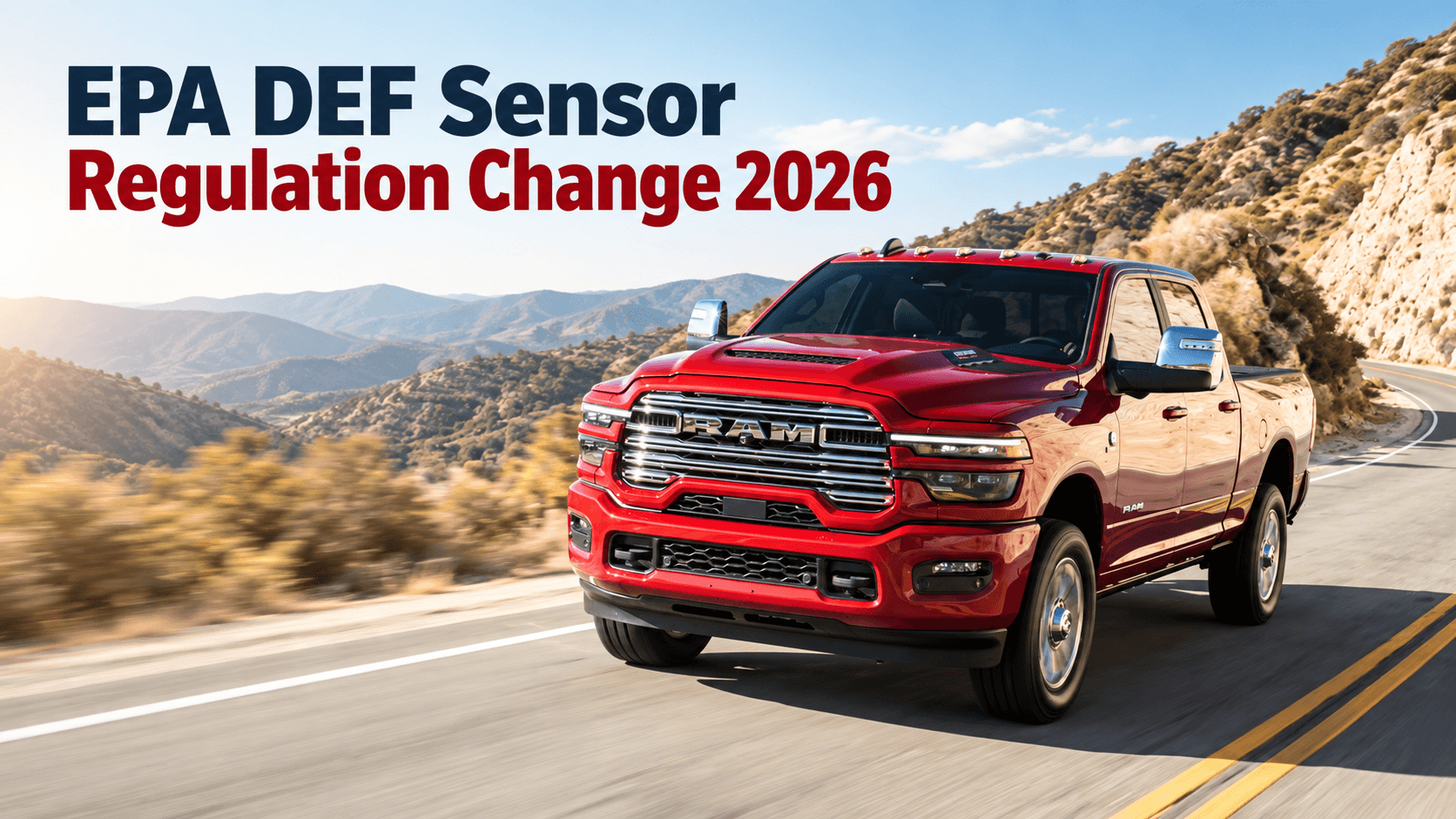
On March 27, 2026, the U.S. Environmental Protection Agency (EPA) issued new guidance that officially removed the mandatory installation requirement for Diesel Exhaust Fluid (DEF) quality sensors—also known as Urea Quality Sensors (UQS)—on diesel equipment. This EPA DEF sensor regulation change means manufacturers are no longer required to use traditional UQS devices to monitor DEF quality and may instead use nitrogen oxide (NOx) sensors to monitor actual emissions.
However, one point must be made clear: DEF itself has not been eliminated. DEF will continue to be used in Selective Catalytic Reduction (SCR) systems to meet NOx emissions standards. The core of the 2026 EPA DEF sensor guidance is a shift from "monitoring DEF quality" to "monitoring actual emissions." If the equipment remains within emissions limits, the system will not trigger a derate or shutdown simply because of a false sensor reading.
This article provides an in-depth explanation of the 2026 EPA DEF sensor guidance, why the change was made, and what it means in practice for truckers, farmers, fleet operators, and other diesel equipment owners.
What Exactly Changed in the 2026 EPA DEF Sensor Guidance?
On March 26, 2026, the EPA officially released guidance document IACD-2026-05, titled DEF Quality Monitoring Using Alternate Sensor Technologies.
In the past, diesel vehicles equipped with SCR (Selective Catalytic Reduction) systems were required to use a physical sensor, or UQS, inside the DEF tank to directly measure urea concentration, which should normally be 32.5%. The latest guidance makes it clear that a physical UQS is no longer the only technical path for meeting the DEF sensor requirement and emissions compliance requirements.
Three Core Changes in the New Guidance:
1. Alternative monitoring technologies are permitted: Manufacturers may monitor changes in NOx sensor readings before and after the SCR catalyst to indirectly determine whether DEF quality is acceptable.
2. Software updates for existing vehicles are supported: Engine manufacturers (OEMs) may submit alternative monitoring strategies to the EPA and, once approved, update the ECM software on vehicles already in service.
3. Compliance boundaries are clarified: Software updates introduced by OEMs as part of an approved alternative strategy are fully legal under the Clean Air Act and are not considered illegal tampering.
Why Did the EPA Remove the Mandatory DEF Sensor Requirement?
The main reason behind this major EPA DEF sensor regulation change is the persistently high failure rate of traditional DEF sensors and the significant economic losses caused by those failures.
UQS devices are submerged in corrosive DEF fluid and are highly vulnerable to crystallization, extreme cold, and severe vibration. When a sensor fails, even if the DEF itself is completely within specification, the system may incorrectly report the fluid as being out of specification, which can trigger a chain reaction:
UQS sensor failure or false reading →
Emissions-related diagnostic trouble code (DTC) →
DEF warning or inducement triggered →
Engine derate or vehicle speed restriction →
Downtime, towing, diagnosis, and repair costs →
EPA warranty data assessments show that UQS failures are among the leading causes of unplanned diesel vehicle downtime and warranty claims. This type of situation—where "the sensor is not working, the fluid is fine, but the vehicle cannot operate normally" - costs the U.S. logistics and agricultural industries billions of dollars each year.
A truck suddenly entering a "5 mph forced speed restriction" inducement while traveling on the highway can also create serious rear-end collision and safety risks.
Is DEF Going Away in 2026?
Absolutely not. DEF must still be added as normal.
It is important to distinguish between the following:
- ❌ The EPA eliminated DEF fluid and emissions standards (Incorrect)
- ✔️ The EPA removed the mandatory installation requirement for physical DEF tank sensors (Correct)
Whether it is a Ford Power Stroke, GM Duramax, or Ram Cummins, any vehicle designed with an SCR emissions-control system must continue to use DEF fluid that meets the ISO 22241 standard. Federal and state NOx exhaust-emissions limits have not changed.
Diesel vehicles in 2026 and beyond will still need to meet strict NOx emissions limits. Vehicles will still require DEF to maintain the SCR reduction reaction. What the EPA changed is "how the system is monitored" - moving from "watching the sensor inside the DEF tank" to "monitoring the actual NOx levels in the exhaust."
So for owners asking "Is DEF still required?", the answer remains yes for diesel engines and equipment designed to use SCR and DEF.
If you’re also wondering how the latest EPA changes affect DPF, EGR, or DEF removal, see our 2026 Diesel Delete Legality Guide for a separate breakdown of federal emissions rules.
What the New EPA Rules Mean for Truckers and Farmers
This new guidance is very good news for truck drivers and farmers:
1. Reduced Unplanned Downtime and Expensive Repairs
Truck drivers will no longer need to face situations where a failed sensor costing only a few hundred dollars forces the entire truck out of service, requires towing, and leads to high labor costs.
2. Better Productivity During Peak Farming Seasons
During critical harvest or planting periods, agricultural machinery will be less likely to enter forced speed restrictions simply because of a DEF sensor failure, helping protect productivity during time-sensitive farm operations.
3. Legal, OEM-Approved Software Updates
Owners do not need to take the legal risks associated with third-party illegal programming or "Delete Kits." Instead, they may rely on official or authorized NOx sensor-based software updates.
This point is especially important when discussing reports that the EPA allows DEF sensor deactivation. The change refers to approved OEM monitoring strategies and software updates, not unrestricted owner modifications or third-party emissions-system bypasses.
The Difference Between EPA DEF Sensor Guidance and DEF Derate Changes
To better understand the EPA's recent actions, it helps to compare the DEF Sensor Guidance with the DEF Derate Changes:
| Policy Action | March 2026 Guidance (IACD-2026-05) | July 2026 Proposed Rule |
| Core Focus | Diagnostic hardware (UQS sensor vs. NOx sensor) | Penalty mechanism (how forced derates are triggered) |
| Policy Status | Guidance already in effect | Proposed rule still under review |
| Main Change | Allows removal of the physical UQS requirement | Proposes replacing immediate 5 mph derates on new vehicles with audible and visual warnings |
Conclusion
The core change in the 2026 EPA DEF sensor guidance can be summarized in one sentence: monitoring is shifting from DEF quality to actual emissions.
Traditional DEF quality sensors are no longer the only required monitoring method, and NOx sensors are accepted as an alternative. DEF itself is still required, and SCR remains a core technology for meeting emissions standards.
For truck drivers and farmers, this means fewer false fault warnings, less unexpected downtime, and billions of dollars in annual cost savings. However, manufacturers will need time to develop and validate new strategies, so the full practical impact will gradually become visible over the next one to two years.