 Contents
Contents
In the architecture of a modern diesel engine, the emission control system has long functioned as an "External Governance Module." In an ideal world, such a sub-system should ensure regulatory compliance without causing destructive interference to the core business mission: power continuity.
However, for over a decade, Diesel Exhaust Fluid (DEF) systems and their regulatory logic have been trapped in a state of "High-Pressure Tight Coupling." To pursue absolute emission targets, these systems were granted supreme authority: once a data anomaly was detected, it triggered a mandatory engine derate (power loss).
While logically sound for compliance, this "zero-tolerance" design led to a collapse in System Availability during real-world edge cases. The EPA 2025/2026 new guidance is an official "Hotfix" for this imbalanced architecture, marking a major evolution from punitive logic toward a Fault-Tolerant governance model.
Engineering Context: What is DEF (Diesel Exhaust Fluid)?
From a chemical engineering perspective, Diesel Exhaust Fluid (DEF) is a non-hazardous solution comprised of 32.5% high-purity urea and 67.5% deionized water. It serves as the primary reactant in the Selective Catalytic Reduction (SCR) system.
When injected into the exhaust stream, DEF undergoes a thermal decomposition to create ammonia ($NH_3$), which reacts with Nitrogen Oxides ($NO_x$) over a catalyst to convert harmful pollutants into harmless nitrogen and water vapor. In the system's control logic, the DEF Quality Sensor is the gatekeeper; if it perceives the urea concentration to be outside the precision window (typically 30.5%–35%), it triggers the "fail-safe" protocols that lead to the engine derates discussed below.
Why Owners of $200,000 Heavy Trucks Choose to "Delete" Sensors
If we view a heavy-duty diesel truck as a complex system architecture, the emission system was originally intended to be a "background plugin." However, in legacy logic, this plugin was granted root-level privileges, resulting in a critical Single Point of Failure (SPOF):
- "Small Components, Massive Authority": A urea (DEF) quality sensor is essentially a peripheral monitoring node with a very low manufacturing cost. However, in old-school architectures, it is tightly coupled with the Engine Control Unit (ECU). According to SAE technical studies, if this inexpensive sensor triggers a false alarm—due to urea crystallization in cold weather or simple road vibrations—it can "overstep" its authority and command the engine to force an immediate power reduction.
- Fragile Fault Tolerance: From an architect's perspective, a robust system must possess "fault tolerance." In practical application, these sensors are notoriously delicate; their Mean Time Between Failures (MTBF) is significantly lower than that of the engine itself. This logic causes vehicles to paralyze exactly when power is needed most, such as during long-haul logistics.
This architectural design has forced truck owners into a desperate corner: balancing a $200,000 asset against a temperamental, low-cost sensor. To guarantee Business Continuity, many users have historically resorted to illegal "tuning" or physically removing hardware, a trend documented in industry reports on derate issues.
Note: What Does a "DEF Delete" Actually Involve?
In the trucking industry, a "Delete" is not a simple part replacement but a multi-dimensional decoupling process. It consists of three primary layers:
- Physical Removal: The mechanical extraction of the DPF (Diesel Particulate Filter) and SCR (Selective Catalytic Reduction) canisters from the exhaust stream to eliminate backpressure and physical failure points.
- ECU Recalibration (Tuning): Rewriting the Engine Control Unit’s firmware to mask sensor signals and bypass the factory emission logic, essentially "blinding" the engine to its own emission output.
- Regulatory Decoupling: The intentional move away from Clean Air Act compliance, which voids warranties and creates significant legal liabilities for the asset owner.
While this radical "surgery" forcefully restores Business Continuity by preventing derates, it incurs massive legal and environmental risks. The new EPA "Fix" is designed as a direct architectural alternative—solving the uptime dilemma through Software-Defined Resilience rather than illegal hardware removal.
The Failure of Rigid Logic: Downtime Losses, Safety Hazards, and Asset Depreciation
The failure of this architectural logic has directly triggered a series of cascading failures in production environments. From a system architect's perspective, a system crash is not merely the cessation of code execution; it represents a total disruption of the underlying business workflow.
- The Devastation of Downtime Costs: Imagine a heavy-duty truck loaded with fresh goods suddenly dropping to 5 mph. This abrupt shutdown results in more than just high repair bills; as analyzed by Transport Topics, it leads to breached logistics contracts and forced idling of expensive assets.
- Collapse of the Safety Defense Architecture: Losing power suddenly in dense traffic is a massive challenge to Safety Architecture. Vehicle owners are forced into an irrational choice between "regulatory compliance" and "physical safety."
- Impairment of Asset Liquidity (Resale Value): In the secondary market, vehicle models labeled with "unreliable emission systems" experience a sharp decline in asset valuation.
To address these critical pain points, the EPA recognized the necessity of performing a "version iteration" on the existing mandatory enforcement logic.
Architectural Redesign: What Does the EPA "Fix" Actually Repair?
The EPA's intervention is more than a policy change; it is a fundamental refactoring of how engines respond to emission faults, as detailed in the 40 CFR Part 1036 Technical Amendments.
From "Death Sentence" to "Probation": Tiered Derate Logic
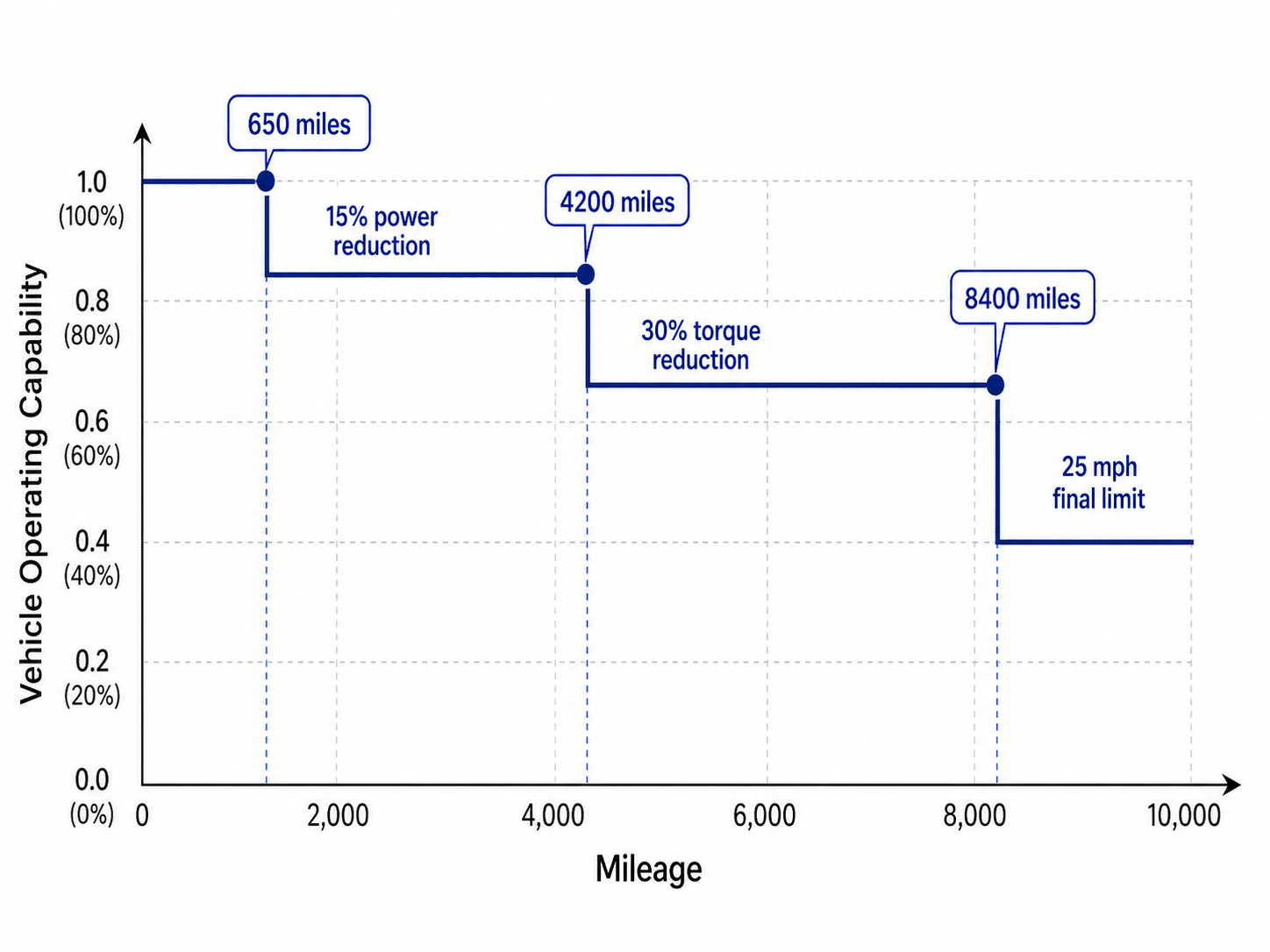
The most effective tool in this architectural optimization is the Latency Policy. Instead of an immediate "self-destruct" sequence, the new logic implements a Graceful Degradation sequence.
As per the EPA’s latest guidance, manufacturers are encouraged to implement software fixes to "stop trucks from being limited to 5 mph suddenly due to DEF faults." This creates a tiered safety net:
| Degradation Stage | Mileage/Time Buffer | Operational Impact |
|---|---|---|
| Phase 1: Warning | Initial 650 Miles | Minimal 15% power reduction; allows driver to cross state lines for service. |
| Phase 2: Deep Buffer | Up to 4,200 Miles | Moderate 30% torque reduction; maintains highway mobility but signals urgency. |
| Phase 3: Final Threshold | 8,400 Miles | Final speed limit of 25 mph (up from 5 mph) to prevent total stranding. |
Software-Defined Compliance: Resilience and the Macro-Strategic Prelude to 2027
This architectural transformation is being implemented smoothly through a Software-Defined approach. The EPA has explicitly stated that this "fix" is not only for new vehicles but also encourages manufacturers to update existing fleets.
- Delivery of the "Hotfix": Manufacturers are rewriting emission logic via firmware updates. This allows a migration to a "resilient" architecture without expensive hardware replacements.
- Deep Reflection on Supply Chain Resilience: Recent global shortages of sensors made the EPA realize that over-reliance on fragile components creates systemic vulnerability.
- Prelude to the 2027 Standards: With stricter standards looming in 2027, the EPA is using this fix to stabilize the industry's foundation and earn the trust of manufacturers and owners.
Through this strategy, the EPA is attempting to build a more Robust industry ecosystem before the 2027 regulations arrive.
Conclusion
As of April 2026, the EPA has established a clear trajectory for the adjustment of heavy-duty diesel emission logic. However, whether this truly improves the user experience remains dependent on OEM execution and verification under actual operating conditions.
In other words, while the policy framework for Architectural Resilience has emerged, its successful landing in the real world still requires ongoing validation from the market and its users.