 Contents
Contents
Introduction: Why CCV Maintenance is Vital for Your 6.7 Cummins
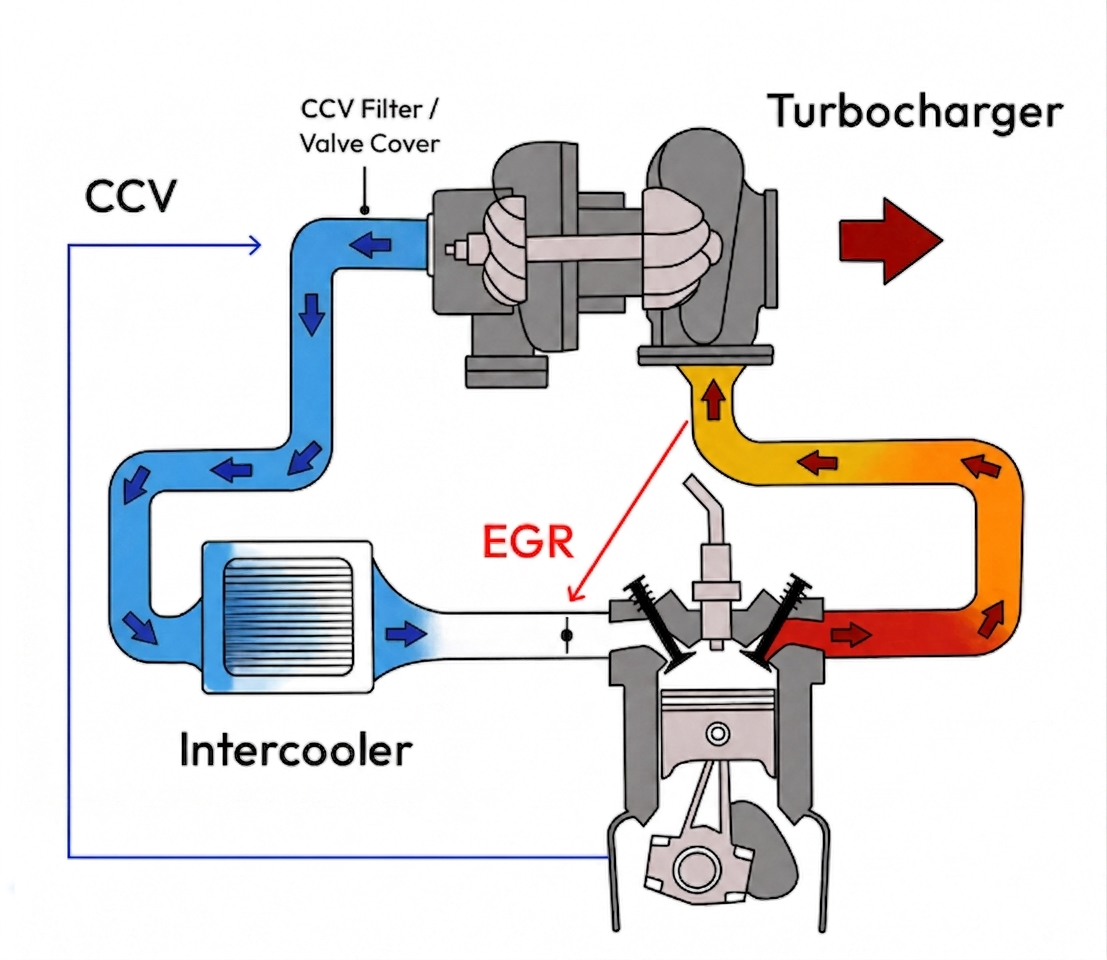
The CCV (Crankcase Ventilation) system serves as the engine's "respiratory system," responsible for managing blow-by gases that leak from the combustion chamber into the crankcase. However, the factory design is far from perfect. To comply with emissions regulations, the 6.7L Cummins employs a closed-loop system that redirects oil-mist-laden exhaust back into the turbocharger intake. Over time, this design presents a series of headache-inducing issues for truck owners:
- "Service CCV Filter" Warning Light: This is the most common early warning signal. The OEM filter is an expensive consumable; once it reaches its service life or becomes clogged, the dashboard will relentlessly display a prompt or even throw a P1507 fault code (Crankcase Filter Pressure Restricted).
- Performance Loss and Carbon Buildup: Once oil mist enters the turbo, it adheres to the precision blades and further contaminates the intercooler and intake manifold. This not only reduces cooling efficiency but also leads to decreased power and rising fuel consumption over the long term.
- Potential Oil Leaks: When the 6.7 Cummins CCV filter is completely clogged, the pressure inside the crankcase has no way to escape. This high pressure will seek out the weakest points to break through, typically manifesting as oil seepage from the Rear Main Seal, which involves extremely high repair costs.
Protecting your 6.7 Cummins must begin with improving its "breathing." The following content will provide a deep analysis of the three mainstream solutions available today: replacing the factory Filter, performing a Reroute (redirection), and a complete Delete (removal), helping you find the most suitable plan for your vehicle.
6.7 Cummins CCV Filter VS CCV Reroute VS CCV Delete
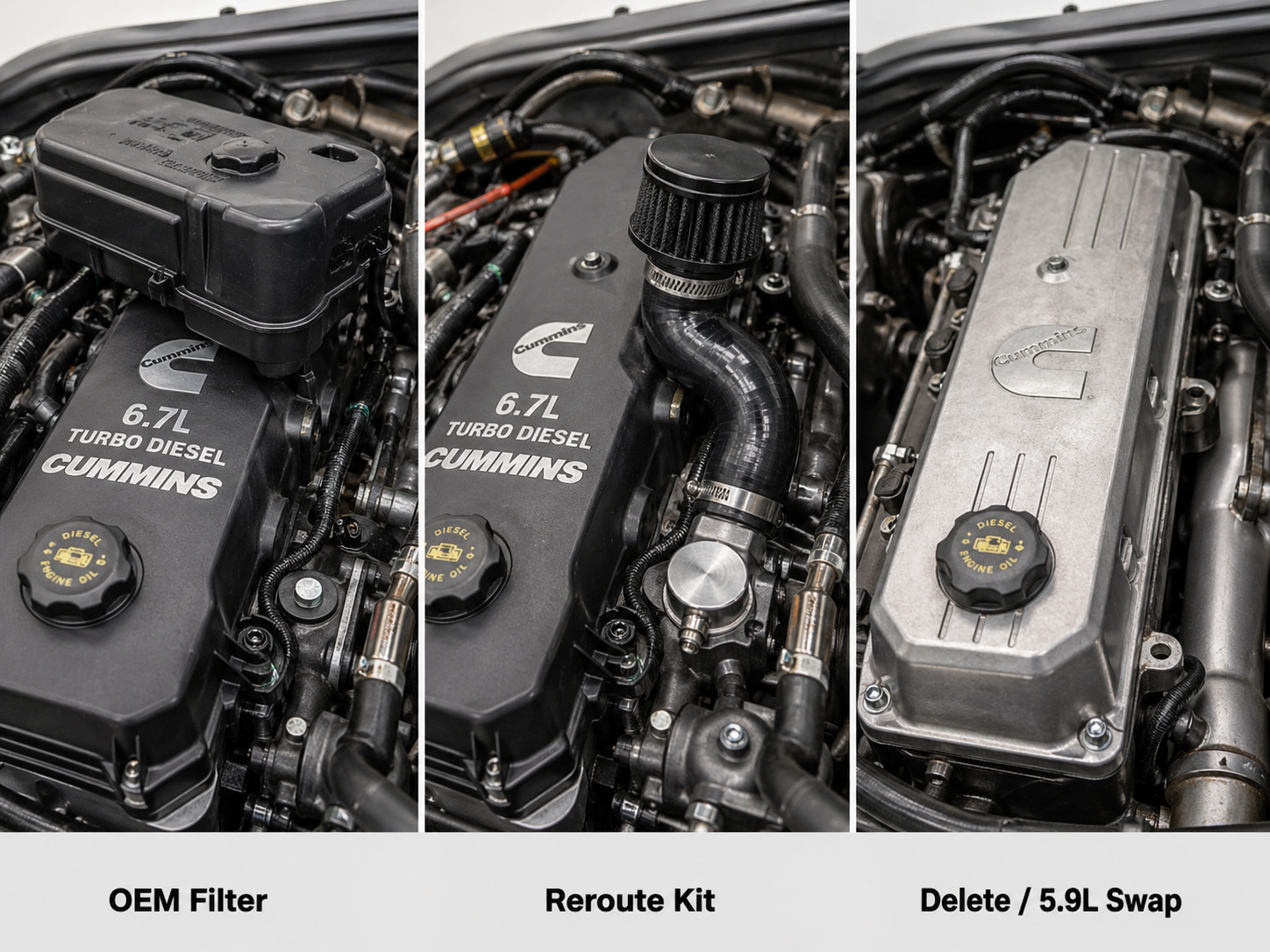
When addressing crankcase ventilation issues on a 6.7L Cummins, owners typically find themselves choosing between "maintaining factory compliance," "reducing intake oil contamination," and "simplifying system architecture." Understanding the differences and connections between these solutions can help you avoid redundant investments and choose the most appropriate upgrade path based on your vehicle's application.
OEM CCV Filter (Factory Filtration Solution)
This is the most fundamental approach and the one closest to the factory configuration. It is suitable for owners who wish to keep their vehicle in stock condition, those still under warranty, or those living in regions with strict emissions inspections.
Operational Logic:
The factory 6.7L Cummins CCV system directs crankcase exhaust into a filtration structure atop the valve cover. After the filter element separates a portion of the oil mist, the gas is recirculated back into the turbocharger intake.
Pros:
- Maintains the original factory closed-loop cycle design.
- More friendly to emissions testing and warranty environments.
- Simple installation and maintenance logic.
Cons:
Because the system remains a closed loop, even with a new CCV filter, a small amount of oil mist can still enter the intake tract. Over long-term use, this oil mist can accumulate at the turbo inlet, intercooler, and intake pipes, leading to decreased intake efficiency, pipe seepage, increased carbon buildup, or higher maintenance frequency.
CCV Reroute Kit
The CCV Reroute is a common advanced solution within the 6.7L Cummins community. Its core purpose is not simply to "delete" the system, but to change the discharge path of crankcase exhaust so that oil mist no longer returns to the turbocharger intake.
Operational Logic:
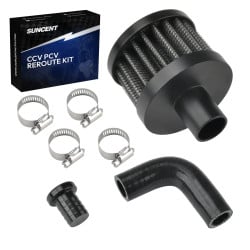
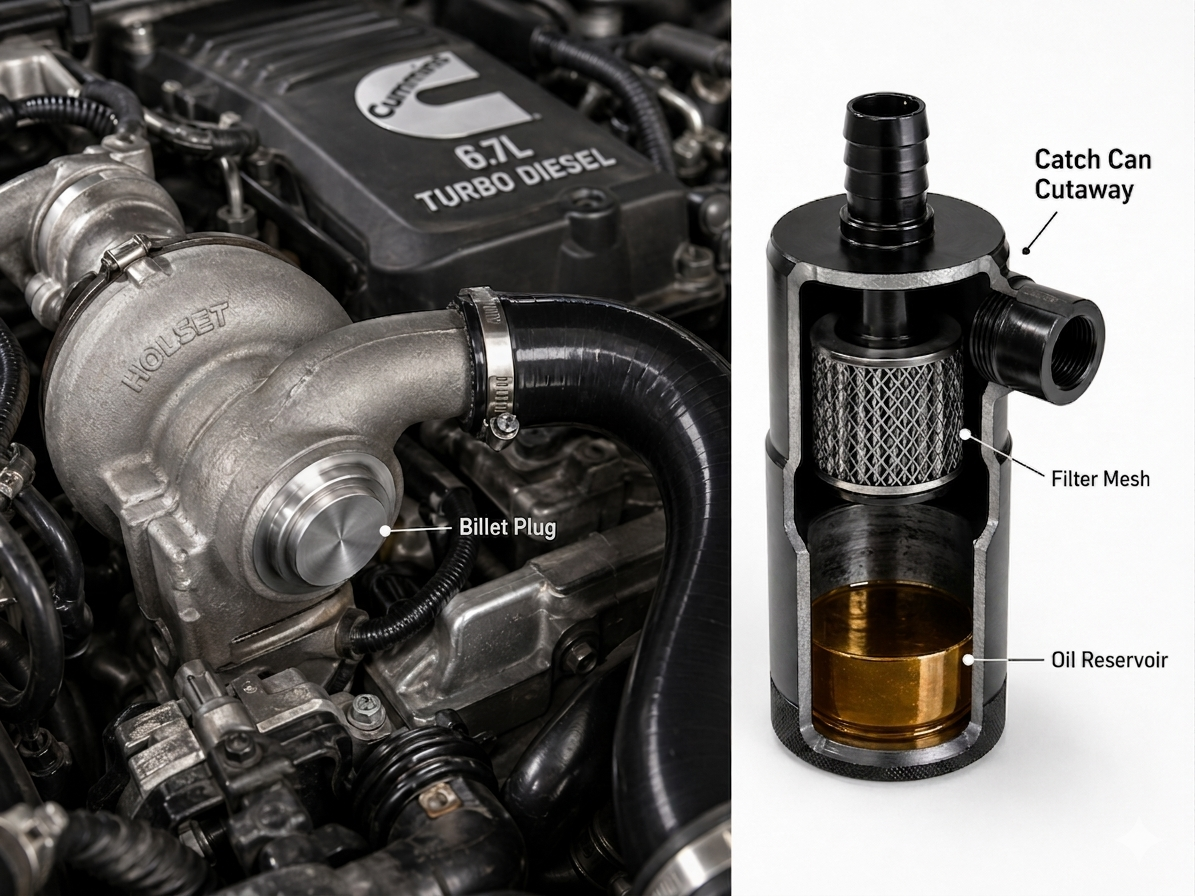
A CCV Reroute kit typically utilizes silicone boots, adapters, plugs, and breather filters to redirect the crankcase exhaust that would originally flow back to the intake. Simultaneously, an aluminum billet plug is used to seal the turbo intake port, cutting off the path for oil mist to enter the intake system.
Pain Points Resolved:
- Reduces oil contamination at the turbo inlet and inside the intercooler.
- Mitigates oil accumulation and seepage in intake piping.
- Reduces maintenance pressure caused by clogged CCV filters.
- Under proper handling of sensors and system logic, it reduces the frequency of CCV-related "Service CCV Filter" alerts or recurring fault codes.
Basic Form: VTA (Vent to Atmosphere)
Some off-road, racing, or non-road vehicles adopt the VTA method, which vents crankcase exhaust to the atmosphere through a small Breather filter. This setup is simple in structure and direct to install, but it may introduce oil odors, chassis oil spots, or engine bay contamination. Local emissions regulations should be confirmed before use.
The "Catch Can" Upgrade: A Cleaner Reroute Solution
If you have already installed a Cummins CCV PCV reroute kit, adding a Catch Can is a very natural progression for your upgrade path.
Upgrade Method:
The small breather filter atop the reroute kit is removed and replaced with an oil-resistant hose leading to the Catch Can. Once the crankcase exhaust enters the collection tank, the oil mist is condensed and separated, while the remaining gas is released through an exhaust port or redirected based on a specific configuration.
Why We Recommend This Combination:
- Significantly cleaner than a simple VTA (Vent to Atmosphere) setup.
- Collects oil mist, reducing oil residue on the chassis and in the engine bay.
- Helps minimize oily odors near the vehicle.
- Maintains a pristine intake system.
- Ideal for vehicles frequently used for towing, long-distance driving, or heavy-duty workloads.
CCV Delete / 5.9L Valve Cover Swap
For owners seeking extreme structural simplicity and long-term reliability, the 5.9L Cummins-style valve cover conversion is a popular choice. This solution is commonly seen in racing, off-road, non-road use, or heavily modified vehicles.
Why Choose a 5.9L Valve Cover Swap?
The factory 6.7L Cummins valve cover integrates a complex CCV filtration and ventilation structure. Over time, the filter element, internal channels, and sensor logic can all become points of failure. In contrast, the 5.9L style valve cover is simpler in construction with a more direct ventilation path, minimizing internal clogging and filter restrictions.
Relationship with Reroute Kits:
A 5.9L Valve Cover Swap does not entirely replace a reroute. In practice, you still typically need a 6.7L Cummins CCV reroute kit—utilizing the silicone boots, hoses, and plugs to rearrange the ventilation path and seal off the original turbo intake recirculation port.
Technical Advantages:
- Simplifies the complex factory CCV architecture.
- Reduces restrictions caused by filter clogging.
- Lowers long-term maintenance frequency.
- More robust for high-mileage, heavy-load, or competitive applications.
- When configured correctly, it reduces the probability of recurring CCV fault codes like P1507.
Note: This solution requires verifying vehicle year, engine layout, sensor configuration, and potential clearance issues. Compatibility varies across 6.7L Cummins model years; consult technical specs before purchasing.
Summary of Solutions:
- OEM CCV Filter = Factory-compliant maintenance.
- Reroute Kit = Foundation architecture (Sealing intake + Redirecting exhaust).
- Reroute + Catch Can = Eco-friendly & Clean (Protects turbo, minimizes odor).
- Reroute + 5.9L Swap = Ultimate reliability (Eliminates structural restrictions).
Technical Comparison Table
| Solution | Maint. Frequency | Intake Cleanliness | Core Components | P1507 Risk |
|---|---|---|---|---|
| OEM Filter | Every 30k-60k Miles | Poor (Carbon Buildup) | Filter Element | High |
| Reroute Kit | Occasional Cleaning | Excellent (Isolated) | Silicone Hose/Breather | Low |
| Catch Can | Regular Drain | Excellent | Hose + Collection Can | Very Low |
| 5.9L Swap | Maintenance-Free | Excellent | 5.9L Valve Cover | None |
If you are seeking cost-effectiveness without extensive modification, installing a 6.7 Cummins CCV reroute kit is an immediate fix for warning lights. For those prioritizing engine bay cleanliness and odor control, adding a Catch Can to the setup is highly recommended.
III. Post-Installation Maintenance and Technical Misconceptions
In diesel technology communities like the Cummins Forum and Reddit, CCV modification plans are a subject of constant, heated debate. We have summarized the three core technical concerns that truck owners care about most:
Eliminating the "Error Code": How to Resolve P1507 or "Service CCV Filter" after modification?
Many owners worry that after removing or modifying the CCV system, the ECU will trigger continuous errors because it cannot sense the expected pressure changes. In reality, the 6.7L Cummins pressure sensor is extremely sensitive. If you simply "hollow out" the factory filter without properly managing the airflow path, the sensor may detect flow anomalies.
Solution: Using a professional Cummins CCV/PCV reroute kit from SA can effectively balance crankcase pressure. For certain model years, if the warning light persists, it typically requires software optimization (Tuning) or the installation of a specific sensor bypass to permanently say goodbye to the mandatory 67,000-mile service reminder.
Regarding "Oil Leaks": Does a CCV modification lead to Rear Main Seal damage?
This is a widespread misconception: some believe that after a Delete or Reroute, the loss of the turbocharger's "active suction" vacuum leads to increased internal engine pressure, which then blows out the oil seals.
Fact Analysis: Oil leaks only occur if your CCV Reroute piping becomes clogged (for example, due to ice buildup in winter or using an undersized hose diameter).
Professional Advice: As long as you ensure the discharge path is unobstructed (we recommend using a hose with a 1-inch or larger internal diameter), natural crankcase pressure can vent normally through a Reroute or a 5.9L valve cover. In fact, most rear main seal leak cases are actually caused by a clogged factory CCV Filter that was not replaced in time.
Northern Cold Climates: The Fatal Trap of Winter Operation
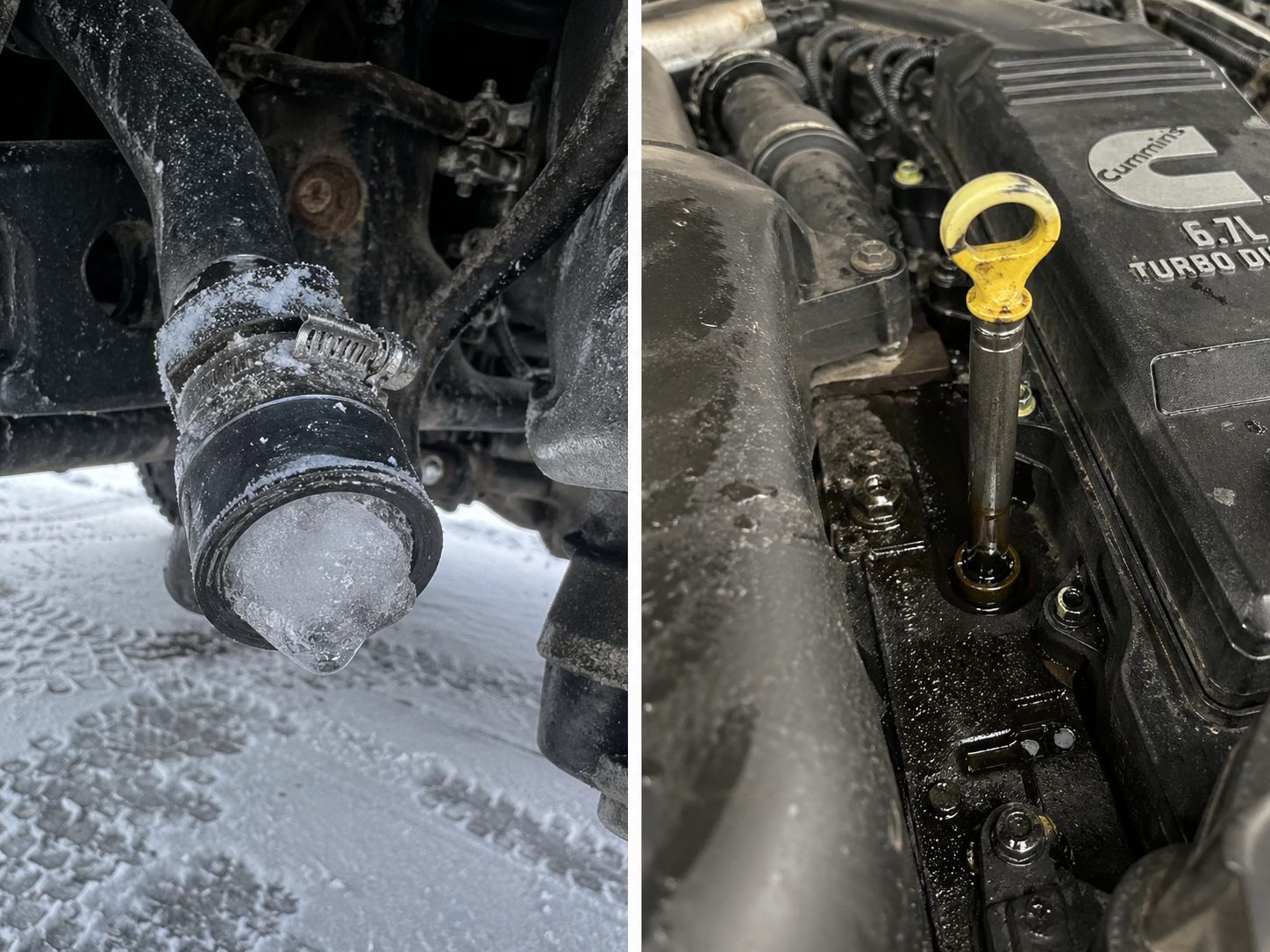
For owners living in Canada or the Northern United States, this is a detail that must be monitored.
Potential Risk: In extreme cold, the exhaust from the CCV contains water vapor, which can easily condense into ice at the exit of the Reroute pipe. If the pipe is completely sealed by ice, crankcase pressure will spike within minutes, instantly blowing out engine oil seals.
Solutions:
- Regularly inspect the exit of the Reroute pipe.
- If a Catch Can is installed, you must increase the frequency of draining accumulated water during winter.
- Keep the exhaust piping as short as possible to avoid creating long condensation zones.
Why Do Veteran Owners Love the 5.9L Valve Cover Swap?
In the hearts of most enthusiasts, this is considered the "Ultimate Retirement Plan." The 6.7L cover is essentially a complex plastic maze, while the 5.9L cover is a simple metal or composite shell.
By removing the 6.7L setup and swapping to the 5.9L version, you exclude all complex sensors and aging seals. Combined with the aluminum plugs from a 6.7L Cummins engine ventilation kit, the engine bay becomes exceptionally clean. As one Reddit user put it: "Since switching to the 5.9L cover, I haven't seen a single drop of oil in the engine bay, and I've never heard a sensor scream again."
IV. Conclusion: Sustaining Your Cummins for the Long Haul
Maintaining the CCV system may seem like a minor detail, but it is directly linked to the lifespan of the 6.7L Cummins core components—specifically the turbocharger and piston rings. Whether you choose to replace the filter element on a regular schedule or undergo a complete overhaul via a Cummins CCV PCV reroute kit, the core objective remains the same: to relieve crankcase pressure and maintain the cleanliness of the intake tract.
Before implementing any modifications, please ensure that the kit in your hands contains critical components such as the interface plugs and oil-resistant silicone hoses. Additionally, adjust your maintenance habits according to your regional climate—especially in extreme cold areas. Only a Cummins that can breathe freely can continue to provide relentless power throughout a million-mile journey.