 Contents
Contents
- The Root Cause: Escalating US-Canada Trade Disputes and the End of De Minimis
- Why Proximity Doesn't Equal Cheap Shipping: Tariff Stacking Explained
- Are U.S. Domestic Merchants Immune to Tariff Spikes?
- Where to Find Affordable Auto Parts Without Extra Import Surcharges
- Practical Sourcing Guide: What to Buy Now, Swap Channels, or Delay
- The Bottom Line: Tariffs Are Temporary, Smart Sourcing Is Permanent
If you’ve recently tried shopping online for auto parts—whether for routine maintenance or performance upgrades—you’ve likely encountered a frustrating surprise at checkout. That exhaust manifold or suspension component sitting in your cart wasn't just marked up by nearly 20% to 30%; a sudden "Tariff Surcharge" or a steep border brokerage fee was slapped onto your final order total.
This "checkout shock" has quickly become the new normal across the North American automotive aftermarket, hitting heavy metal components, exhaust systems, and mechanical hardware particularly hard. Drivers shopping for aftermarket exhaust manifolds or metal piping are finding that the price advantages once offered by online retailers are rapidly eroding.
The Root Cause: Escalating US-Canada Trade Disputes and the End of De Minimis
The driving force behind this price spike is the escalating trade conflict between the U.S. and Canada in 2026:
- Tensions Rise (Feb 2025 – Mid 2026): Following tariffs imposed on Canadian industrial goods and auto components in early 2025, trade relations continued to strain.
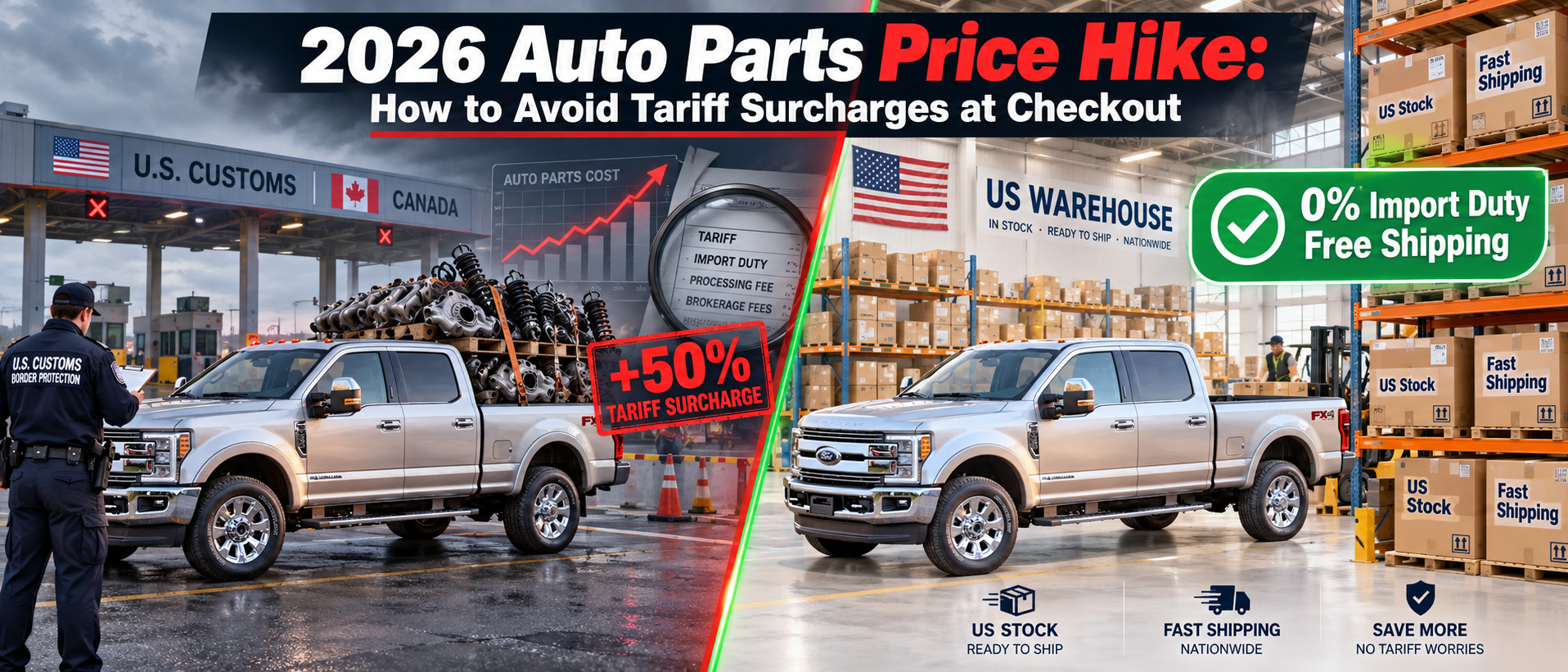
- Full Escalation (July – August 2026): After negotiations broke down, the U.S. invoked Section 338 of the Tariff Act of 1930, pushing tariffs on Canadian automotive parts, steel, and aluminum up to 50%. Canada swiftly retaliated with dollar-for-dollar counter-tariffs on U.S. industrial imports.
This tariff battle has dealt a severe blow to cross-border e-commerce storefronts, especially Canadian-based shops shipping directly into the U.S. Previously, many Canadian retailers relied on the U.S. De Minimis Rule—which allowed shipments under $800 USD to enter the U.S. duty-free. As customs enforcement tightened and exemptions were removed, cross-border sellers lost their duty-free edge. Today, items like DPF delete pipes face heavy border tariffs alongside unexpected brokerage fees from carriers like UPS or FedEx.
Why Proximity Doesn't Equal Cheap Shipping: Tariff Stacking Explained
A common question among truck owners is: "The U.S. and Canada share a border, so why are shipping and import fees higher than trans-Pacific shipping?"
Geographic proximity cannot overcome policy barriers, due to a phenomenon known as Tariff Stacking. Because North American automotive manufacturing is deeply integrated, a single auto component may cross the U.S.-Canada border multiple times before final assembly.
Take a popular high-performance cast iron exhaust manifold for 6.7L diesel engines as a real-world example:
- Pre-Tariff Price (Normal Rates): A Canadian online store listed it at around $380 USD. Under De Minimis, U.S. buyers paid what they saw at checkout with zero hidden import fees.
- Post-2026 Tariff Price (Current Reality): Driven by 50% tariffs on raw steel and aluminum, the base manufacturing cost rose by $70–$90 USD. Upon crossing the border, customs duties were assessed alongside $50–$100 in carrier brokerage fees. The final out-of-pocket cost for the buyer surged to $550–$600 USD—a total price increase of 45% to 50%.
As seen in real discussions across truck forums and Reddit communities (such as r/trucks), buyers aren't just paying for product markups; they are absorbing cumulative cross-border compliance costs.
Are U.S. Domestic Merchants Immune to Tariff Spikes?
Faced with steep price increases from Canadian cross-border shops, many drivers have turned to U.S.-based sellers expecting a price shield. However, the reality is more complex: U.S. domestic manufacturers are not entirely immune to tariff pressures.
Even aftermarket auto parts labeled "Made in the USA" rely heavily on integrated cross-border supply chains. Key raw materials—such as high-strength steel tubing, aluminum stock, or specialized electronic sensors—are frequently imported from Canadian processing facilities. As 50% tariffs hit these imported raw materials, domestic production costs inevitably rise, causing list prices at U.S. factories to tick up by 10% to 20% across the board.
That said, U.S. domestic shipping offers one major advantage over direct cross-border ordering: price transparency. When buying from a U.S.-based warehouse, the price at checkout is the final price. Buyers don't face unexpected brokerage fees, surprise import duties, or customs hold-ups at the border.
Where to Find Affordable Auto Parts Without Extra Import Surcharges
To avoid paying tariff surcharges, vehicle owners should look beyond traditional cross-border direct shipping and leverage platforms utilizing diversified global supply chains paired with U.S. warehouse fulfillment.
1. Leveraging Resilient Supply Chains
Not every international manufacturing region faces the same cross-border tariff structures impacting U.S.-Canada trade:
- Chinese Manufacturing Clusters: Thanks to massive industrial infrastructure and economies of scale, aftermarket components produced in China remain highly cost-competitive.
- Mexican Manufacturing Infrastructure: Under CUSMA/USMCA frameworks, automotive parts produced in and shipped directly from Mexico continue to benefit from relatively predictable clearance guidelines.
2. The Solution: "Global Sourcing + U.S. Domestic Stocking"
The smartest strategy for DIY builders and truck owners is to shop with direct-to-consumer platforms that source quality parts internationally and store them in U.S. domestic warehouses.
- Bypass Border Friction: By stocking inventory in bulk within U.S. borders, these platforms absorb customs clearances upfront. This shields retail customers from unpredictable de minimis checks or surprise import duties at delivery.
- Lock in Discounts and Stable Pricing: Beyond avoiding import surcharges, buying from domestic stock lets you combine stable pricing with free nationwide shipping. When purchasing heavy hardware like diesel delete kits, you can further lower costs by taking advantage of SuncentAuto deals and coupon offers.
Practical Sourcing Guide: What to Buy Now, Swap Channels, or Delay
Navigating tariff-driven market fluctuations doesn't mean pausing all vehicle maintenance or performance builds. The most cost-effective approach is categorizing auto parts by urgency, material composition, and sourcing route:
1. Parts to Swap Channels (Prioritize U.S. Warehouse Stock)
- Heavy Metal Upgrades & Mechanical Assemblies: Exhaust piping, cast iron manifolds, control arms, and underbody protection heavily reliant on steel and aluminum. Because cross-border tariffs hit raw metal components hardest, buy these strictly from platforms with pre-stocked U.S. warehouses to eliminate import surcharges.
- Universal Performance Parts: Components like cold air intake upgrades or intercooler piping should be sourced locally from domestic inventory to avoid carrier brokerage fees.
2. Essential Parts to Buy On Schedule (Do Not Delay)
- Routine Maintenance & Wear Items: Brake pads, spark plugs, rotors, and vital gaskets.
- Scheduled Filter Replacements: Critical maintenance elements—such as crankcase ventilation filters outlined in this routine CCV filter maintenance guide—directly protect engine longevity. Delaying these routine changes risks far more expensive mechanical failures down the road.
3. Non-Urgent Upgrades You Can Delay
- Cosmetic Upgrades: Aesthetic accessories, body kits, and non-essential interior trims. If budget is a concern, consider waiting for quarterly promotional events or for trade policy adjustments to settle.
The Bottom Line: Tariffs Are Temporary, Smart Sourcing Is Permanent
While trade tensions have introduced pricing volatility to the automotive aftermarket, cross-border trade disputes eventually reach new trade agreements or market equilibriums.
For truck owners and DIY enthusiasts—especially when navigating broader industry shifts like the latest EPA DEF system regulatory shifts—the key to protecting your wallet is moving away from unpredictable cross-border direct shipping and choosing platforms with transparent pricing and U.S. domestic warehouse fulfillment. By buying from domestic stock and choosing resilient supply channels, you can easily bypass tariff surcharges and keep your build on budget.