 Contents
Contents
- What Is a Straight Pipe?
- Is Straight Pipe Illegal in the U.S.?
- Straight Pipe Legality by U.S. State
- What Laws Actually Make a Straight Pipe Illegal?
- Is Straight Pipe Legal If Your State Has No Emissions Testing?
- How Do You Make a Straight-Piped Vehicle Legal Again?
- FAQs
- Conclusion and Recommendations
Many vehicle owners install a straight pipe exhaust to get a louder, more direct exhaust sound or to reduce restrictions in the factory exhaust system. But before making this modification, there is a more important question: is straight pipe illegal?
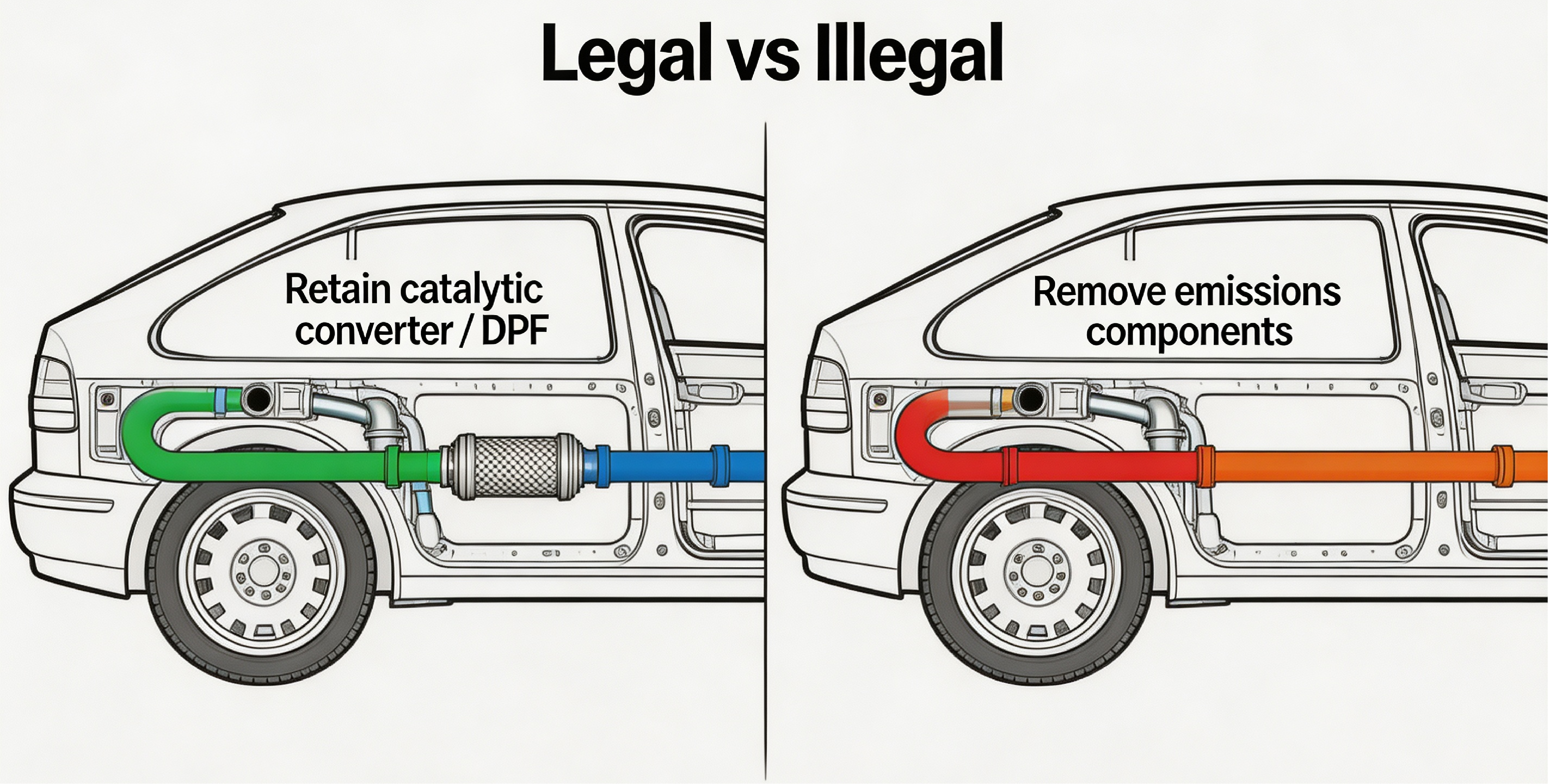
Quick Answer: A true straight pipe is illegal for street use when it removes, disables, or bypasses the catalytic converter, diesel particulate filter (DPF), DOC (diesel oxidation catalyst), SCR/DEF system, or any other emissions-control component required by law.
The key issue is whether the factory-installed emissions-control equipment has been removed. Even if your state or county does not require regular emissions testing, this still creates a federal emissions tampering issue.
If the modification keeps all emissions components intact and only replaces the muffler, resonator, or piping located after the catalytic converter, the federal tampering risk is lower, but it may still violate state muffler requirements, inspection standards, cutout valve bans, or local noise regulations.
What Is a Straight Pipe?
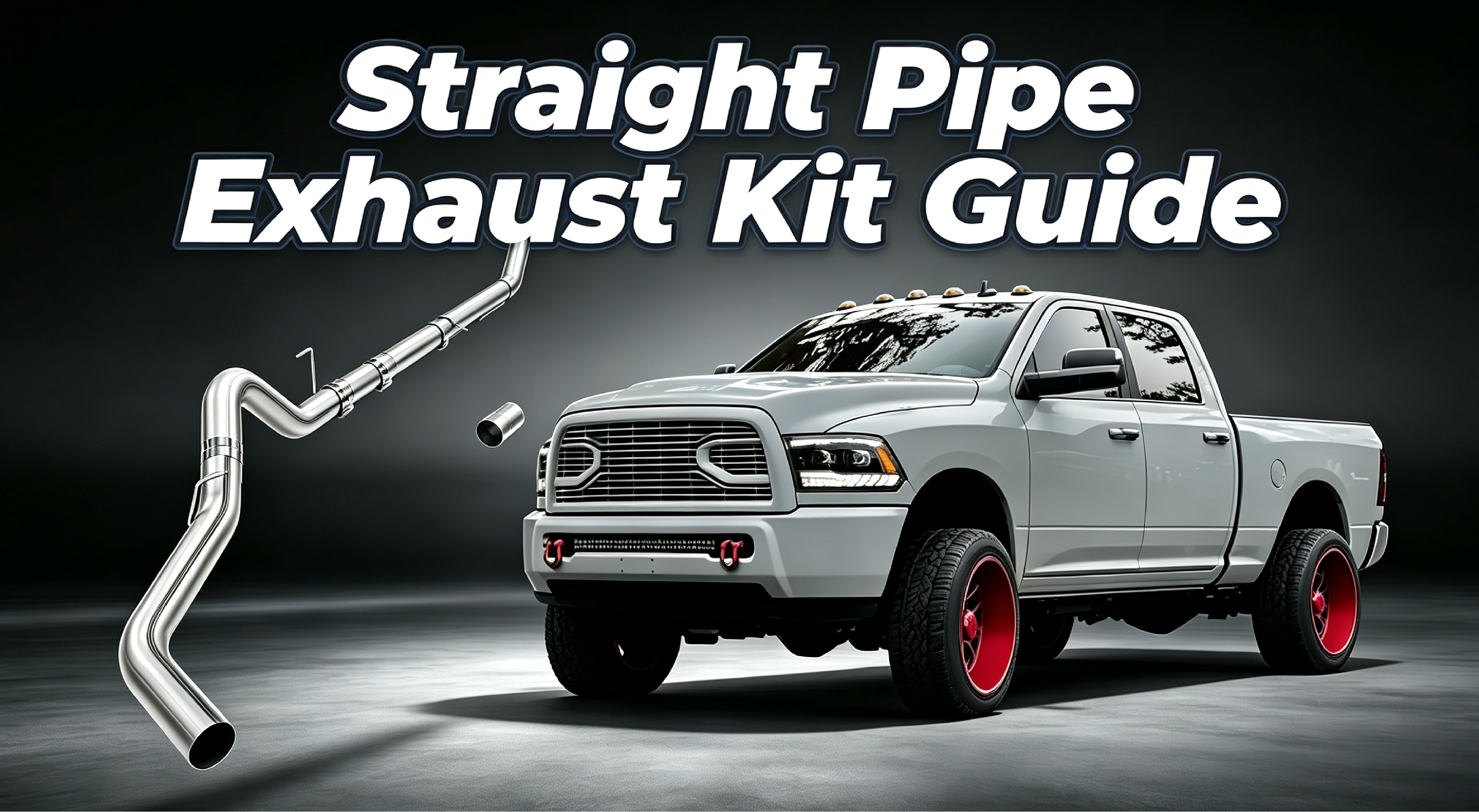
A straight pipe refers to removing the muffler, resonator, and catalytic converter from the factory exhaust system and replacing them with a straight metal pipe, allowing exhaust gases to flow directly from the engine to the rear of the vehicle. Simply put, it means "a straight-through path with no filtration or sound suppression."
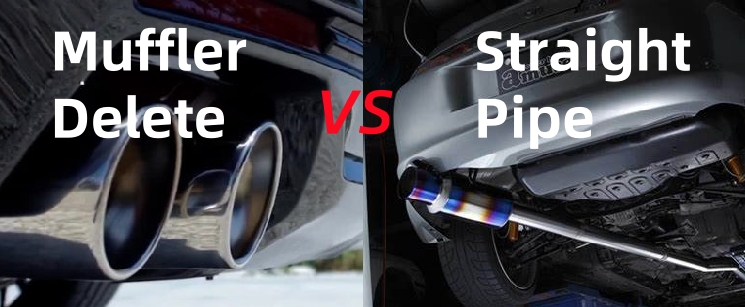
A straight pipe exhaust essentially allows exhaust gases to exit through a more direct exhaust path with fewer components. However, "straight pipe" is not a very strict mechanical term. Muffler deletes, cat-back systems, DPF-back systems, and similar setups can all sometimes be described as straight pipe configurations, even though they are not the same type of exhaust system.
Straight Pipe vs. Common Exhaust Modifications: Legality Comparison
| Modification Type | Main Modification | Main Risks | Street Legality |
| Full Straight Pipe(Straight Pipe) | Removes the catalytic converter (Cat), DPF, and all other emissions-control and sound-suppression components. | Violates federal emissions law, fails vehicle inspections, and may prevent legal resale of the vehicle. | Illegal (Strictly Prohibited for Street Use) |
| Muffler Delete(Muffler Delete) | Removes the rear muffler while keeping the front catalytic converter. | Excessive exhaust noise, violation of state muffler laws, and low-frequency cabin drone. | Very Low (Illegal in Many States) |
| Resonator Delete(Resonator Delete) | Removes only the mid-pipe resonator to change the exhaust tone. | Local noise disputes and possible highway drone. | Moderate (Depends on Noise) |
| Cat-Back Exhaust(Cat-Back Exhaust) | Replaces only the exhaust piping and muffler located after the catalytic converter. | Mainly installation-fitment issues and local decibel-limit risks. | Relatively High (Mainstream Recommendation) |
| Diesel Rear Exhaust(DPF-Back Exhaust) | Replaces only the piping and exhaust tip located after the DPF aftertreatment system. | Almost no environmental risk; sound changes may be relatively minor. | High (Factory Emissions Equipment Retained) |
Is Straight Pipe Illegal in the U.S.?
From a legal perspective, whether a straight pipe is illegal mainly depends on two areas: federal environmental law and state/local traffic and noise laws.
- Federal level: The U.S. Environmental Protection Agency (EPA) strictly prohibits anyone from removing, tampering with, or disabling any emissions-control device on a vehicle used on public roads—including catalytic converters, oxygen sensors, and similar equipment. This rule applies in every U.S. state with no exceptions.
- State and local level: States further restrict allowable exhaust sound levels, typically around 80–95 decibels, as well as the physical integrity of exhaust systems through motor vehicle safety standards and environmental regulations.
Therefore, the answer is clear: driving a straight-piped vehicle on public roads is illegal throughout the United States.
Straight Pipe Legality by U.S. State
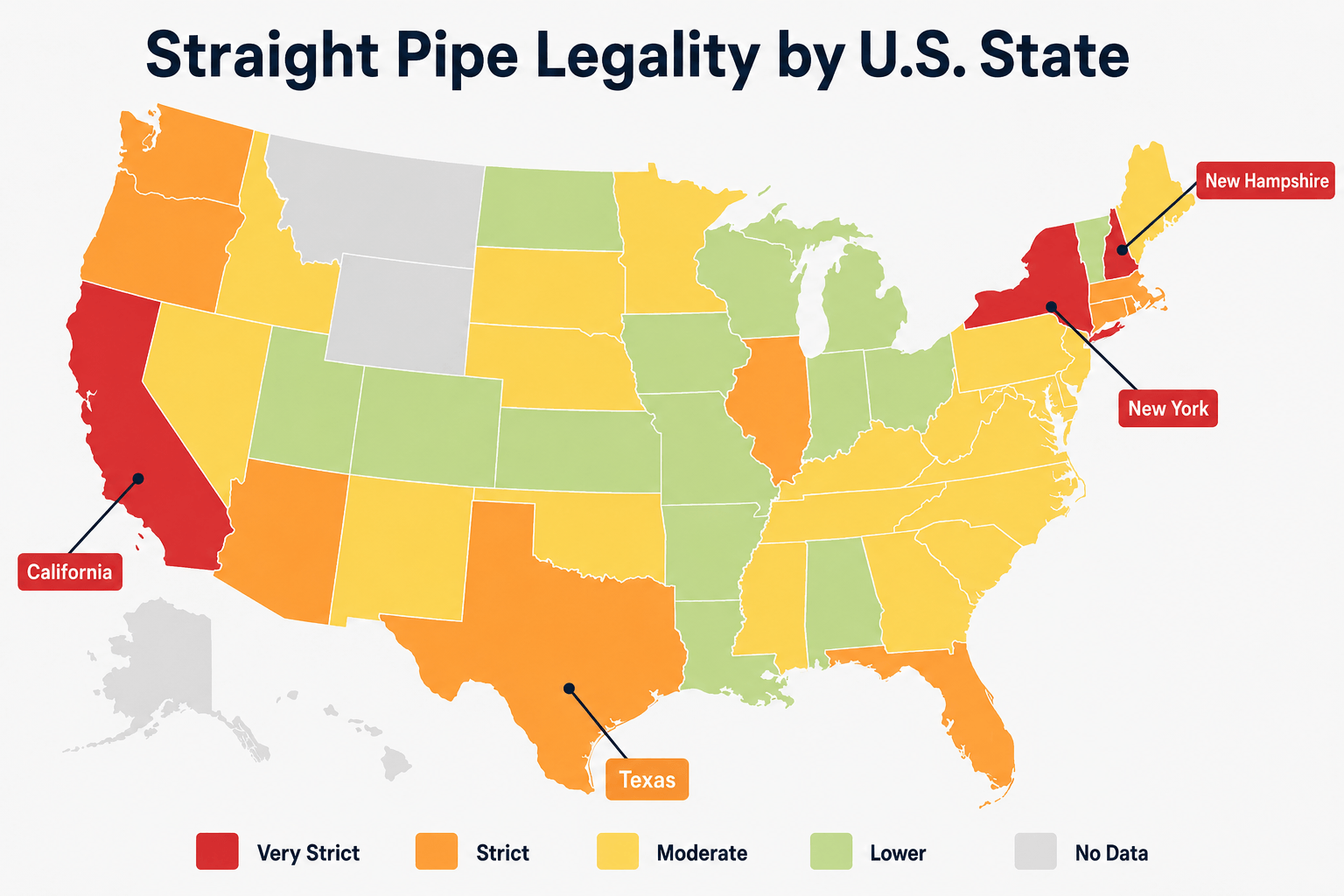
Although federal law uniformly prohibits removing catalytic converters, enforcement levels and additional penalties vary significantly by state.
California
The California Air Resources Board (CARB) requires exhaust modifications to comply with applicable certification requirements. California police may issue a "Fix-it Ticket" or significant fines for excessively loud exhaust systems, potentially exceeding $1,000, and the vehicle may need to be inspected at a designated station to confirm that it has been restored to compliance.
- Noise limit: Passenger vehicles may not exceed 95 decibels under the SAE J1169 measurement standard
- Enforcement: Beginning in January 2026, California Smog Check stations implement real-time CARB EO verification
- Penalties: Fines may reach up to $25,000 per vehicle; vehicle registration may be placed on hold
- State Referee: Non-compliant vehicles must be taken to a State Referee inspection station for a full inspection and must be restored to factory or CARB-certified condition before registration can be renewed
Texas
Texas does not have statewide emissions testing, except in certain counties and cities, but state motor vehicle law still clearly requires all vehicles operated on public roads to have a properly functioning muffler to prevent excessive or unusual noise.
- Catalytic converter: Texas regulations explicitly prohibit tampering with emissions-control devices, and removing the catalytic converter is illegal
- Noise: Texas Transportation Code Section 547.604 requires all vehicles to have a continuously operating muffler and prohibits “muffler cutouts, bypasses, or similar devices”
- Noise standard: Texas requires vehicle exhaust noise to remain below 95 decibels when measured at 20 inches. In actual enforcement, noise standards may be somewhat subjective
- Emissions-inspection counties: Brazoria, Collin, Dallas, Harris, Tarrant, Travis, and 17 other counties require annual emissions inspections
- Consequences: You may receive a “Fix-it Ticket” requiring the vehicle to be restored to compliance within a specified period, or vehicle registration may be suspended
New York
New York has implemented the SLEEP Act (Stop Loud and Excessive Exhaust Pollution Act), significantly increasing penalties for illegal exhaust modifications and excessively loud exhaust systems. Violators may face fines of up to $1,000.
- New York Vehicle and Traffic Law Section 375(31) includes specific noise restrictions
- It is illegal to sell, offer for sale, or install straight pipes without internal baffles
- Violations may result in fines of up to $1,000 and/or 30 days in jail
New Hampshire
- The law specifically defines and prohibits straight pipe exhaust systems
- The first offense carries a fine of no less than $100, the second offense within one year no less than $250, and the third and subsequent offenses no less than $500
State Quick Reference
| State | Straight Pipe Legality | Noise Limit | Notes |
| California | ❌ Completely Illegal | 95 dB | CARB certification requirements; strictest in the U.S. |
| Texas | ❌ Illegal (if catalytic converter is removed) | 95 dB | Emissions testing required in 17 counties |
| Florida | ❌ Illegal | Subjective standard | Cannot be louder than factory condition |
| New York | ❌ Illegal | Specific limits apply | Up to $1,000 fine + possible jail time |
| New Hampshire | ❌ Explicitly Prohibited | — | Tiered fines from $100–$500+ |
| Chicago (IL) | ❌ Explicitly Prohibited | — | Vehicle may be impounded; fines of $750+ |
| Pennsylvania | ❌ Illegal | — | Motorcycle straight pipe fines start at $250+ |
What Laws Actually Make a Straight Pipe Illegal?
The illegality of straight pipes comes from three layers of law working together:
Layer One: Federal Clean Air Act
This is the most fundamental legal basis:
- Section 203(a)(3)(A): Prohibits any person from removing or rendering inoperative an emissions-control device
- Section 203(a)(3)(B): Prohibits the manufacture, sale, or installation of "defeat devices," and straight pipes are explicitly included among them
Key point: This law applies to everyone—manufacturers, dealers, repair shops, and individual vehicle owners. You cannot avoid liability by saying, "I only installed it on my own vehicle."
Layer Two: State Noise Ordinances
Almost every state has laws requiring vehicles to be equipped with continuously operating mufflers. For example:
- California Vehicle Code Section 27150: All vehicles must be equipped with an adequate muffler
- Texas Transportation Code Section 547.604: Vehicles must have a continuously operating muffler to prevent excessive noise
- New Hampshire RSA 266:59: Specifically prohibits straight pipe exhaust systems
Layer Three: State Emissions Testing / Smog Check
In states that require emissions inspections, such as California, certain Texas counties, and New York, a straight-piped vehicle has a 100% chance of failing inspection. Failing inspection = inability to renew vehicle registration = inability to legally drive on public roads.
Is Straight Pipe Legal If Your State Has No Emissions Testing?
The answer is still no.
Even if your state, such as certain counties in Florida or Texas, does not require emissions inspections, a straight pipe is still illegal. Here is why:
1. Federal Law Takes Priority Over State Law
The Clean Air Act is federal law and applies in all 50 states. Regardless of whether your state has emissions-inspection stations, removing the catalytic converter itself already violates federal law. The EPA has authority to enforce these rules in any state.
2. "No Inspection" Does Not Mean "No Enforcement"
Not having emissions inspections only means no one is routinely inspecting your vehicle. It does not mean police cannot stop you on the road. If your vehicle is excessively loud, which a straight pipe inevitably is, police can:
- Stop you for a noise violation
- Inspect whether the exhaust system is complete
- Issue a federal-level violation after discovering that the catalytic converter is missing
3. Noise Laws Exist Independently
Even without emissions inspections, noise regulations still apply. Straight pipes commonly produce sound levels above 100 decibels, far exceeding the noise limits in most states, which are typically between 80 and 95 decibels.
How Do You Make a Straight-Piped Vehicle Legal Again?
If you have already installed a straight pipe or have just received a ticket, the following steps can help restore the vehicle to legal compliance:
Step One: Restore the Catalytic Converter
This is the most important step. You need to install:
- OEM catalytic converter: The safest option and 100% compliant
- EPA-certified aftermarket catalytic converter: Make sure it meets federal standards
- CARB-certified catalytic converter (California only): Must have a CARB Executive Order number
Step Two: Install a Compliant Muffler
- Make sure exhaust noise does not exceed your state's legal limit, which is typically 80–95 decibels
- Choose a muffler with a CARB Executive Order number in California
Step Three: Pass Inspection
- In states that require emissions testing, the vehicle must pass a Smog Check or emissions inspection
- In California, a State Referee Inspection may be required
- Keep all compliance documentation, including receipts and EO-number paperwork
Step Four: Submit Proof of Correction to the Court
If you received a Fix-it Ticket, you need to complete the following within the required time:
- Complete the repairs listed above
- Take the vehicle to a designated inspection station for reinspection
- Submit proof of passing inspection to the court
- Pay any administrative fees, if applicable
FAQs
Conclusion and Recommendations
In all US states, it is illegal to remove the catalytic converter and install a straight-through exhaust pipe on a vehicle intended for public roads. Enforcement varies by state, with California being the strictest and Texas relatively more lenient. However, regardless of the state, if pulled over by traffic police, this modification is illegal and will be punished.
If you want better performance and a deeper exhaust note while still complying with street driving regulations, we recommend the following options:
- Mid-section and rear-section exhaust system: Retain the catalytic converter, only replace the mid-section and rear-section exhaust – legal and compliant, and significantly improves the sound.
- High-flow catalytic converter: Retains the catalytic converter function while increasing exhaust flow – requires confirmation of EPA/CARB certification.
- Rear exhaust: Only replace the tailpipe muffler – the most conservative but safest option.