 Contents
Contents
Have you ever heard a car on the street let out a deafening roar that sounds like it could tear the pavement apart? Chances are, it was a car with a straight pipe exhaust. For car enthusiasts, modifying the exhaust system is often the first step toward improving sound and performance. But what exactly does a "straight pipe exhaust" mean? Is it right for your vehicle? Let's take a closer look at the details, principles, pros, and cons of this popular modification.

What Is a Straight Pipe Exhaust?
Simply put, a straight pipe exhaust is an exhaust modification that replaces one or more components in the factory exhaust system with a more direct exhaust pipe.
Generally, a factory exhaust system may include components such as a catalytic converter, resonator, and muffler. A Straight Pipe usually means replacing some of these sound-reducing components with regular exhaust tubing so the exhaust gases can exit through a more direct path.
In simple terms: from the engine to the exhaust outlet, there is basically just one straight metal pipe, with no muffler, no resonator, and in many cases, no catalytic converter either.
How Does a Straight Pipe Exhaust Work?
In a factory exhaust system, exhaust gases leave the engine and pass through the following components in sequence:
- Exhaust manifold/header — collects exhaust gases from each cylinder.
- Catalytic converter — reduces harmful emissions through chemical reactions.
- Resonator — cancels specific noise frequencies and reduces cabin drone.
- Muffler — uses chambers, perforated tubes, and sound-absorbing materials to significantly reduce noise.
- Tailpipe — releases the treated exhaust gases into the atmosphere.
Although these components successfully make the vehicle quieter and more environmentally friendly, they also create something called "exhaust backpressure" because the gases are forced through dense catalytic converters and muffler baffles.
A straight pipe system removes all of these restrictions. With no catalytic converter, resonator, or muffler, exhaust gases can exit directly with very little resistance. The engine can "breathe" much more freely, the turbocharger, if equipped, can respond faster, and the engine can rev more quickly. At the same time, a Straight Piped vehicle is usually much louder than one with a factory exhaust.
Advantages of a Straight Pipe Exhaust
The main advantages of a Straight Pipe are related to sound, exhaust flow, and modification flexibility.
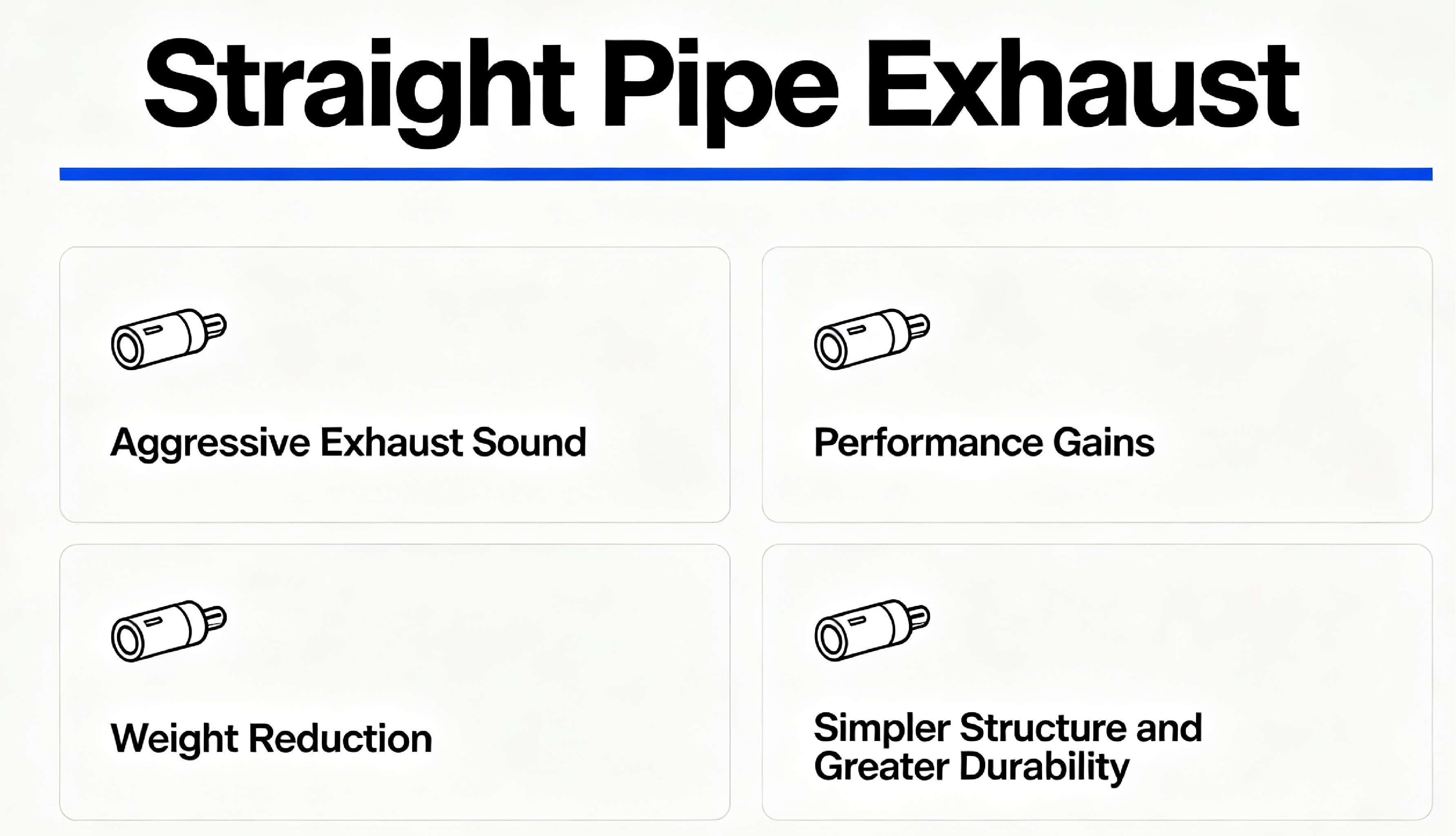
1. Aggressive Exhaust Sound
After the sound-reducing components are removed, more of the raw exhaust sound comes directly out of the tailpipe, allowing you to hear the pure, unfiltered roar of the engine.
For diesel trucks, this change is often even more noticeable. Turbo-diesel engines in particular usually produce a much more noticeable turbo whistle after exhaust modifications. However, it is important to remember that louder does not always mean better. An exhaust note that feels exciting during a short drive may become very tiring during long highway trips.

2. Performance Gains
After removing sources of backpressure, the engine no longer has to "fight" against the exhaust system, and the results can show up directly in several ways:
- More responsive throttle — engine speed rises faster.
- Increased horsepower and torque — usually around 2%–5%, with the biggest difference felt at higher RPM.
- Faster turbo response — on turbocharged engines, reduced backpressure allows the turbine to spin more easily, noticeably reducing turbo lag.
3. Weight Reduction
Factory mufflers and catalytic converters can be quite heavy. Replacing them with lightweight straight tubing can reduce some vehicle weight. However, the overall weight savings are usually not very large.
4. Simpler Structure and Greater Durability
Fewer parts mean fewer potential failure points. A straight pipe system has no muffler packing that can burn through, no catalytic converter that can become clogged, and no moving parts that can fail. A high-quality stainless steel pipe may even last longer than the vehicle itself.
Disadvantages of a Straight Pipe Exhaust
The disadvantages of a Straight Pipe are just as obvious.
1. Legality and Emissions
In most areas, including most U.S. states, driving a straight-piped vehicle on public roads is generally considered an illegal modification. It is also almost impossible to pass annual emissions inspections.
2. Noise and "Drone"
When the Muffler or Resonator is removed, the vehicle becomes louder not only under acceleration but also during cold starts. In addition, during highway cruising, the cabin may develop a constant humming sound known as drone, which can easily cause headaches.
3. Loss of Low-End Torque
Although a straight pipe can improve high-RPM horsepower, it may reduce low-RPM torque. Factory exhaust systems use carefully selected pipe diameters and crossover pipes, such as H-pipes and X-pipes, to create a scavenging effect that helps pull exhaust gases out of the cylinders at lower engine speeds. With a completely straight-through system, low-end torque may feel weaker, and the vehicle may not feel as strong when starting from a stop.
4. Engine Computer (ECU) Errors
Modern vehicles use front and rear oxygen sensors (O2 sensors) to monitor the operating condition of the catalytic converter in real time. If the catalytic converter is removed, the rear oxygen sensor may detect abnormal exhaust composition and trigger the Check Engine Light. The ECU may force the engine into a “limp mode” or enrich the fuel mixture, leading to spark plug carbon buildup and increased fuel consumption unless the ECU software is additionally tuned.
5. Environmental Pollution
After the catalytic converter is removed, the vehicle can emit large amounts of nitrogen oxides, carbon monoxide, and hydrocarbons, directly increasing air pollution. This is also the fundamental reason why regulations take such a strict approach to these modifications.
Straight Pipe vs. Other Exhaust Modifications
Straight Pipe is only one of many exhaust modification options. In addition, the term straight pipe is often used in a broader sense, and any pipe with a straight-through internal design may sometimes be called a straight-through pipe. Below is a comparison of different exhaust modifications:
| Exhaust Setup | Main Change | Sound | Main Purpose |
|---|---|---|---|
| Straight Pipe | Replaces parts of the exhaust system with more direct piping | Very loud | Sound, exhaust flow, customization |
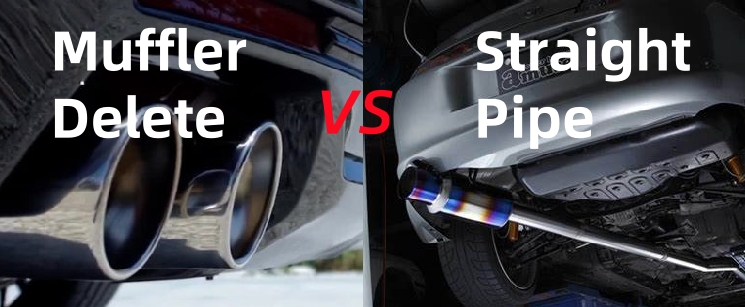
| Muffler Delete | Removes only the muffler | Louder | Simple increase in exhaust sound |
| Resonator Delete | Removes the resonator | Changes tone, slightly louder | Adjust exhaust tone |
| Cat-Back Exhaust | Replaces the exhaust system behind the catalytic converter | Moderate to loud | Sound + performance + fitment |
| Axle-Back Exhaust | Replaces the exhaust section behind the rear axle | Moderate to loud | Primarily improves sound |
| Performance Muffler | Uses a low-restriction performance muffler | Moderate | Balance between sound and comfort |
Conclusion: If you want to find a balance between sound, performance, and legal compliance, a Cat-Back Exhaust is usually the most practical choice. It only upgrades the piping behind the catalytic converter, improving exhaust efficiency without making the modification illegal. A straight pipe is an "extreme" option and is recommended only for dedicated track vehicles.
Do Straight Pipes Increase Horsepower?
Yes, but it depends on the vehicle's follow-up tuning.
- Average gain: around 5–15 wheel horsepower, which works out to roughly a 2%–5% increase.
- Turbocharged engines: benefit the most. With reduced backpressure, the turbo responds faster and boost builds more easily, so the improvement is more noticeable than on naturally aspirated vehicles.
- Diesel engines: diesel trucks and off-road vehicles are very sensitive to straight pipe modifications, especially after DPF removal. With proper tuning, horsepower can increase by 20–30 hp, and fuel economy often improves as well.
Key requirement: If you do not tune the ECU, the Check Engine Light may come on, the air-fuel ratio may become unstable, and actual performance may suffer. Therefore, tuning costs should always be included in the budget.
Who Is a Straight Pipe Best For?
Straight Pipe is not for everyone. It is better suited to owners who know exactly what they want and are willing to accept changes in noise and everyday driving comfort.
More specifically, it is best suited to the following types of vehicles and use cases:
- Track & Project Cars
- High-Power Trucks (V8 & Diesel Trucks)
- Diesel enthusiasts seeking maximum exhaust sound
- Dedicated Off-Road Vehicles
One-sentence recommendation: If you still use your vehicle for everyday commuting, choosing a Cat-Back Exhaust or a high-performance muffler is the better way to balance sound and comfort.
Conclusion
A straight pipe exhaust is the ultimate modification for drivers seeking raw exhaust sound and maximum exhaust flow. It can deliver the wildest exhaust note, stronger high-RPM performance, and weight-saving benefits, all of which are highly attractive to many performance enthusiasts. But those thrills come with equally serious tradeoffs: excessive noise, loss of low-end torque, legal risks, and a greater environmental impact.
If you simply want your daily driver to sound sportier, choosing a legal aftermarket exhaust, such as a Cat-Back system, is the smarter decision.
If you have a dedicated track toy, a straight pipe can be incredibly exciting. But if it is a daily-driven vehicle, choosing a high-quality Cat-Back exhaust or simply doing a muffler delete is clearly the more practical and responsible choice. Before making any modifications, be sure to check your local laws, your tolerance for noise, and whether you are willing to spend extra money on ECU tuning.