 Contents
Contents
- Will a Muffler Delete Trigger a Check Engine Light or Damage the Engine?
- Global Law Map: What Do Police Look for During a Roadside Inspection?
- Deep Dive: The Three Stages of a Roadside Inspection
- Legal Sound Solutions: How to Improve Tone Without Attracting Police?
- Why the "Cheap" Muffler Delete Can Actually Be More Expensive
- Expert Advice: The "Three-Check" List Before Modifying
- FAQs
Will a Muffler Delete Trigger a Check Engine Light or Damage the Engine?
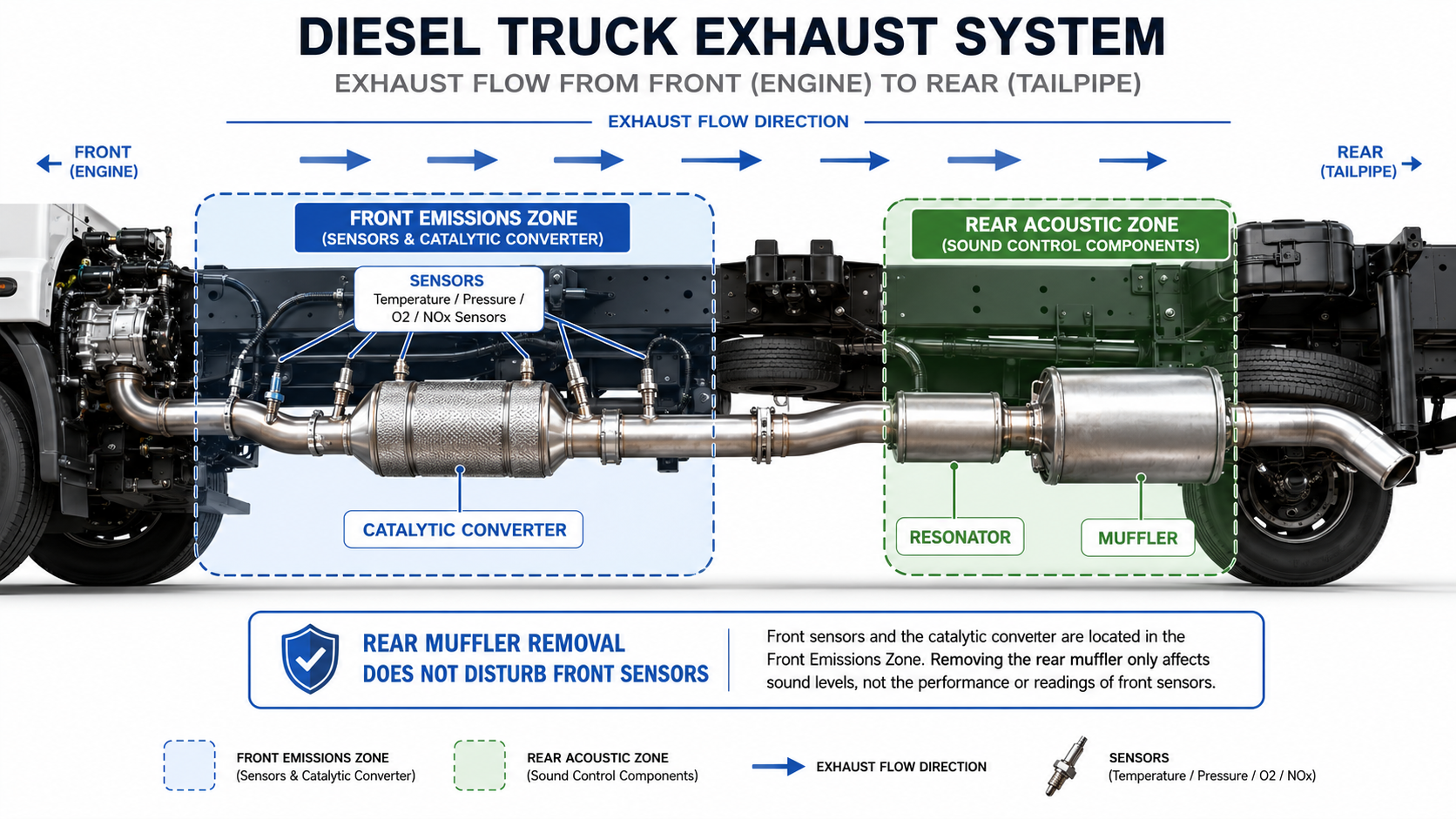
A common anxiety among vehicle owners is whether removing the muffler will cause the dashboard to "light up like a Christmas tree." In most cases, a simple rear muffler delete will not trigger a Check Engine Light (CEL). This is because the core sensors responsible for monitoring emissions—such as O2 sensors, NOx sensors, and DPF pressure sensors—are located in the front and mid-sections of the exhaust system, far upstream from the muffler.
From a mechanical standpoint, as long as the welding and piping are of high quality, a muffler delete is not inherently bad for your car. Modern Engine Control Units (ECUs) are designed to adjust fuel trim based on real-time sensor data, and the slight change in backpressure is usually well within the engine's operating tolerances. However, there is a catch: if your vehicle is equipped with OEM electronic exhaust valves, removing them without installing a "valve simulator" or bypass plug can cause the computer to log a communication error, potentially putting the vehicle into a "Limp Mode" with restricted power.
Global Law Map: What Do Police Look for During a Roadside Inspection?
When it comes to modified exhausts, the "yardstick" used by law enforcement varies significantly across the globe. Understanding the enforcement logic in different regions can help you distinguish between a "grey area" modification and a "guaranteed ticket" zone.
Global Enforcement Comparison Table
To help you make a quick decision, refer to the table below for the primary enforcement focus in different regions:
| Region | Primary Focus of Inspection | Enforcement Logic | Risk Level |
|---|---|---|---|
| USA (e.g., California) | Decibel Testing (95dB) | As long as the volume does not exceed the limit, there is room to argue the legality of a muffler delete. | ⭐⭐⭐ |
| Canada (e.g., BC) | Visual Inspection + Integrity | Even if it isn't loud, you may be ticketed for "missing equipment" if the stock silencer is absent. | ⭐⭐⭐⭐ |
| Germany / EU | Certification (E-mark/TÜV) | A "permit-based" system; straight pipes without documentation are strictly illegal. | ⭐⭐⭐⭐⭐ |
| Australia (AU) | ADR Standards + Roadworthiness | Police frequently issue "Defect Notices," forcing you to return to stock for a re-inspection. | ⭐⭐⭐⭐ |
| Asia / South America | Complaint-Driven + Spot Checks | Standards vary; "revving" in residential areas is the most common cause for fines. | ⭐⭐ |
Deep Dive: Enforcement Details Across Four Major Markets
North America: Decibel Levels vs. Emissions Integrity
In the United States, the federal EPA focuses on your catalytic converters, while State Patrol officers focus on your decibels. Using California’s SEMA legal framework as an example, officers primarily conduct roadside tests following SAE J1492 standards: measuring at a 45-degree angle, 0.5 meters from the exhaust tip. As long as the noise level stays below 95dB, you can often drive legally. However, in Canada, as noted by DriveSmartBC, inspectors prioritize "physical integrity." If an officer finds a straight pipe welded in place of the factory muffler, you may be ticketed for "missing equipment," even if the car is relatively quiet.
Europe: The "Permit-Only" Culture and Automated Enforcement
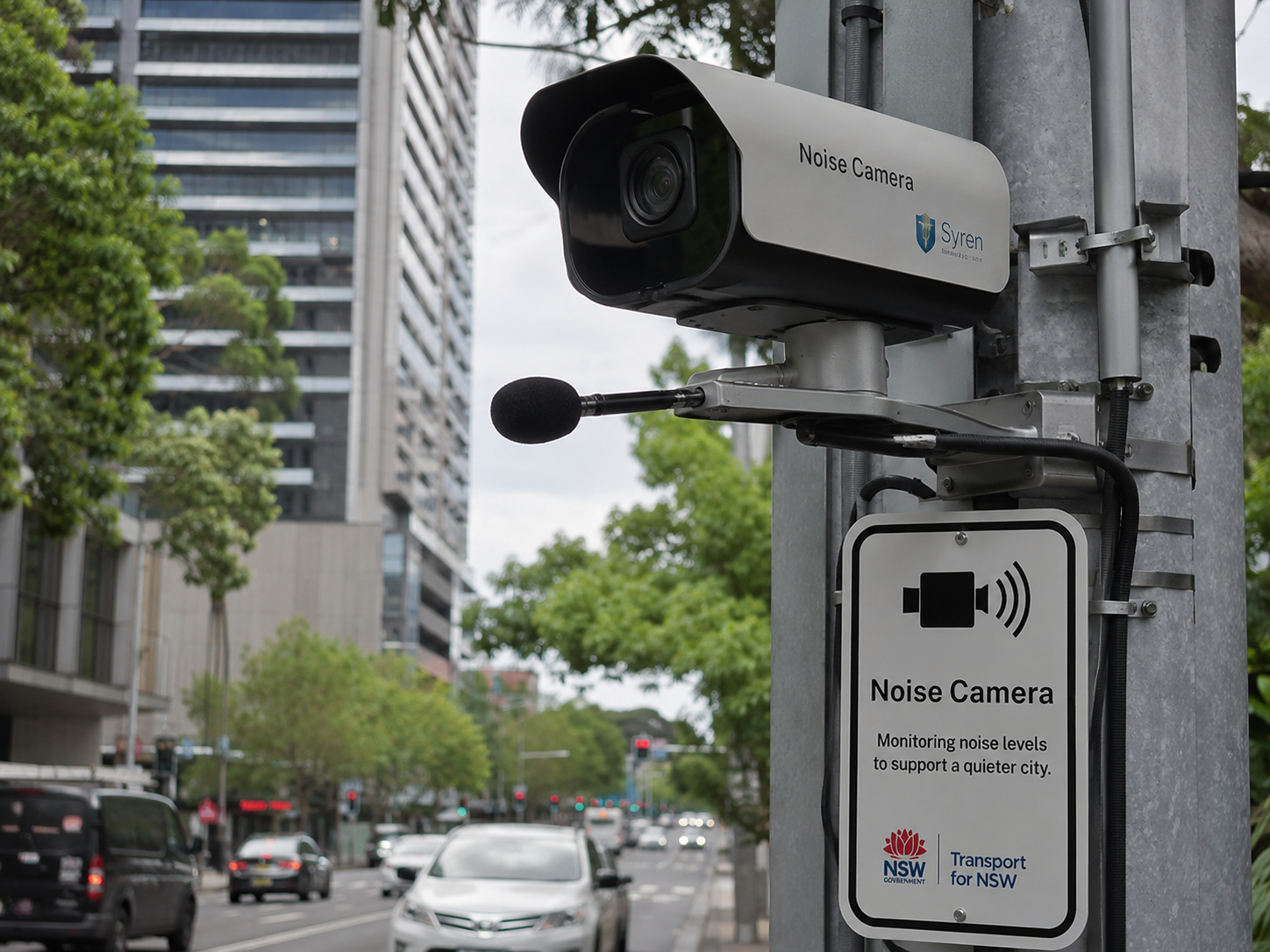
In countries like Germany or Austria, GTÜ inspectors look for one thing: the E-mark stamped on the pipe or a TÜV/ABE certificate in your glovebox. Muffler deletes that destroy the factory structure are classified as "strictly illegal." More cutting-edge is the deployment of Noise Cameras in cities like London and Paris. These devices use acoustic arrays to automatically capture and mail fines to owners who exceed decibel limits, making it nearly impossible to evade electronic enforcement.
Australia: ADR Standards and the "Yellow Sticker" Risk
Australian enforcement is governed by ADR 83/00 (External Noise). Down Under, police don't necessarily have to prove you are over the limit on the spot; they only need "reasonable suspicion." If an officer suspects your muffler delete affects roadworthiness, they will issue a Defect Notice (commonly known as a yellow sticker). This effectively suspends your road registration, forcing you to revert to stock and pass a Roadworthy Test at a licensed inspection station within a set timeframe.
Asia and South America: Complaint-Driven Enforcement
In these regions, while laws exist, enforcement is typically "complaint-driven." Police rarely patrol with decibel meters; instead, fines usually stem from neighborhood complaints. Consequently, while the physical cost of a muffler delete is lowest in these markets, the lack of clear decibel exemptions means that once pulled over, officers often have significant discretionary power to issue fines.
Deep Dive: The Three Stages of a Roadside Inspection
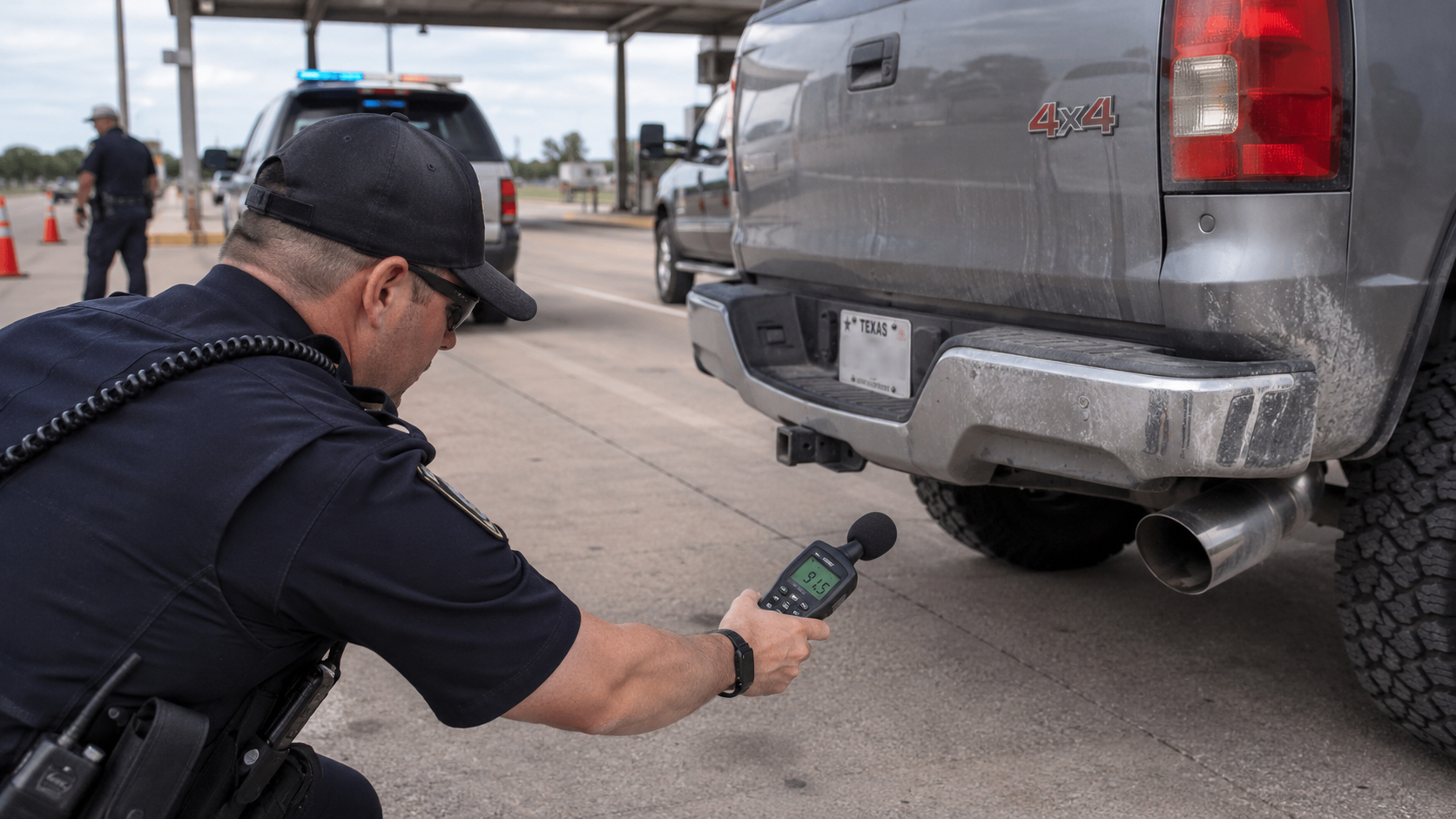
When you are pulled over for a modified exhaust, law enforcement typically follows a three-stage protocol to determine if your vehicle is street-legal. Understanding these "checkpoints" can help you prepare for a potential inspection.
- Stage 1: The Decibel Test (Sound Level)
Officers use a standardized procedure (typically measuring at a specific distance, angle, and RPM) to conduct a static noise test. Remember: Subjective loudness is not the legal metric; exceeding the specific decibel limit of your jurisdiction (commonly 90–95dB) is the objective trigger for a citation. - Stage 2: Visual Inspection (Physical Integrity)
This is where a muffler delete often fails. In jurisdictions like British Columbia (Canada) or most Australian states, inspectors will look under the chassis to confirm that the factory silencer has not been replaced by a "straight pipe." The physical absence of the component—even if the car isn't excessively loud—is frequently deemed a failure of roadworthiness. - Stage 3: Emissions System Integrity (Federal Compliance)
Strictly Prohibited: Tampering with the Catalytic Converter (CAT), Diesel Particulate Filter (DPF/GPF), or SCR system. Removing or "gutting" these components is a serious federal-level violation in most countries. The fines for emissions tampering are significantly higher than those for simple noise violations, and it can lead to permanent vehicle impoundment.
Legal Sound Solutions: How to Improve Tone Without Attracting Police?
Instead of a "one-size-fits-all" aggressive approach like a muffler delete, the following solutions offer better value for money and significantly lower legal risks. These options allow you to achieve a deeper, more refined exhaust note while staying within the boundaries of the law.
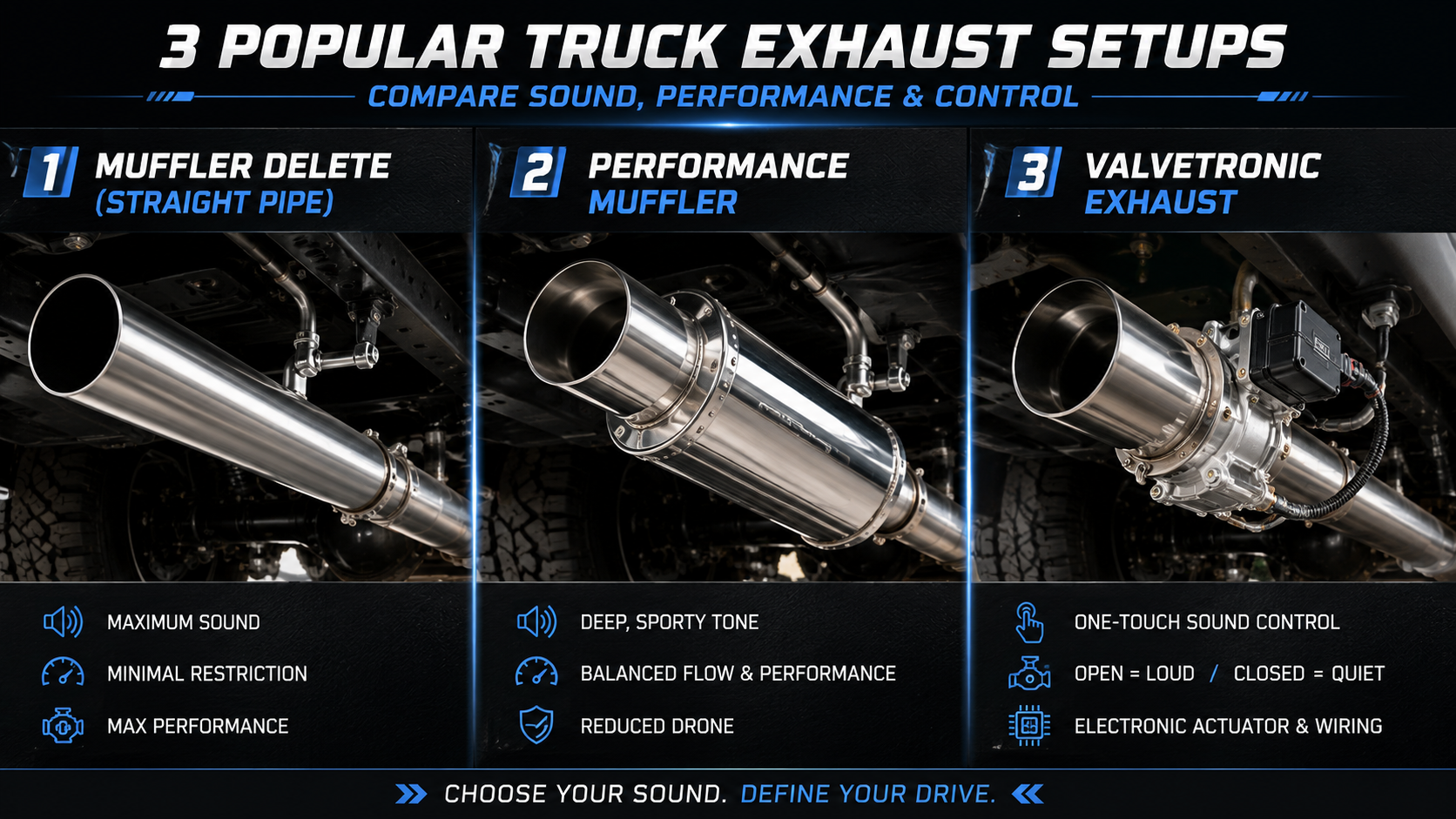
- Option A: Performance Cat-back / DPF-back System (The Most Reliable Upgrade)
A Cat-back (for gasoline vehicles) or DPF-back (for diesel vehicles) system replaces the entire section of the exhaust from the catalytic converter or DPF back to the tailpipe. Pros: Since these systems do not touch the core emissions components, they rarely trigger a Check Engine Light. High-end brands like Borla or MagnaFlow are acoustically tuned to eliminate "drone" while providing a deep, muscular growl that often comes with emissions compliance certification. - Option B: Valvetronic Exhaust—The "Survival Tool" for Avoiding Complaints
If you want a racing roar on the track but need to be silent in your driveway at 3:00 AM, a Valvetronic system is the ultimate solution. Pros: These systems feature electronically controlled valves. Quiet Mode is perfect for residential areas, long-distance highway cruising, and daily commuting. Open Mode bypasses the mufflers for maximum sound on the track or non-public roads. However, the system itself must still comply with local noise regulations and should not be used solely as a tool to evade enforcement. - Option C: High-Performance Muffler Replacement Instead of Deletion
If you find the factory sound too muffled, you don't necessarily need to delete the component. Replacing the stock silencer with a High-flow Performance Muffler improves the exhaust tone while maintaining the physical structure of the system. This is particularly effective in regions like Canada or Australia that emphasize "physical integrity."
To learn more about the specific differences between these setups, click: Resonator vs. Muffler Difference & Muffler Delete Guide.
Pro-Tips for Different Vehicle Types:
- Diesel Trucks: It is strongly recommended to keep the DPF intact and upgrade only to a DPF-back system. This allows for larger exhaust tips (e.g., 5-inch or 6-inch) to dramatically improve the look and airflow efficiency while remaining 100% street-legal.
- Gasoline Performance Cars: If your budget allows, a valved Axle-back system is the most cost-effective choice. By only replacing the very end of the exhaust, you get an immediate sound improvement that is much easier to pass during annual inspections.
Why the "Cheap" Muffler Delete Can Actually Be More Expensive
A muffler delete may seem like a bargain, costing only a few hundred dollars for basic welding. However, behind that low price tag lie potential "hidden costs" that could reach thousands of dollars in the long run:
- Insurance Risks: This is a critical point. If you are involved in an accident and your insurance provider discovers an undeclared or illegal exhaust modification, they may use it as grounds to deny your claim entirely.
- Loss of Resale Value: Most buyers are wary of "hacked" used cars. A car with a welded straight pipe is often seen as a sign of aggressive driving. Keeping your factory parts for restoration ensures you can protect the vehicle's residual value when it's time to sell.
- Restoration Costs: A single $500 fine, combined with the labor costs of being forced to re-install the factory exhaust for a mandatory re-inspection, can quickly exceed the price of a high-quality, legal performance exhaust system.
Expert Advice: The "Three-Check" List Before Modifying
- Check the Decibels: Look up the specific dB limits for your city, not just the state or provincial laws, as local ordinances are often stricter.
- Check the Paperwork: When purchasing aftermarket parts, always request and carry a Compliance Certificate in your vehicle.
- Check the Neighborhood: Even if your exhaust is technically legal, revving high in a residential area at night is the fastest way to attract unwanted attention from the police.
Author’s Recommendation
If you are chasing pure driving passion, prioritize certified Cat-back or valved exhaust systems. This is not just about avoiding a hefty fine; it is about protecting your car’s value and ensuring that your pride and joy remains a reliable piece of precision machinery—rather than a poorly welded "decibel bomb"—for its next inspection or owner.