 Contents
Contents
The 6.4L Powerstroke is a high-performance diesel engine, but it is certainly not a "low maintenance" machine. Found in 2008–2010 Ford Super Duty trucks, this engine features a twin-turbocharged design that delivers massive torque and exceptional towing capacity. Many owners are drawn to its immediate power response and significant tuning potential.
However, from a long-term reliability perspective, the challenges of the 6.4L Powerstroke extend beyond the engine block itself. The real issues lie within the highly complex systems surrounding the motor, particularly:
- Dual EGR Cooler System
- Cooling System
- Oil Cooling System
- Fuel System
- Emissions Aftertreatment Components
Among these, the Dual EGR Cooler system is one of the most frequent and frustrating reliability risks for owners. If you are experiencing mysterious coolant loss, white smoke from the exhaust, overheating, or skyrocketing repair bills, understanding why the factory EGR architecture fails is the first step toward improving 6.4 Powerstroke reliability.
6.4 Powerstroke Common Issues: Why Does the Dual EGR Cooler Fail?
When reading for 6.4 Powerstroke problems, leaks and cooling issues consistently rank at the top. Unlike its predecessor, the 6.0L—which struggled with a single, fragile cooler—Ford engineers attempted to solve high combustion temperatures in the 6.4L by doubling the hardware. The result was a Dual EGR Cooler series layout, arguably the most complex and failure-prone system in the Ford Super Duty lineup.
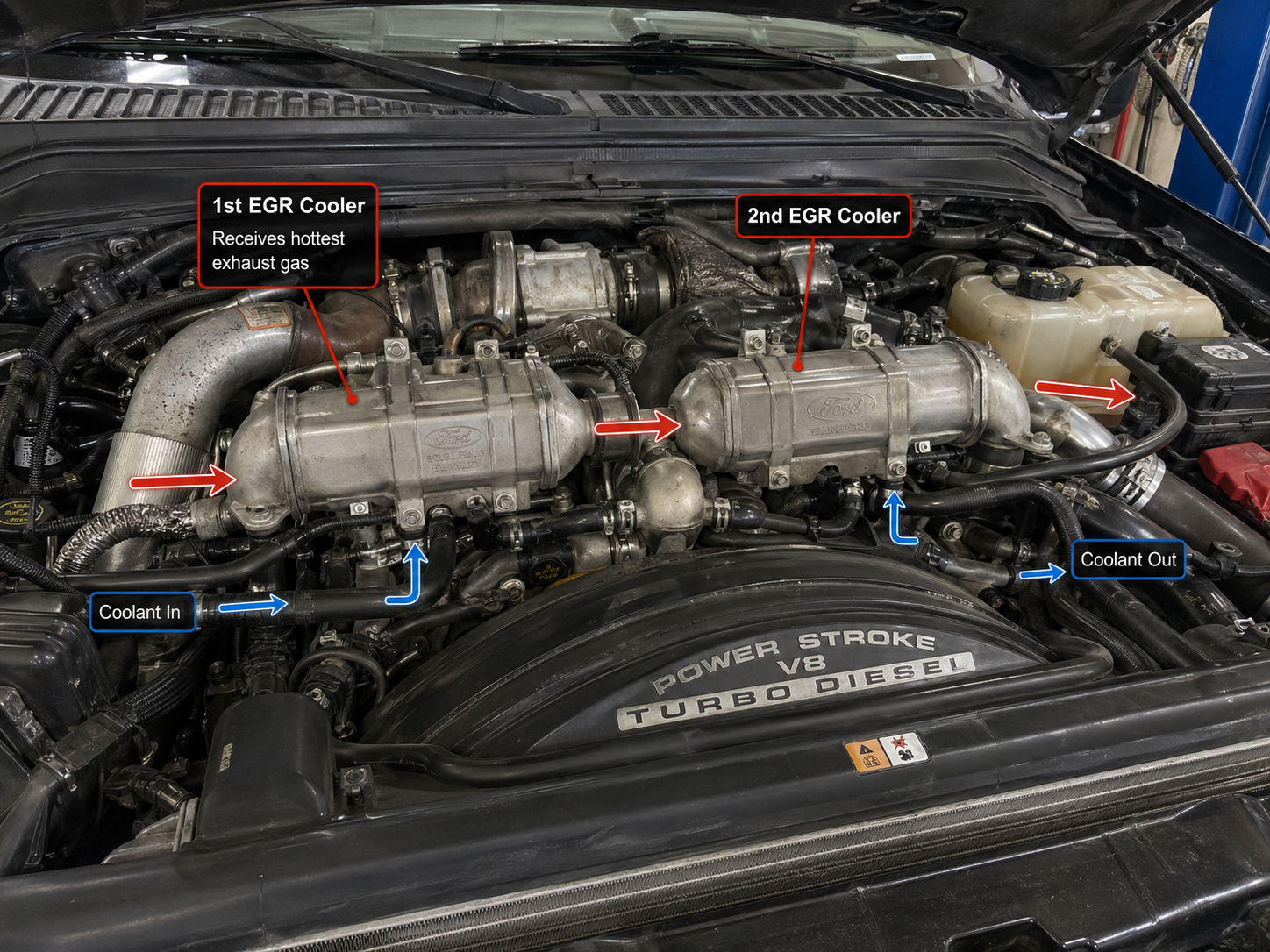
Two Coolers Mean Double the Leak Points
In the 6.4L architecture, exhaust gases pass through two independent coolers arranged in a series. This creates extreme complexity under the hood:
- Multiple Failure Points: Having two coolers means you have more sealing surfaces, gaskets, coolant passages, and connection lines.
- Increased Crack Risks: There are more physical locations where metal fatigue can lead to cracks.
If a crack develops inside either cooler, coolant leaks into the exhaust or intake path. The result is rarely a puddle on the ground; instead, owners typically notice:
- The coolant degas bottle level constantly dropping
- Thick white steam/smoke exiting the exhaust pipe
- Abnormal pressure within the cooling system
- Spiking engine temperatures and potential catastrophic engine damage
This hidden nature of the leak is exactly what makes the 6.4L dual EGR cooler so troublesome for daily drivers.
Heat Concentration: The Weak Link in the Series Layout
The "Series" design of the 6.4L system creates a massive thermal imbalance. The first cooler in the sequence bears the brunt of the raw exhaust gas, which can exceed 1,000°F. This intense heat, combined with heavy towing, high EGT (Exhaust Gas Temperature) conditions, and constant thermal cycling, rapidly accelerates metal fatigue.
Once internal welds or coolant tubes develop hairline cracks, coolant is sucked into the exhaust stream. Because this coolant is instantly vaporized by the high temperatures, owners often won't see a visible leak under the truck; instead, they are left wondering why their coolant levels are "mysteriously" dropping.
Extreme Maintenance Difficulty: The "Cab-Off" Reality
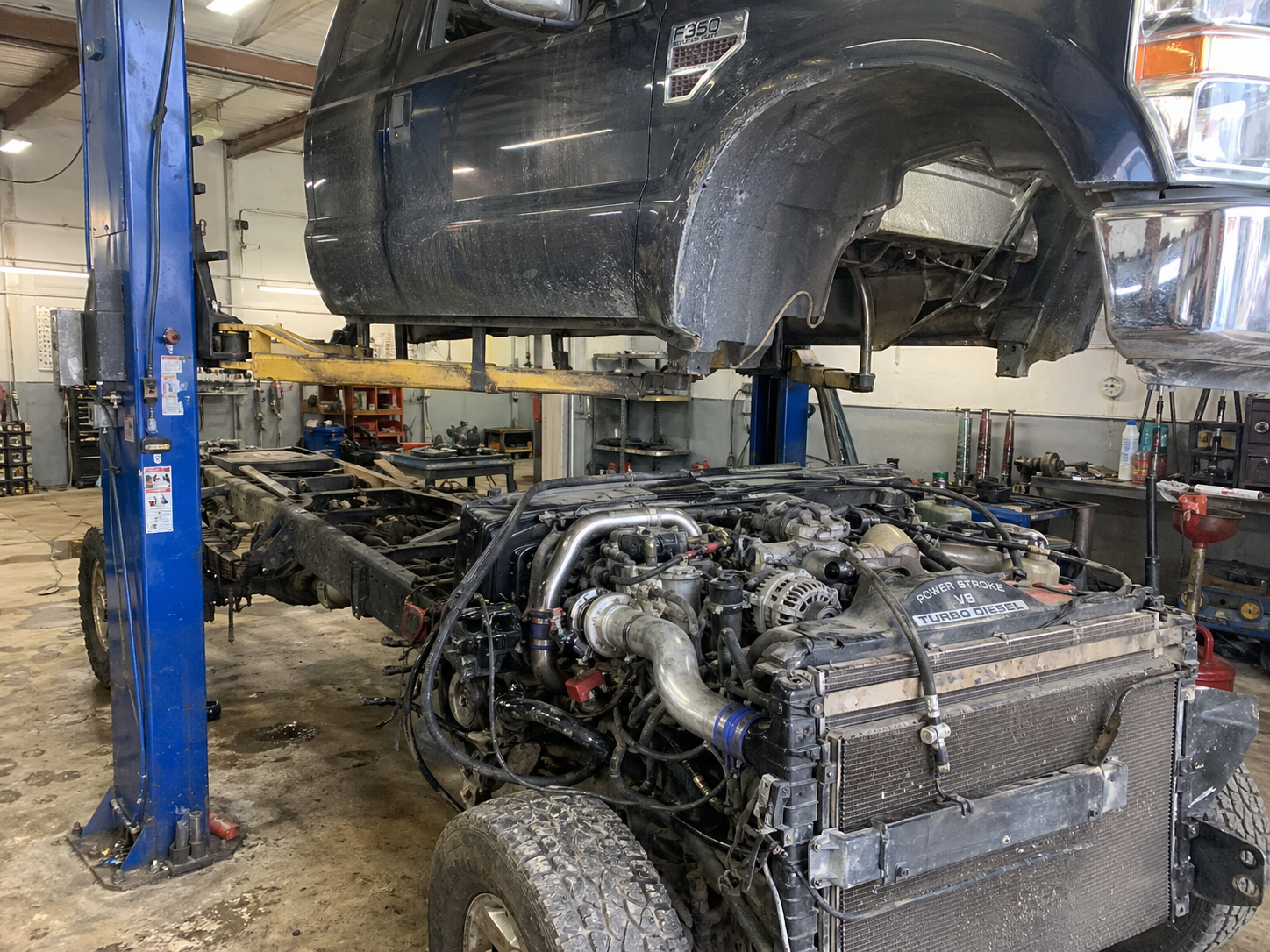
One of the biggest 6.4 Powerstroke problems isn't just that parts fail, but where they are located. The engine bay of the 2008–2010 Ford Super Duty is incredibly cramped. The EGR valves, dual coolers, turbocharger system, and a maze of intake and coolant lines are packed tightly against the rear of the engine and the firewall.
This layout means a "simple" EGR inspection or cooler replacement is rarely straightforward. In many cases, to reach the components properly and avoid cross-threading or damaging surrounding lines, technicians must perform a "Cab-Off" surgery—literally lifting the entire truck body off the chassis.
Breaking Down the Cost: Labor vs. Parts
If you are asking, "Is the 6.4 Powerstroke a good motor?" , you must factor in the potential for astronomical repair bills. Using the Houston, Texas diesel repair market as a benchmark, here is what a typical EGR-related repair looks like:
- Labor Hours: A standard EGR valve check or cooler replacement typically requires 10–15 hours of labor.
- Hourly Rates: Professional diesel shops in major hubs charge between $150–$200 per hour.
- Total Labor Cost: Just to get the parts on and off, you are looking at $1,500–$3,000 in labor alone.
Keep in mind, this does not include the cost of the OEM EGR coolers, gaskets, fresh coolant, specialized hoses, sensors, or any other "while you're in there" repairs.
Common Symptoms of 6.4L EGR System Failure
If you encounter any of the following situations, it indicates that your dual cooler setup is likely starting to fail:
- Mysterious Coolant Loss: You find yourself constantly topping off the degas bottle, yet there are no visible puddles on your driveway.
- White Smoke: Thick white smoke/steam exiting the exhaust (especially under heavy load) suggests coolant is leaking internally and being burned in the cylinders.
- Engine Overheating: Heat buildup caused by series passage blockages can lead to warped cylinder heads or blown head gaskets.
For many owners, the solution to these 6.4 Powerstroke problems isn't simply replacing broken parts with more failure-prone factory units, but rather simplifying the entire system. For more detailed insights, check out the Top 7 6.4 Powerstroke Problems & How to Prevent Them.
How to Improve 6.4 Powerstroke Reliability?
The core of improving 6.4 Powerstroke reliability isn't just chasing higher horsepower; it’s about making the engine's peripheral systems more stable, simpler, and easier to maintain.
Option 1: Compliant Repair or Upgrading the EGR Cooler System
For street-legal vehicles, the safest route is usually inspecting and repairing the original EGR system or choosing compliant upgraded replacement parts. If the EGR cooler has leaked internally, you should simultaneously inspect:
- The EGR Valve and associated piping
- Coolant lines and the Oil Cooler efficiency
- The Degas bottle and pressure cap
- Overall coolant contamination and radiator health
- Related sensors and connection hardware
Simply replacing one damaged cooler without addressing coolant contamination or oil cooler inefficiency often leads to secondary failures or recurring overheating issues.
Option 2: EGR Delete Solutions for Off-Road or Racing Use
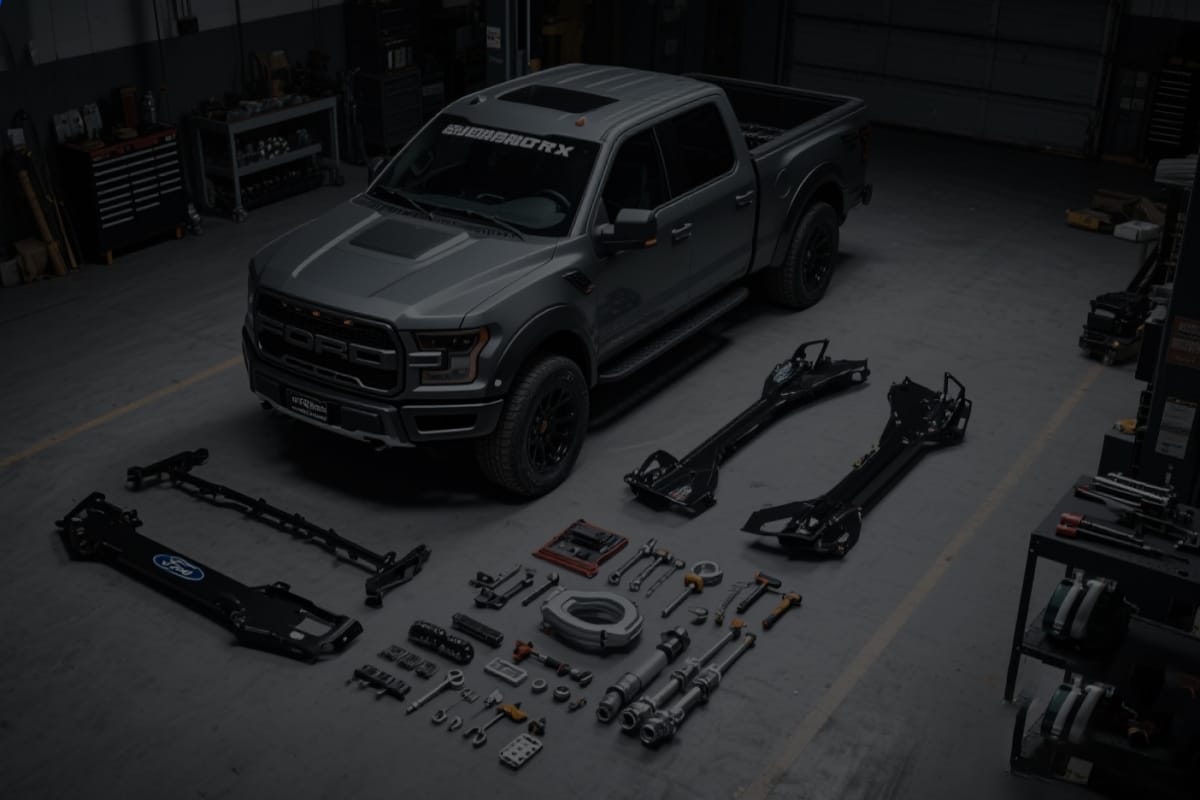
Facing the extreme maintenance difficulty and the inherent risks of the dual-cooler setup, the most thorough solution is often "simplification" rather than repeated repairs. By installing a 6.4 Powerstroke EGR delete kit, you can physically remove those redundant emission components, allowing the engine to return to its most efficient operating state.
Potential advantages include:
- Removal of two high-risk EGR coolers.
- Significantly reduced risk of internal coolant leaks.
- Decreased carbon soot buildup in the intake system.
- Freed up engine bay space for easier maintenance and inspections.
- Reduction in long-term maintenance pressure and labor costs.
To demonstrate the effects of this upgrade more intuitively, we have compared the factory 6.4L state with the SunCant 6.4 Powerstroke egr delete kit solution:
| Dimension | Factory Dual EGR System | Simplified EGR Solution (e.g., SunCent Kit) |
|---|---|---|
| Cooler Configuration | 2 coolers in series layout | Physically removed based on the plan (for off-road use) |
| Failure Points | More welds, gaskets, coolant passages, and connection lines | Simpler structure with significantly fewer potential leak points |
| Coolant Leak Risk | Higher due to complex series architecture | Significantly reduced |
| Carbon Buildup | Exhaust gas recirculation causes heavy soot buildup in the intake | Cleaner intake path |
| Maintenance Space | Cramped and extremely difficult to disassemble | Improved engine bay space, especially at the rear |
| Follow-up Maintenance | High labor hours and a high risk of recurring failure | Inspections and maintenance are more direct and efficient |
| Compliance | OEM street legal | Subject to local regulations; usually restricted to off-road/racing |
| Target User | Street-driven users with strict emissions inspection requirements | Off-road, racing, or non-highway use users |

You may also choose the best 6.4 Powerstroke delete kit for a total removal based on your current needs.
Note: Deleting the EGR system must be paired with an ECU tuner; otherwise, the check engine light will trigger, or the truck may enter "Limp Mode".
Option 3: Deep Cooling System Cleaning and Coolant Upgrades
The 6.4L Powerstroke is exceptionally sensitive to the condition of its cooling system. Aging coolant, contamination, sediment buildup, or mixing incompatible coolant types can lead to a drastic drop in cooling efficiency.
Key areas to focus on:
- Change coolant at regular intervals.
- Avoid mixing different types of coolants.
- Inspect for oil contamination, rust, or sediment in the coolant.
- Perform a full cooling system flush when necessary.
- Use high-quality ELC (Extended Life Coolant) specifically designed for diesel engines.
- Check the condition of the degas bottle, pressure cap, and all hoses.
A stable cooling system is the fundamental foundation for the long-term reliable operation of the 6.4L.
Option 4: Monitoring EOT and ECT Temperature Delta
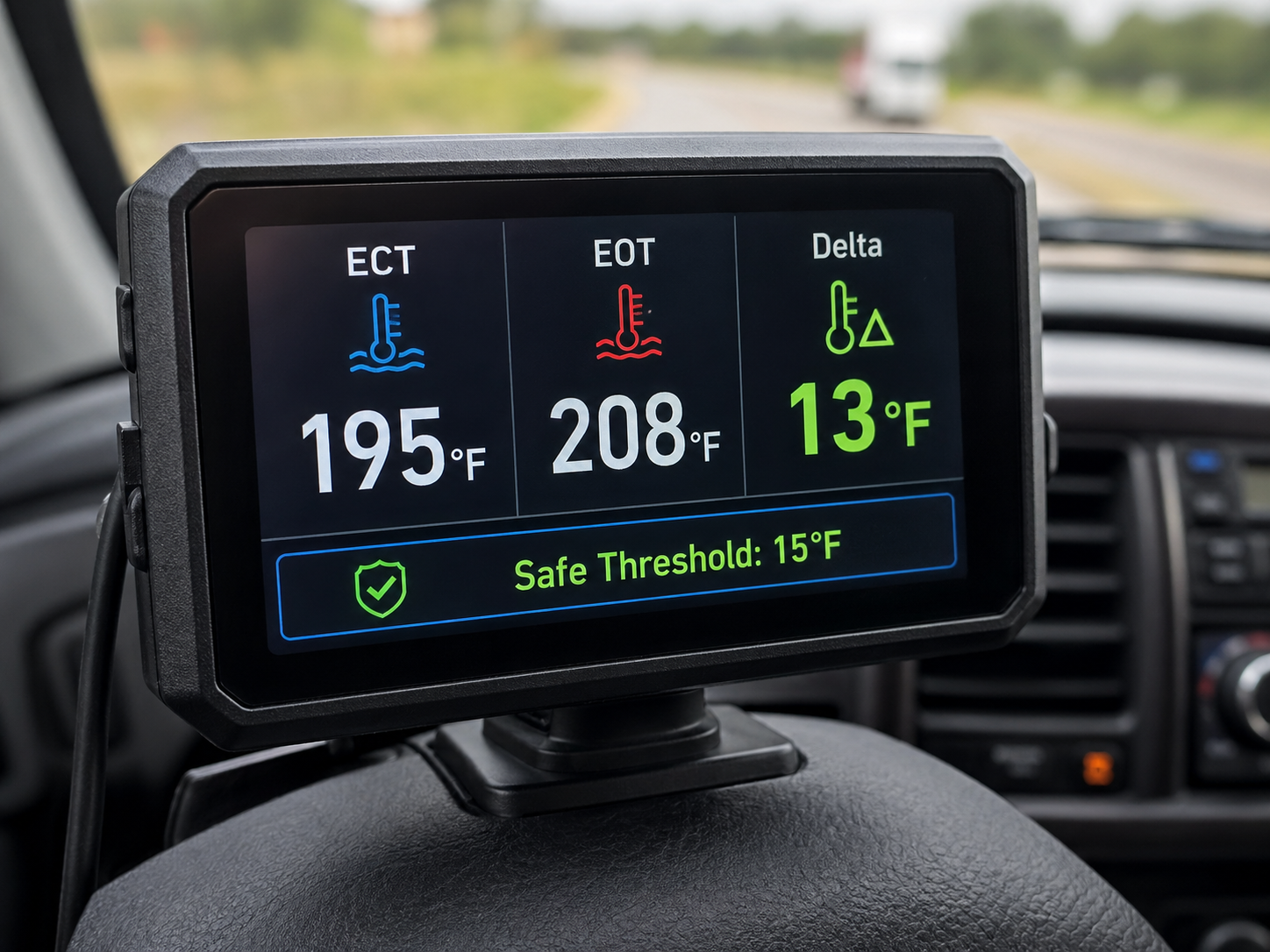
Many 6.4 Powerstroke owners install digital monitors to track critical parameters in real-time. One of the most vital data sets is the relationship between:
- ECT: Engine Coolant Temperature.
- EOT: Engine Oil Temperature.
If the delta (difference) between the EOT and ECT remains consistently large, it may indicate declining oil cooler efficiency or a risk of blockage within the cooling system.
In daily use, owners should observe these temperature trends rather than waiting for a dashboard warning light. For an engine with high thermal management stress like the 6.4L, early detection of a trend is more important than post-failure repair.
Option 5: Enhanced Oil and Fuel Filtration
The 6.4L Powerstroke utilizes a high-precision fuel system that demands superior fuel quality and oil condition.
Recommendations:
- Change engine oil on schedule using high-specification diesel oil.
- Replace fuel filters regularly.
- Avoid long-term use of low-quality fuel.
- Use high-quality diesel additives when necessary.
- For high-load or high-mileage trucks, consider a bypass oil filtration system.
Cleaner oil and fuel help protect the fuel injectors, high-pressure fuel system, turbocharger bearings, and internal engine components.
Generational Evolution: 6.0L vs. 6.4L vs. 6.7L Powerstroke Comparison
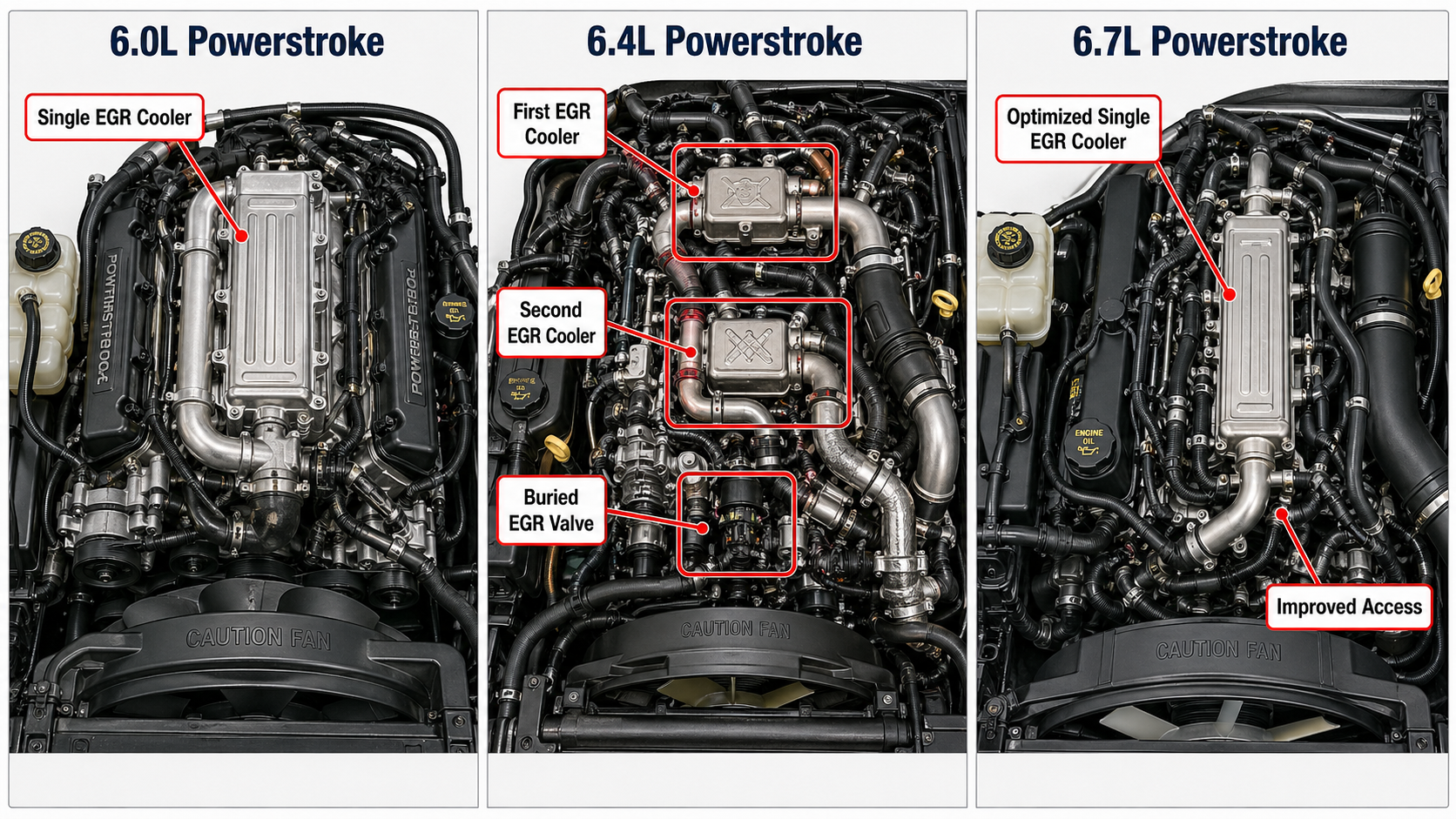
Comparing the 6.4L to other members of the Powerstroke family reveals its unique design characteristics. You will find that the dual EGR cooler structure is a specific "engineering trap" in the history of the Ford family.
| Project | 6.0L Powerstroke | 6.4L Powerstroke | 6.7L Powerstroke |
|---|---|---|---|
| EGR Cooler Count | 1 | 2 (Series Layout) | 1 |
| Structural Complexity | Moderate | Very High | Relatively more optimized |
| Valve Location | Top of intake manifold; relatively easy to access | Near cooler outlet; extremely difficult to access | Near the intake elbow; better serviceability |
| Common Pain Points | Cooler clogging and internal leaks | Dual cooler leaks, white smoke, overheating, extreme repair difficulty | EGR carbon buildup and valve sticking |
| Maintenance Difficulty | Moderate | High; some repairs require massive labor hours | Relatively Low |
| Owner Focus | Health status of the single cooler | Risks associated with the entire dual EGR system | Carbon soot and sensor status |
6.4 Powerstroke Reliability Upgrade Checklist
If your goal is to make your 6.4 Powerstroke stable and suitable for the long haul, follow this priority-based inspection and upgrade checklist.
1. Inspect for "Invisible" EGR System Leaks
- Symptom Monitoring: Watch for white smoke from the exhaust, dropping coolant levels in the degas bottle, or abnormal cooling system pressure.
- Professional Tip: Do not rely solely on seeing puddles on the ground; the dual EGR cooler structure often leaks internally, where coolant is vaporized directly in the intake manifold.
2. Monitor Temperature Deltas to Assess Oil Cooler Health
- Key Indicator: Use a digital monitor to track the difference between Engine Oil Temperature (EOT) and Engine Coolant Temperature (ECT).
- Warning Sign: If the delta consistently exceeds 15°F, or spikes significantly during towing, your oil cooler is losing efficiency, which is often a precursor to major engine failure.
3. The "Six-Point" Cooling System Inspection
Coolant purity is vital for the 6.4L's precision passages. Perform these checks quarterly:
- Color and Level: Check for cloudy coolant or unexplained drops in the degas bottle.
- Contamination: Inspect for oil in the coolant, rust, or sediment.
- Physical Connections: Verify that hoses are not aged or cracked and that the pressure cap is sealing correctly.
4. Monitor the 6 Critical Data Points
For the 6.4L, a digital monitoring tool (like the Edge Insight) is an essential early-warning system rather than a luxury. Track these in real-time:
- ECT/EOT: For thermal balance.
- EGT: To prevent overheating the exhaust side.
- Boost: To monitor turbo performance.
- Fuel Pressure and Battery Voltage: To ensure the precision electronics and injectors remain stable.
5. High-Frequency Fuel System Maintenance
- Injector Protection: The 6.4L Piezo injectors are extremely sensitive to debris and water.
- Maintenance Advice: Strictly follow fuel filter replacement intervals and only use high-quality fuel from reputable stations to prevent damage to the high-pressure fuel system.
Conclusion
The 6.4L Powerstroke has immense potential, but its longevity depends entirely on how you manage its "nightmare" factory components. By choosing the right optimization strategy—whether through compliant upgrades or structural simplification—you can transform this engine from a potential "problem source" into a high-performance, reliable beast.