



 Contents
Contents
- Before Choosing a Kit: Is Your 6.4 Worth the Project?
- Which 6.4 Powerstroke Delete Setup Fits Your Situation?
- If Your Problem Started With the DPF, Don't Skip the Diagnosis
- Scenario 1: You Only Need to Address the DPF/Exhaust Section
- Scenario 2: The Existing Exhaust Also Needs Replacement
- Scenario 3: You Want the Main Components in One Package
- Scenario 4: The DPF Side Is Already Addressed and You're Comparing EGR Hardware
- A Delete Kit Does Not Fix Every 6.4 Powerstroke Reliability Problem
- What Should You Compare Before Buying?
- Does 4-Inch vs. 5-Inch Exhaust Matter?
- How Much Installation Time Should You Actually Plan For?
- How Much Should You Budget for a 6.4 Powerstroke Delete Project?
- Seller Support Can Change the Real Cost of the Kit
- So, What Is the Best Delete Kit for a 6.4 Powerstroke?
- FAQs
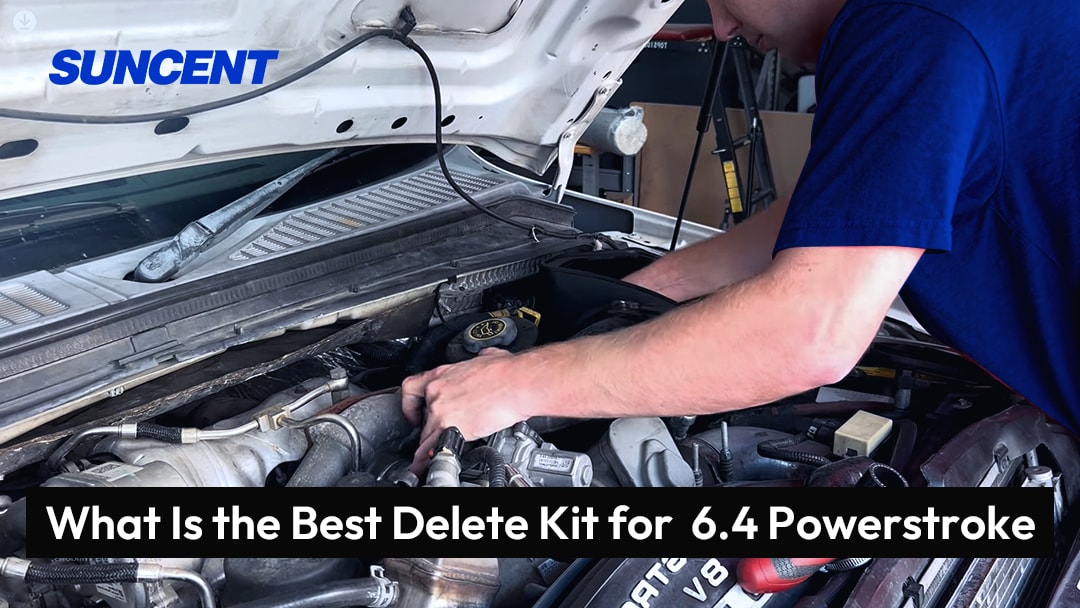
If you're searching for the best delete kit for 6.4 Powerstroke, don't start with pipe diameter or the biggest package on the page. Start with two questions: what problem are you trying to address, and how much of the truck do you actually need to change?
A DPF/CAT race pipe, a downpipe-back exhaust, an EGR kit, and a complete package solve different parts of the project. They also differ in cost, installation time, required supporting components, and fitment checks.
This guide is designed for 2008–2010 Ford 6.4L Powerstroke owners who are already comparing options and want to narrow down the right setup before spending money on parts they may not need.
Before Choosing a Kit: Is Your 6.4 Worth the Project?
This is especially important if you recently bought the truck or are dealing with a higher-mileage 6.4L. The first buying decision is sometimes not “Which kit should I buy?” but “Is the truck healthy enough to justify the investment?”
Before setting a modification budget, check the truck's current condition and maintenance history. Existing cooling, fuel, turbo, valvetrain, piston, or other mechanical problems will not disappear simply because DPF or EGR hardware is changed.
- Coolant loss or overheating
- Hard starting, misfires, or abnormal smoke
- Fuel in the oil or unexplained oil-level changes
- Turbo, exhaust-leak, or abnormal engine noises
- Active diagnostic trouble codes that have not been diagnosed
- An unknown tune or previous emissions/exhaust modifications
If you're still determining whether the issue is emissions-related or mechanical, start with our guide to common 6.4 Powerstroke problems before buying additional hardware.
Which 6.4 Powerstroke Delete Setup Fits Your Situation?
For buying purposes, think in terms of project scope rather than trying to decide which product is universally “best.”
| Your Situation | Option to Compare | Typical Starting Budget* | Time to Plan For* |
| Your project is mainly focused on the DPF/exhaust section | DPF delete kit (race/ CAT pipe or downpipe-back exhaust) | About $870–$1,450 for exhaust hardware + compatible tuning when starting from stock | Simple exhaust-side work: about 1–4 hours |
| The exhaust side has already been addressed and your project is EGR-specific | EGR delete kit | About $735–$1,200 for EGR hardware + compatible tuning when starting from stock | EGR-side work can add about 2–6 hours |
| You already know the project needs exhaust + EGR + supporting tuning components | Complete diesel-delete kit | Roughly $955–$1,650 in DIY parts + tuning for a typical 2008–2010 6.4L configuration | A complete project commonly needs about 4–10 hours |
*These are planning ranges rather than guaranteed prices or labor times. Package contents, existing tuning, corrosion, broken hardware, previous modifications, tools, and professional labor can move the final number substantially.
If Your Problem Started With the DPF, Don't Skip the Diagnosis
Repeated regeneration, a restriction warning, or a DPF-related fault does not automatically mean replacing emissions hardware is the only available path. The condition of the filter matters.
If the DPF is still serviceable, cleaning or professional service may cost less and preserve the factory emissions system. Compare those paths first in our DPF cleaner vs. professional cleaning vs. delete kit comparison .
💡 Don't Confuse a DPF Race Pipe With a Turbo-Back Exhaust
This distinction is easy to miss when comparing product names. A DPF/CAT race pipe replaces a relatively short DOC/DPF section, while a downpipe-back system replaces a much larger section of the exhaust.
That difference changes the number of parts you receive, installation time, shipping size, total price, and how much of the original exhaust remains on the truck. Two products appearing for the same “6.4 Powerstroke delete kit” search can therefore represent very different projects.
Scenario 1: You Only Need to Address the DPF/Exhaust Section
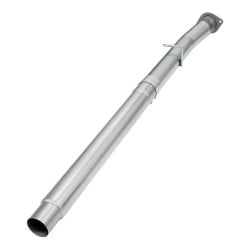
If the rest of the factory exhaust is still in usable condition and your project is limited to the DOC/DPF section, a race pipe is the smallest hardware change of the main options.
The practical advantage is not a dramatic horsepower claim. It is simpler: less hardware, lower upfront cost, and less installation time than replacing a larger section of the exhaust.
- The remaining exhaust is still worth keeping.
- You do not need a full exhaust replacement.
- Lower parts cost and shorter downtime matter.
- You have already confirmed the required supporting tuning/calibration.
Scenario 2: The Existing Exhaust Also Needs Replacement
A downpipe-back system makes more sense when you already plan to replace a larger section of the exhaust rather than simply installing a short replacement pipe.
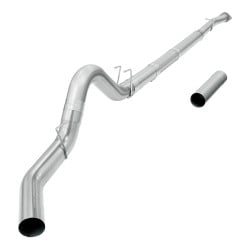
This is often a more logical choice when the existing exhaust is rusty, damaged, previously modified, or when a different full-exhaust configuration is already part of the project.
Scenario 3: You Want the Main Components in One Package
A complete package becomes relevant once you have already decided that the project involves several systems. Its biggest buying advantage is convenience: you do not have to source the exhaust hardware, EGR-side components, and available tuning options one by one.
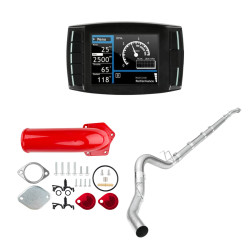
Before choosing a complete diesel delete kit , compare the configured package rather than the lowest advertised starting price.
- Which exhaust configuration is actually included?
- Which EGR components are included?
- Is a tuner included, optional, or sold separately?
- Are tune files included or purchased separately?
- Does the package match your exact 2008, 2009, or 2010 truck configuration?
- Are clamps, gaskets, and required supporting hardware included?
If you've already decided on a complete package and now want to compare package contents, tuner options, and year-specific fitment, continue to the 2008–2010 6.4 Powerstroke complete kit guide .
Scenario 4: The DPF Side Is Already Addressed and You're Comparing EGR Hardware
An EGR kit belongs in a different decision branch. It changes EGR-side hardware and should not be treated as another version of a DPF exhaust kit.

This option is most relevant when the exhaust/DPF side has already been dealt with and you are specifically evaluating EGR-side components.
If the DPF is still installed, do not assume changing the EGR side makes the DPF question disappear. The two systems interact with the engine differently. Read whether you can delete EGR without deleting the DPF before treating this as a stand-alone purchase.
A Delete Kit Does Not Fix Every 6.4 Powerstroke Reliability Problem
This matters because many 6.4 owners are not really shopping for more power. They are trying to make an expensive older truck easier to keep on the road.
Emissions-system changes do not repair an existing piston, valvetrain, cooling, fuel-system, turbo, head-gasket, or lubrication problem. If reliability is the real goal, evaluate the truck as a complete system rather than treating one modification as a complete reliability plan.
For a more complete maintenance and reliability path, see how to make a 6.4 Powerstroke more reliable .
What Should You Compare Before Buying?
The original product price is only one part of the decision. For a 6.4 Powerstroke, these factors usually matter more than choosing the biggest pipe.
Confirm model year, 6.4L engine, chassis/body configuration, and exhaust layout. Do not assume every product labeled “2008–2010 6.4 Powerstroke” contains the same parts.
Compare the actual parts list. A lower starting price can become more expensive once a tuner, tune file, EGR hardware, clamps, fluids, or other pieces are added.
The vehicle's control strategy and the physical hardware need to match. If you're unsure why that matters, read what happens when EGR/DPF hardware and ECU tuning do not match .
A short exhaust-side project and a full exhaust/EGR/tuning job can differ by most of a working day. That affects DIY difficulty, shop labor, and vehicle downtime.
Budget for the configuration you actually need—not the cheapest product shown before tuner, labor, fluids, hardware, tax, or unexpected repairs are added.
Fitment help, installation documentation, shipping visibility, return conditions, and technical support matter much more when several components must work together.
Does 4-Inch vs. 5-Inch Exhaust Matter?
Yes, but it is a second-stage decision. First decide whether your project actually calls for a race pipe or a larger downpipe-back exhaust. After that, pipe diameter can be compared based on packaging, price, sound preference, and the rest of the build.
Do not choose a 5-inch system simply because it is bigger. If you have already narrowed the project down to the DPF/exhaust side, see our 6.4 Powerstroke DPF delete kit guide for the detailed race-pipe vs. downpipe-back, 4-inch vs. 5-inch, material, and DPF-specific fitment comparison.
How Much Should Exhaust Material Affect Your Choice?
Material mainly affects corrosion resistance, expected service life, and price. Aluminized steel is generally the budget option, 409 stainless is a common value-oriented exhaust material, and 304 stainless is the premium option when corrosion resistance is a higher priority.
But material should be a tie-breaker after fitment, package scope, installation requirements, and total cost—not the reason you choose the wrong type of kit.
How Much Installation Time Should You Actually Plan For?
Installation time is a real buying factor because it changes labor cost and downtime. For budgeting purposes, a simple exhaust section may take roughly 1–4 hours. EGR-side hardware can add roughly 2–6 hours, while a full exhaust, EGR, and tuning project commonly falls around 4–10 hours.
Those ranges can grow quickly on a 2008–2010 truck. Rusted bolts, seized clamps, previous exhaust work, broken hardware, limited lift access, or additional diagnostics can turn a planned half-day job into a full-day project.
SuncentAuto provides separate 2008–2010 6.4 Powerstroke installation guides for the race pipe, downpipe-back exhaust, and EGR-side hardware.
How Much Should You Budget for a 6.4 Powerstroke Delete Project?
For a 2008–2010 6.4L Powerstroke, a useful starting budget is more specific than simply saying “a full kit costs more.”
If you are paying a shop rather than doing the work yourself, current budgeting data for older 6.0/6.4 Powerstroke projects puts lower-cost installed totals roughly around $900–$2,600, while a typical specialist project may fall closer to $1,200–$3,000.
These are planning ranges, not quotes. Broken bolts, rust repair, diagnostic time, tune-file support, additional hardware, tax, and other work can push the final number higher. See the full diesel delete cost guide for the detailed breakdown.
Seller Support Can Change the Real Cost of the Kit
The cheapest package is not always the cheapest project. A wrong fitment, missing parcel, incomplete parts list, or incompatible tuner can create downtime and additional labor costs that are much larger than the original price difference.
Complete 6.4 Powerstroke packages may ship in multiple parcels, so do not take the truck apart until every package has arrived and every component has been checked.
This matters even more because SuncentAuto's 45-day return policy requires eligible returned products to remain unused and in original condition. Products that have been used or fully/partially installed are generally non-returnable.
If the installation date matters, check the current shipping and delivery information before scheduling shop time. Exhaust and multi-component orders can involve several packages or warehouse locations.
Before checkout, you can also review SuncentAuto's payment methods and payment-security information . Product-specific tuner return terms may differ from the general parts return policy, so check the selected package before ordering.
So, What Is the Best Delete Kit for a 6.4 Powerstroke?
There is no single configuration that is automatically best for every 6.4L truck. The right choice depends on the condition of the truck and the scope of the project.
Once you know which path applies, compare your options in this order: truck condition → fitment → package contents → tuner compatibility → installation workload → total project cost → material/pipe details → seller support.
If you've completed those checks and are ready to compare Ford-specific product options, browse SuncentAuto's Powerstroke diesel delete kits .





Comments