 Contents
Contents
- What Does It Mean to Delete a Truck?
- Is It Legal to Delete a Diesel Truck Now? Recent Changes in 2026
- Legal Status and Real-World Enforcement Are Not the Same
- Can You Legally Delete a Diesel Truck Now?
- Why Legal and Financial Risks Still Matter?
- Is Every Type of Delete Equally Risky?
- Will Deleting Diesels Ever Be Legal?
- National Compliance Risk Map Analysis: Which Color Zone Are You In?
- Practical Advice for Truck Owners and Industry Professionals
- Frequently Asked Questions
- Summing Up
Spend enough time around diesel shops, truck forums, or YouTube and you will eventually hear it: “Diesel deletes are legal now.”
That claim became much more common after federal enforcement policy changed in 2026. But it mixes together three different questions: what the law says, how the law is enforced, and what you are allowed to do when repairing your own truck.
It is still illegal under federal law to knowingly remove or permanently disable required emissions controls on a road-going diesel truck. That can include the DPF, EGR, SCR/DEF system, catalysts, and emissions-related software.
What varies much more is the real-world risk. A deleted truck may be easy to own in one area and become a major problem in another when inspection, registration, resale, or repair enters the picture.
What Does It Mean to Delete a Truck?
A diesel truck is commonly called “deleted” when one or more factory emissions systems have been removed, bypassed, or electronically disabled.
The diesel particulate filter is removed, gutted, or bypassed.
The EGR system is blocked, removed, or electronically switched off.
The DEF dosing and SCR emissions system is disabled or bypassed.
The ECU is changed so the truck can run without the original emissions setup.
Why Do People Delete Diesel Trucks?
Most owners start thinking about a delete after dealing with an emissions problem. Common complaints from diesel owners include:
- Repeated DPF regeneration problems
- Failed DEF, NOx, pressure, or temperature sensors
- Limp mode or engine derates
- Expensive emissions-system repairs
- Downtime on a work or tow vehicle
- Concerns about performance or fuel economy
The Purpose & Drawbacks of Emissions Systems
DPF, EGR, SCR, and related systems reduce soot and nitrogen oxide emissions. But they also add filters, sensors, pumps, valves, heaters, wiring, and software that can fail as a truck ages.
Is It Legal to Delete a Diesel Truck Now? Recent Changes in 2026
This is where most of today's confusion started.
Department of Justice Reduces Criminal Prosecutions
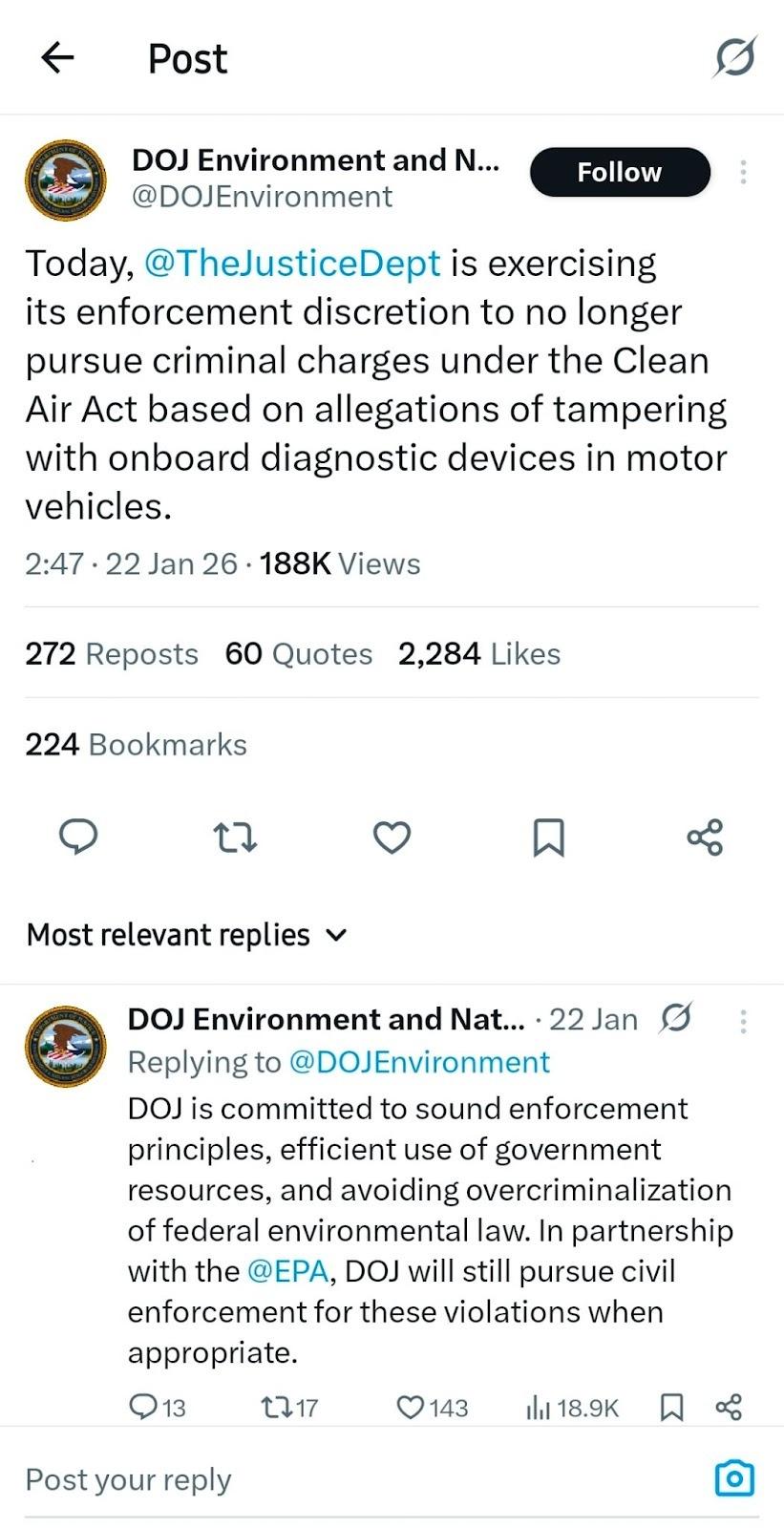
In January 2026, the U.S. Department of Justice changed its criminal enforcement approach for certain Clean Air Act cases involving tampering with vehicle onboard diagnostic systems.
That was a meaningful change in enforcement policy. It was not a repeal of the federal rules covering emissions tampering or defeat devices.
Civil Enforcement Still Exists
One of the easiest ways to see the difference between criminal and civil enforcement is to look at what EPA was still doing in 2026.
STM Tuning — Spokane, Washington
EPA Expedited Settlement Agreement
EPA's 2026 settlement documents say STM Tuning committed 11 Clean Air Act tampering violations. The listed vehicles had modifications including DPF, EGR, SCR/DEF, oxygen-sensor, and other emissions-related deletes.
The case involved diesel Volkswagen and BMW vehicles rather than pickup trucks, but the point is important for the broader diesel-delete debate: EPA was still using its civil Clean Air Act authority in 2026.
View the EPA settlement →Freedom to Fix Gave Owners Something Different
Later in 2026, the federal government moved strongly in favor of owners being able to diagnose and repair their own vehicles.
EPA's Freedom to Fix guidance says owners and independent shops should have access to emissions-related service information, training materials, OBD data, enhanced diagnostics, reprogramming information, and manufacturer-specific repair tools.
EPA also clarified that temporarily disabling an emissions control can be allowed when it is genuinely needed to complete a repair.
Official sources: EPA Freedom to Fix · June 29, 2026 Presidential Memorandum
DOJ enforcement, EPA repair guidance, DEF policy, civil enforcement, and aftermarket certification all changed the diesel emissions discussion in different ways.
Read the 2026 Diesel Delete Law Update →Legal Status and Real-World Enforcement Are Not the Same
A truck can violate federal emissions rules and still go years without being inspected. Another truck with the same modification can run into problems almost immediately.
No testing can mean lower inspection pressure. It does not create a federal exemption.
Federal enforcement has historically looked very different for an individual owner and a business selling thousands of products.
For many owners, the problem first becomes real in a much less dramatic way: inspection, registration renewal, resale, moving to another state, or returning the truck to stock.
Can You Legally Delete a Diesel Truck Now?
If your truck was certified for road use, permanently removing or disabling required emissions controls can violate Section 203 of the Clean Air Act.
That can include physical hardware changes as well as software that prevents the truck's OBD system from detecting that the original emissions equipment is no longer working.
Federal reference: 42 U.S.C. § 7522 — Prohibited Acts
Off-Road Declaration ≠ Automatic Protection
Putting “off-road use only” on a truck or product does not automatically make a delete legal.
Weekend racing does not automatically turn a normal road truck into an exempt competition vehicle.
A label does not change how the truck was originally EPA-certified or how it is actually used.
EPA has historically used enforcement discretion for some owners who permanently convert a vehicle solely for competition and never drive it on public roads. That is not a blanket racing exemption.
EPA reference: Tampering and Aftermarket Defeat Devices
Repair Is Different From a Permanent Delete
The easiest way to understand the difference is to look at what happens when the work is finished.
Why Legal and Financial Risks Still Matter?
Not everyone involved in a diesel delete has the same risk. What matters is what you do, how often you do it, and whether you are dealing with one truck or thousands of products.
Owner, Shop, Tuner, or Seller: The Risks Are Different
The most immediate problems are often inspection, registration, resale, warranty, diagnostics, or the cost of returning the truck to stock.
A shop can create exposure across many vehicles. Invoices, customer records, advertising, and repeat work can all document the activity.
A physical DPF removal is not the only issue. Tunes that change emissions monitoring or OBD behavior have appeared repeatedly in federal cases.
A business selling hundreds or thousands of products creates a much larger enforcement footprint than one owner with one pickup.
EPA Enforcement by the Numbers
EPA's FY2020–FY2023 national defeat-device initiative shows how large commercial enforcement became during that period. These numbers describe historical enforcement and are not a prediction of what every truck owner faces today.
Source: U.S. EPA — Stopping Aftermarket Defeat Devices
Real EPA Cases Put the Risk Into Perspective
Turn 14 Distribution
EPA says Turn 14 sold more than 140,000 tampering devices between 2016 and 2021, including products for diesel trucks from Ford, GM, and Stellantis.
Full Force Diesel Performance
EPA reported that Full Force Diesel sold at least:
- 406 exhaust-control delete hardware kits
- 337 EGR delete kits
- 21 throttle-valve delete kits
- 955 tuning products
A company selling 140,000 devices is obviously not in the same situation as someone driving one modified pickup.
That does not make the owner's truck legal. It means the problems owners commonly face are different: inspection, registration, resale, moving to another state, or paying to return the truck to stock.
What If You Bought a Truck That's Already Deleted?
This is common in the used-diesel market. You may buy a Power Stroke, Cummins, or Duramax and only later discover that the truck has been tuned, the DPF is missing, or other emissions equipment has already been changed.
- Find out exactly what was removed or disabled.
- Check both hardware and ECU software.
- Check the inspection rules where the truck is registered.
- Find out what parts and programming are needed to return it to stock.
- Keep purchase, diagnostic, and repair records.
A deleted truck that causes no problems today may become much more expensive when you sell it, trade it in, move to another state, or need to restore the original emissions system.
EPA reference: EPA Tampering FAQ
Is Every Type of Delete Equally Risky?
No. Different modifications leave different clues during an inspection or diagnostic check.
That does not mean one type is automatically legal or safe. It simply means some changes are easier to spot than others.
| Modification | What Changes | Where It May Be Noticed |
|---|---|---|
| DPF Delete | Major exhaust hardware, sensors, and calibration may change. | Visual inspection, OBD data, sensor readings, ECU calibration. |
| EGR Delete | Engine-side emissions hardware or flow is disabled. | Engine-bay inspection, diagnostics, ECU data. |
| DEF / SCR Delete | DEF dosing and NOx-control functions are disabled. | DEF diagnostics, NOx sensors, OBD data, ECU software. |
| Delete Tune | Software changes even when much of the hardware still looks stock. | OBD behavior and software or calibration checks. |
California is a useful example of why software matters. Its Bureau of Automotive Repair can identify non-approved modified software during Smog Check, and affected vehicles must be restored to an approved configuration before they pass.
Public reference: California BAR OBD Test Reference
For component-specific details, see our EGR delete legality guide and DPF delete guide.
Will Deleting Diesels Ever Be Legal?
Nobody can honestly give truck owners a date.
Enforcement policy can change quickly. The underlying legal framework is harder to change.
What Changes are Required to Make Diesel Deletes Legal?
A real nationwide change would need more than a new enforcement priority or a viral headline.
- Federal law or EPA regulations would need to change in a meaningful way.
- EPA would need to explain what previously prohibited modifications are now permitted.
- States could still keep their own emissions, inspection, or registration requirements.
Legal Reality vs. Political Narratives
This is why headlines such as “diesel deletes are legal again” should be treated carefully.
A government can change how aggressively it enforces a rule without making the underlying rule disappear. The 2026 DOJ change is a good example of that difference.
National Compliance Risk Map Analysis: Which Color Zone Are You In?
Federal emissions law provides the baseline, but the day-to-day experience of owning a modified truck can be very different across the country.
SuncentAuto's map compares practical factors such as inspection programs, OBD and visual checks, registration requirements, regional enforcement, and real-world owner and shop observations.
toLax(blue)titledRegulationStrictness-69dde19bd7e1d.png)
Based on SuncentAuto research into public regulations, inspection programs, OBD and visual inspection practices, registration requirements, and field observations.
Strict: California (CA), Maine (ME)
For road-driven deleted trucks, these are close to a “No-Go Zone.” Emissions modifications are much more likely to become an inspection or registration problem.
- Visual inspection can reveal missing or altered emissions hardware.
- OBD checks can expose monitor, code, sensor, or software problems.
- Failed emissions compliance can prevent normal registration renewal.
California is the clearest public example. Its Smog Check program can include visual, functional, and OBD checks, and non-approved modified software can cause a vehicle to fail.
Public reference: California Bureau of Automotive Repair
Moderately Strict: New York (NY), Colorado (CO), New Jersey (NJ)
These states can create recurring headaches for modified trucks through inspections, emissions diagnostics, registration requirements, or aftermarket-parts rules.
For many owners, the problem is not one dramatic enforcement event. It is having to deal with the truck again every time inspection or registration comes due.
Moderate: Texas (TX), Pennsylvania (PA), Georgia (GA)
These states show much more regional variation. Inspection exposure can depend on the county, metro area, vehicle class, and registration situation.
Two owners in the same state can therefore have very different experiences with similar trucks.
Lower Inspection Friction: Florida (FL), Michigan (MI), Montana (MT)
Diesel owners sometimes call these areas “safe havens” because day-to-day inspection pressure can be much lower.
In this map, “safe haven” means lower practical inspection friction—not a federal legal exemption.
A truck that causes little trouble locally may still become difficult to sell, move to another state, or return to stock later.
“Can I drive it without getting checked?” and “Is the modification legal?” are not the same question. Your location can change the first answer much more than the second.
Practical Advice for Truck Owners and Industry Professionals
Bottom-Line Advice for Owners
Before spending money on a delete, answer a few practical questions first.
What is actually failing?
A bad NOx sensor, pressure sensor, injector, thermostat, EGR component, or other fault can sometimes make the entire emissions system look worse than it is.
Can the DPF be cleaned or repaired?
A loaded but usable DPF is a different problem from a physically damaged one.
Will you ever sell or move the truck?
A modification that causes little trouble today can become expensive after a move, trade-in, inspection, or sale.
What does your local inspection actually check?
Do not stop at “my state doesn't test diesels.” Check the rules for your county, vehicle class, OBD system, and registration.
Is there a compliant repair or aftermarket option?
You may be able to solve the original problem without creating the same inspection, resale, and restoration issues later.
Practical Tips for Industry Professionals
- Do not assume a customer's “off-road only” statement automatically settles the compliance question.
- Separate legitimate emissions repair from permanent emissions defeat.
- Keep clear records of repairs, calibration work, and the final vehicle configuration.
- Use current EPA and state guidance instead of relying on old forum advice.
Safe and Compliant Alternatives
The choice is not always “leave the truck broken” or “delete everything.”
- Diagnose failed DEF, NOx, pressure, and temperature sensors.
- Find the cause of unusually frequent DPF regeneration.
- Clean a serviceable DPF when appropriate.
- Repair injector, turbo, intake, or EGR problems that create excess soot.
- Use emissions-compliant replacement or aftermarket parts where available.
- Restore approved ECU software when software changes are creating compliance problems.
Aftermarket Does Not Automatically Mean Non-Compliant
EPA took an important step in July 2026 by recognizing SEMA's Certified Emissions (SC-E) Program as an alternative way for aftermarket manufacturers to demonstrate Clean Air Act compliance.
That matters because truck owners now have another pathway for identifying aftermarket parts that have gone through emissions-compliance testing. It also shows an important distinction: the federal government is creating more room for compliant aftermarket products—not simply banning all vehicle modification.
EPA reference: EPA Recognition of SEMA Certified Emissions
If DPF clogging is your main problem, compare the options in our DPF cleaner vs. professional cleaning vs. delete guide .
SuncentAuto covers Power Stroke, Cummins, Duramax, diesel emissions systems, exhaust, tuning, repair, and aftermarket parts. Before changing an emissions-related system, confirm the truck's configuration, intended use, and the rules that apply where it will actually be driven.
Frequently Asked Questions
Is it still illegal to delete a diesel truck?
Yes. Federal anti-tampering rules still cover required emissions equipment. Changes in enforcement policy do not automatically repeal those rules.
Can I legally delete my diesel truck now?
Not simply because federal enforcement priorities changed in 2026. Permanently removing or disabling required emissions controls can still violate federal law.
Is a diesel delete legal if my state has no emissions testing?
No emissions test can mean lower day-to-day inspection risk, but it does not automatically create an exemption from federal emissions law.
Is DEF delete legal?
Permanently disabling a required DEF/SCR system on a road-going truck can create the same federal anti-tampering problem as permanently disabling other required emissions controls. Repairing a failed DEF system is different from permanently deleting it.
Can I delete my diesel truck if I only use it off-road?
An “off-road only” label does not automatically create a federal exemption. EPA distinguishes true permanent competition-only use from ordinary street vehicles that are occasionally used off-road or raced.
What if I bought a truck that was already deleted?
Start by finding out exactly what hardware and software were changed. Then check your inspection requirements and what it would cost to return the truck to a compliant configuration.
Does Freedom to Fix make diesel deletes legal?
No. Freedom to Fix improves access to diagnostics, tools, service information, software, and legitimate emissions repairs. It does not make a permanent emissions delete the same thing as a repair.
Summing Up
So, is it legal to delete a diesel truck? For a road-going truck, permanently removing or disabling required emissions controls can still violate federal law.
But the real-world risk is not identical everywhere or for everyone. A truck owner in a low-inspection area, a shop deleting dozens of trucks, and a distributor selling thousands of products are three very different situations.
The most owner-friendly development in 2026 is something different: better access to repair, diagnostics, independent shops, and compliant aftermarket parts.
Before modifying your truck, ask the question that usually matters most in the long run: What happens when I eventually need to inspect, register, repair, move, trade in, or sell this truck?