 Contents
Contents
- What Is a Downpipe?
- What Is a Straight Pipe?
- Downpipe vs Straight Pipe: Key Differences
- Downpipe vs Straight Pipe: Performance Differences
- Downpipe vs Straight Pipe Sound: Which Is Louder?
- Legality, Emissions, and Daily Driving
- Cost and Installation Differences
- Downpipe or Straight Pipe: Which Should You Choose?
- Final Thoughts
- Related Exhaust Parts: Downpipe, Headers, Front Pipe, Mid Pipe, and Rear Section
In the world of exhaust modifications, downpipe vs straight pipe is a very common topic. Many car owners want to understand the differences between these two setups and figure out which one is better suited for their vehicle.
Strictly speaking, they are not the same type of modification. A downpipe is a specific component within the exhaust system, while a straight pipe is more of an overall exhaust setup, typically aimed at removing as many restrictions as possible so exhaust gases can flow out freely.
This article will break down Straight Pipe vs Downpipe in detail: what they are, how they affect performance and sound, legality, daily drivability, cost, installation difficulty, and finally help you decide which one to choose.

What Is a Downpipe?
A downpipe is the section of piping that connects the turbo outlet to the rest of the exhaust system. Because of its position near the front of the exhaust system, the downpipe has a direct impact on exhaust efficiency.
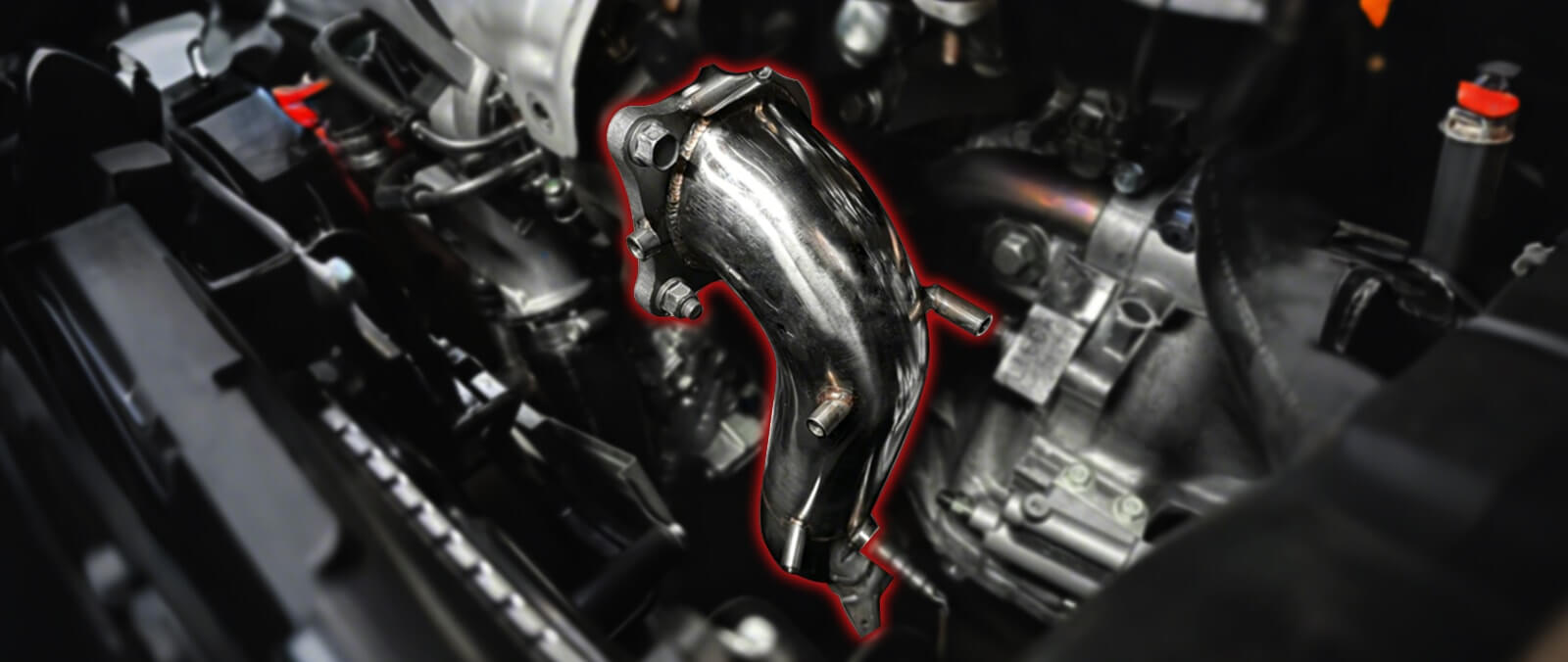
Stock downpipes are typically narrow in diameter, include dense catalytic converters, and often have crushed bends — all designed with emissions in mind. However, these factors also create higher exhaust backpressure. The purpose of upgrading to a performance downpipe is to eliminate these restrictions.
Common Types of Downpipes
Catted downpipe (high-flow catalytic): Retains a catalytic converter, more emissions-friendly, suitable for daily driving.
Catless downpipe: Removes the catalytic converter entirely. Offers maximum flow and the most aggressive sound, but is typically limited to track or off-road use.
See also: Catted Downpipe vs Catless Downpipe
Pros & Cons of a Downpipe
Pros
- Reduces exhaust backpressure, allowing gases to exit faster.
- Helps the turbo spool faster.
- Improves throttle response.
- Produces a deeper, more aggressive exhaust note.
- Catted versions can retain emissions compliance.
- Can add 10–30+ wheel horsepower when paired with ECU tuning.
Cons
- Catless versions may cause emissions and legal issues.
- Some vehicles may trigger check engine lights.
- High-flow catted versions can be expensive.
What Is a Straight Pipe?
A straight pipe is not a single part, but a type of exhaust setup. When someone says their car is "straight piped," it usually means the exhaust system has had components like the muffler, resonator, and often the catalytic converter removed — leaving a nearly straight path from the engine (or turbo outlet) to the exhaust tip.
The goal is not precise optimization of one section, but rather to open up the entire exhaust system as much as possible.
Pros & Cons of a Straight Pipe
Pros
- Maximum, raw exhaust sound.
- Eliminates most exhaust restrictions.
- Popular for show cars or track-focused builds.
- Can improve flow — though in modern turbo cars, the main restriction is usually the downpipe, not the mid or rear sections.
Cons
- Often exceeds legal noise limits.
- Without a catalytic converter, it cannot be street legal.
- Modern cars will almost always trigger a check engine light.
Downpipe vs Straight Pipe: Key Differences
The core difference is simple: A downpipe is a component, while a straight pipe is a setup.
A downpipe replaces only the section between the turbo and the mid-pipe — a targeted performance upgrade.
A straight pipe, on the other hand, removes restrictions throughout the entire exhaust system.
Quick Comparison Table
| Category | Downpipe | Straight Pipe |
| Nature | Exhaust component after the turbo | Low-restriction exhaust setup |
| Main Goal | Improve exhaust efficiency and response | Maximum sound and flow |
| Application | Mainly turbocharged vehicles | Various modified vehicles |
| Sound Change | Louder, depends on full setup | Usually louder and more direct |
| Daily Use | Generally more practical | Generally less practical |
| Emissions Legality | Catted may be compliant; catless is not | Almost always illegal (no catalytic converter) |
| Installation | Bolt-on (moderate difficulty) | Cutting/welding (irreversible) |
Downpipe vs Straight Pipe: Performance Differences
If performance is your goal, a downpipe is usually the better choice on turbocharged vehicles.
The reason is simple: it works at a more critical point. Since the downpipe sits directly after the turbo, improving flow here has a more noticeable effect on exhaust efficiency and turbo performance.
A straight pipe does reduce restriction, but it mainly opens up the entire system rather than optimizing the most critical section.
See also: How Much Horsepower Does a Downpipe Add
Downpipe vs Straight Pipe Sound: Which Is Louder?
A straight pipe is usually louder.
That’s because it removes multiple sound-dampening components across the system, not just one section. The result is a more direct, aggressive sound with a higher chance of drone. A catless downpipe combined with a full straight pipe system ( straight through from turbo back) is the loudest setup possible.
A downpipe will also change the sound, but in a more controlled way. A catless downpipe paired with a free-flowing exhaust can still be very loud, but generally not as extreme as a full straight pipe.
Conclusion: Straight pipe setups — especially full turbo-back straight pipes — are the loudest. A good downpipe alone can still deliver a great sound without excessive drone.
Legality, Emissions, and Daily Driving
This is where most people make their final decision.
Downpipe
High-flow catted downpipe
Still retains a catalytic converter. Emissions legality depends on local regulations. Sound remains moderate and suitable for daily driving.
Catless downpipe
Illegal under EPA regulations in the U.S. Not street legal. Will trigger a check engine light without tuning.
Straight Pipe
Almost always illegal for street use because it removes catalytic converters. The noise level is also very high, which can lead to complaints or traffic stops.
Cost and Installation Differences
At first glance, straight pipe setups may seem simpler and cheaper, since they involve removing restrictive components and replacing them with straight tubing.
However, in reality, costs can add up due to custom fabrication, welding, sensor adjustments, and dealing with noise or fitment issues.
A downpipe is a more defined upgrade. High-quality options may not be cheap, but they serve a clear purpose and are easier to integrate into a performance build.
Installation-wise, downpipes can be tricky due to tight engine bay space on many turbo cars. Straight pipe setups may involve more extensive modification depending on how much of the system is changed.
So there is no universal answer — it depends on your vehicle and how far you plan to go.
Downpipe or Straight Pipe: Which Should You Choose?
Ask yourself the following:
Do you need to pass emissions testing?
→ Choose a catted downpipe. Straight pipes or catless downpipes will fail.
Is this your daily driver?
→ Choose a catted downpipe. Straight pipes are too loud and impractical.
Is your car naturally aspirated?
→ Downpipes don’t apply. Straight pipe is an option, but may reduce low-end torque. Consider mid/rear exhaust upgrades instead.
Do you want maximum sound for a track build?
→ Go with a catless downpipe + full straight pipe. But remember, this is not street legal.
Final Thoughts
Both downpipes and straight pipes change how an exhaust system behaves, but they solve different problems.
If you drive a turbo car and want real performance gains, a quality downpipe is the better upgrade.
If your goal is maximum sound for track or off-road use, a straight pipe setup may suit you — but with clear trade-offs.
For most drivers, the answer is simple:
Upgrade the downpipe first, then decide how far you want to go with the rest of the exhaust.
Ready to upgrade your downpipe? Browse our full range of downpipes and straight-through options to suit your specific vehicle model. Free shipping within the US + 45-day no-questions-asked returns. Even better, we're offering our readers an exclusive 12% discount coupon!
Related Exhaust Parts: Downpipe, Headers, Front Pipe, Mid Pipe, and Rear Section
From front to back, a typical exhaust system can be understood as:
👉 Engine → (NA: Headers / Turbo: Turbo) → Downpipe → Front Pipe → Mid Pipe → Rear Section (Cat-back) → Exhaust Tip
Headers
Headers are typically found on naturally aspirated vehicles. They collect exhaust gases from each cylinder and direct them into the rest of the exhaust system.
Downpipe
Used on turbocharged vehicles, the downpipe connects the turbo outlet to the rest of the exhaust.
Naturally aspirated cars focus on headers; turbo cars focus on downpipes.
Front Pipe
Located after the downpipe, it continues routing exhaust toward the mid section. In some vehicles, it may be combined with the downpipe.
Mid Pipe
The middle section of the exhaust system, often containing a resonator. It plays a major role in shaping sound and controlling drone.
Rear Section/Exhaust Tip
The rear section includes the muffler and is responsible for final sound output and comfort.
The exhaust tip is the visible end — mostly cosmetic.