 Contents
Contents
- B20 Engine: A Model or a Fuel?
- Can My Diesel Truck Really Run B20?
- Will Using B20 Affect Maintenance, Emissions Systems, and Servicing?
- Cold Weather Gelling: Why B20 Can Leave Your Truck Stranded in Winter
- Which Diesel Trucks Are Better Suited for Long-Term B20 Use?
- If Your Truck Already Has Emissions Problems, Stay Away from B20
- Practical Guide: What Is the Safest Way to Try B20 for the First Time?
- Suncent’s Deep Take: From “Temporary Experiment” to “Permanent Immunity”
- Conclusion
- FAQs
B20 Engine: A Model or a Fuel?
Many diesel owners have the same initial misunderstanding when they first come across the term “B20”: is a “B20 engine” some kind of specific engine model? In reality, B20 is a fuel, not a piece of hardware.
More specifically, B20 refers to a blended diesel fuel made from 20% biodiesel and 80% petroleum diesel. So when people search for a “B20 engine”, what they usually mean is: “Can my diesel engine safely run on B20 fuel?”
B20 vs. ULSD: Understanding the Difference
Many people also confuse B20 with ULSD, but the two actually describe completely different dimensions of diesel fuel.
- ULSD (Ultra-Low Sulfur Diesel) = the industry standard: This is the standard diesel fuel currently sold across North America. Its defining metric is sulfur content ( ≤15 ppm), and its purpose is to protect modern emissions systems such as DPF and SCR.
- B20 = the blend ratio: This describes the composition of the fuel itself. B20 = 20% Biodiesel + 80% traditional petroleum diesel (ULSD).
These two are not opposites. In the real world, the B20 you pump is typically based on ULSD, with roughly 20% bio-content blended into it. Compared with straight ULSD, B20 offers better lubricity and higher oxygen content, but the tradeoff is slightly lower energy density and greater sensitivity in cold weather.
Can My Diesel Truck Really Run B20?
Many truck owners hesitate when they see a pump labeled “B20” (meaning it contains 20% bio-content). It may be a few cents cheaper than regular diesel, but is it actually safe for your 6.7L Cummins, Powerstroke, or Duramax?
Modern Models: B20 Compatibility Table (2011–2026)
Most high-pressure common-rail diesel engines built after 2011 were designed with B20 compatibility in mind. Manufacturers addressed biodiesel’s solvent-related issues by upgrading to corrosion-resistant Viton seals, while also strengthening cylinder heads and valve seats.
| Vehicle Series | Engine Platform | Supports B20 | Official Recommendation |
|---|---|---|---|
| RAM 2500 / 3500 | 6.7L Cummins | Yes | Allowed, but oil change intervals must be shortened. |
| Ford F-250 / F-350 | 6.7L Powerstroke | Yes | Supports B20; check for a B20 label on the door or fuel cap. |
| GM Silverado / Sierra | 6.6L Duramax | Yes | Supports B20; fuel filter life must be monitored closely. |
For example, the L5P Duramax uses Downstream Injection (often called the 9th injector). During regeneration, fuel is sprayed directly into the exhaust stream rather than into the cylinders. That dramatically reduces the risk of B20-related Fuel Dilution in the engine oil. As long as you stay on top of filter changes, these trucks can handle B20 over the long term.
“Built-Tough” Older Workhorses: Natural Allies of B20 (1994–2004)
These older engines were designed before emissions systems became so complex. In many cases, B20’s excellent lubricity actually acts like a mechanical advantage, helping protect the fuel systems on these older trucks.
| Vehicle Series | Engine Platform | Risk Level | Core Advantage |
|---|---|---|---|
| Ford Super Duty | 7.3L Powerstroke | Extremely Low | No DPF regeneration, so there is no oil dilution risk at all. |
| Dodge Ram | 5.9L Cummins | Extremely Low | Its mechanical pump can tolerate almost any oil-based fuel. |
| GM Silverado | LB7 Duramax | Low | Improved lubricity benefits early common-rail systems. |
“High-Sensitivity” Transition Models: Keep Your Distance (2007.5–2010)
These trucks belong to the early transition era of emissions technology. The systems were not fully mature yet, and B20 can easily trigger very expensive repairs.
| Vehicle Series | Engine Platform | Risk Level | Core Weakness |
|---|---|---|---|
| Ford Super Duty | 6.4L Powerstroke | Extremely High | Aggressive post-injection causes oil level to rise rapidly and heavily dilutes the oil. |
| GM HD Trucks | LMM Duramax | High | The DPF logic struggles to deal with the special ash created by biodiesel. |
| Ford Super Duty | 6.0L Powerstroke | Medium-High | Its highly sensitive oiling and fuel system reacts badly to B20’s cleaning effect, making clogging much more likely. |
Because B20 has a very high boiling point (around 600°F), it cannot fully vaporize during post-injection. Instead, it runs down the cylinder walls and into the oil pan, which can quickly destroy the main bearings.
Key Tip: Before filling up with B20, always check your owner’s manual, fuel cap label, or official diesel supplement.
Will Using B20 Affect Maintenance, Emissions Systems, and Servicing?
For most diesel truck owners, the real concern is never just the definition of B20. The real questions are much more practical:
After switching to B20, will the fuel filter clog more easily? Will DPF regeneration happen more often? Will it affect engine oil, maintenance intervals, or even the long-term reliability of the truck itself?
B20 is not automatically a problem, but it absolutely changes what you need to pay attention to. That is exactly why many manufacturers permit B20, while also requiring owners to follow stricter fuel and maintenance practices.
The First Part to Take the Hit Is Usually the Fuel Filter
If a diesel truck has been running regular ULSD for years and then suddenly switches to B20, the first part that usually reacts is not the injector and not the high-pressure pump— it is the fuel filter.
That happens because biodiesel has a natural solvent and cleaning effect. It can loosen the old deposits, varnish, sludge, and residue that have built up inside the fuel tank, fuel lines, and the rest of the fuel system. All of that material has to go somewhere, and in many cases it ends up trapped by the fuel filter.
The result is simple: during the first few tanks of B20, the filter can be put under much heavier load. Some trucks may experience early filter restriction, reduced fuel delivery, harder starts, or a dull, sluggish feeling under throttle.
Data shows that trucks switching to B20 for the first time see about a 40% increase in the likelihood of premature fuel filter failure or restriction severe enough to trigger Limp Mode.
Why Are “Old Trucks” and “Used Trucks” More Vulnerable?
If you bought a used diesel truck with an unknown maintenance history, or you are running a high-mileage older workhorse, the risks of switching to B20 increase dramatically.
The hidden “fuel-system bomb”: You often have no idea whether the previous owner serviced the truck on time. The bottom of the tank may already be holding years of sediment and contamination. Once B20 enters the system, it can effectively detonate those hidden issues all at once.
Aging system weakness: The problem is not always that the engine itself cannot burn B20. More often, the weak points are the old rubber seals and the nearly worn-out fuel filters, both of which may be too fragile to handle such a sharp change in fuel behavior.
Typical symptoms: During the first one or two tanks of B20, you may notice soft power delivery, a slightly rough idle, or even fuel-delivery-related warnings when you step into the throttle hard while passing.
3 Survival Tips for Truck Owners
If you plan to run B20 regularly—especially for the first time—follow these three steps without exception:
- Confirm filter health: Before switching fuels, make sure your fuel filter has been replaced within the last 5,000 miles.
- Keep a spare in the glovebox: This is a veteran truck-owner habit for a reason. Always keep a brand-new fuel filter in the glovebox. B20-related clogging always seems to happen when it is least convenient— such as while towing on a long trip.
- Watch the truck closely in the early phase: If cold starts get worse, throttle response feels lazy, or the truck begins to idle rough after switching to B20, do not wait—replace the filter immediately.
Fuel Dilution and Engine Wear: The Biggest Risk of All
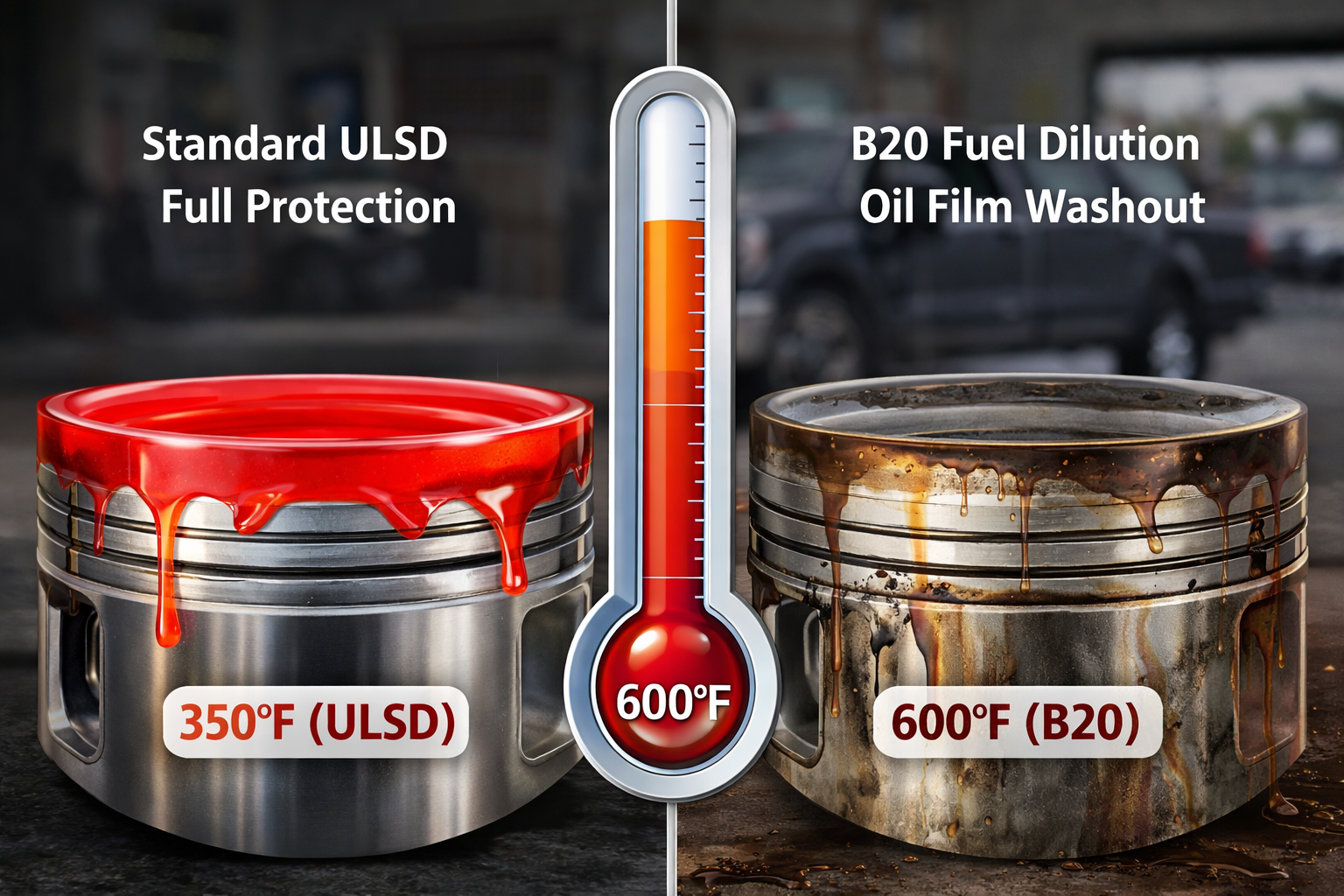
If filter clogging is just an annoyance, then Fuel Dilution is the core threat that can ruin an engine. This is the deepest technical conflict between modern DPF-equipped diesel systems and biodiesel.
The Boiling Point Problem: 350°F vs. 600°F
To understand this risk, you need to look at one critical set of numbers:
- Regular petroleum diesel (ULSD): boiling point of around 350°F. Under the high temperatures inside a cylinder, it atomizes and vaporizes much more easily.
- B20 biodiesel blend: boiling point of up to 600°F. Under the same operating conditions, it is much harder to fully vaporize.
How DPF Post-Injection Turns Into “Cylinder Washing”
To burn soot out of the DPF, modern diesel trucks use a regeneration cycle. During this process, the ECU commands the injectors to spray an extra shot of fuel into the cylinder late in the stroke (post-injection), with the goal of letting that fuel burn in the exhaust stream and heat up the DPF.
Here is the chain reaction with B20:
- Because B20 has such a high boiling point, the post-injected fuel may not vaporize properly in the cylinder.
- Instead, some of it remains liquid and lands on the cylinder walls.
- That creates a cylinder-washing effect, stripping the lubricating oil film off the walls.
- The liquid fuel then slips past the piston rings and drains into the oil pan below.
Official Warning Data (Using Ram/Mopar as an Example)
This is not scare talk. According to official technical guidance, trucks running B20 long term can face a serious lubrication crisis:
- Dilution speed: fuel content in engine oil can rise to 3%–5% in as little as 3,000 miles.
- Mandatory maintenance rule: oil change intervals must never exceed 6 months.
Once fuel thins the oil, shear stability and lubrication performance fall quickly. As soon as the oil becomes too thin, your bearings and camshaft are pushed into direct metal-to-metal contact, leading to irreversible engine wear.
Cold Weather Gelling: Why B20 Can Leave Your Truck Stranded in Winter
If oil dilution is the long-term hidden threat, then low-temperature flow behavior is the immediate problem northern truck owners can wake up to on a freezing morning. The physical properties of biodiesel make its cold-weather behavior significantly worse than straight petroleum diesel.
The Harsh Reality of the Cloud Point
The Cloud Point is the temperature at which wax crystals begin to form and the fuel starts turning cloudy. Once that threshold is reached, the fuel loses flow quality and can turn gel-like, clogging the pump and the filter.
- Regular petroleum diesel (ULSD): typically begins to gel at around -10°F.
- B20 blend: can start forming crystals at around 25°F to 30°F (roughly 0°C to -4°C).
Why Is the Winter Starting Risk 3 Times Higher?
In places like Minnesota, Canada, or any region that sees real winter, that 30-degree difference is the gap between driving away normally and being stuck with a truck that will not move.
The “gel effect”: The bio-content in B20 becomes thicker even in mildly cold conditions. That means your fuel system may already be losing performance and throwing warnings before temperatures even fall far below freezing.
According to the data, trucks running B20 in northern cold-weather regions face a 3x higher risk of winter starting failure or stalling caused by fuel filter gelling compared with trucks running standard diesel.
Survival Guide for Extreme-Cold Owners
If you live in a cold climate and your tank is filled with B20, you need to be prepared:
- Winterized fuel is a must: Make sure your fuel source has been properly treated for winter conditions.
- Use heat support: Block heaters or indoor garage parking are essential. Otherwise, B20 can lose flow quality overnight while the truck sits outside.
- If you cannot guarantee a stable supply of winter-treated B20: staying with straight petroleum diesel ( No. 2 Diesel) in winter, or optimizing the system, is the only truly sustainable long-term strategy.
Which Diesel Trucks Are Better Suited for Long-Term B20 Use?
Based on the hardware realities and environmental factors we covered above, we can summarize the decision using a clear three-dimensional evaluation method. If you want to know whether your truck can live comfortably at the B20 pump, check it against the standards below.
1. Hardware Factor: Does the Truck Have a Built-In Shield Against Fuel Dilution?
This is the single most important factor. If your truck meets either of the following conditions, the threat of B20 to engine life becomes much lower:
- It uses a downstream exhaust injector: Check your exhaust setup. Trucks like the L5P Duramax inject regeneration fuel into the exhaust, not into the cylinder, which physically cuts off the path by which B20 can dilute the engine oil.
- It is an older non-DPF truck: Classic platforms like the 7.3L Powerstroke or 12-valve 5.9L Cummins do not even run active regeneration. For them, B20 is not a burden—it can actually be an excellent lubricant for the high-pressure fuel system.
2. Duty Cycle Factor: Do You Run the Truck Under Real Load?
Fuel-related variables get amplified under light-duty use. If your truck sees the following kinds of operation, B20 is generally safer:
- Frequent highway or long-distance driving: The engine stays at operating temperature long enough to support passive regeneration, which reduces how often the ECU needs to trigger aggressive post-injection. That helps protect oil quality.
3. Modification Factor: Has the Truck Already Been System-Optimized?
This is the ultimate route to true “fuel freedom”:
- DPF Delete completed: Once you remove the DPF and its complicated regeneration logic, you eliminate the post-injection process that causes Fuel Dilution. In an engine that no longer uses post-injection, B20’s high boiling point is no longer the same threat, and biodiesel blends become far easier to live with.
If Your Truck Already Has Emissions Problems, Stay Away from B20
If your truck is already showing signs of emissions-system trouble, then B20 is not a money-saving tool—it is a repair bill waiting to happen. Adding fuel variability into an already unstable emissions system is a dangerous move.
How to Recognize the Warning Signs
If your dash or scan tool is already showing any of the following symptoms, stop using B20 immediately:
- Regen intervals have shortened dramatically — for example, from every 500 miles down to every 200 miles.
- High DPF pressure sensor readings — indicating that soot or ash loading is already near a critical point.
- Engine oil level is rising abnormally — a classic sign that regeneration is already causing oil dilution.
- Frequent trouble codes such as P0401 (EGR) or P242F (DPF).
Why B20 Makes It Worse
A truck with an already unstable emissions system is the last vehicle that should be exposed to a major change in fuel behavior.
- Different combustion residue: The particulate matter produced by B20 does not behave exactly like standard petroleum diesel soot. When the DPF is already partially restricted, the ash from B20 is harder to clear through passive regeneration. That forces the ECU to command more frequent and more aggressive active regens.
- A destructive loop: More forced regen means more post-injection. More post-injection means more Fuel Dilution. Eventually, the truck may fall into Limp Mode or even damage the expensive SCR catalyst.
Do Not Try a New “Treatment” on a Truck Already in the Hospital
Put simply, B20 does not always create problems—but it absolutely magnifies problems that already exist. If your exhaust and aftertreatment system is already struggling, feeding it B20 is like asking someone with the flu to run a marathon. In that situation, your first priority should be to fix or optimize the existing emissions system, not to experiment with a different fuel.
Practical Guide: What Is the Safest Way to Try B20 for the First Time?
A lot of truck owners are not completely against B20. They simply want to know: if they are going to try it for the first time, how do they do it without creating a mess?
This is not a laboratory experiment. It is real-world truck ownership. If you want to test B20, follow this steady, low-risk fueling strategy.
1. Verify Identity: Don’t Rely on “I Heard It From Someone”
Before you even touch the nozzle, your first move should always be to open the Owner’s Manual or check the fuel cap label. Only if the manufacturer clearly states that the truck supports B20 do you have a real starting point.
If the manual only approves up to B5, then “other people are doing it” is not a good enough reason to gamble.
2. Think of It as a System Checkup
The first tank of B20 is not about whether the truck can move. It is about how the truck responds. If you have a used truck, a high-mileage older truck, or one that has already shown regen-related warnings, do not immediately switch over for long-term use.
The first tank of B20 should be treated like a system stress test, not just a routine fuel stop.
3. Your Fuel Filter Is the First Line of Defense
If there is only one thing you do before running B20, make it this: inspect the fuel filter.
Because of B20’s cleaning effect, years of buildup inside the fuel system can be knocked loose almost immediately. If your filter is close to the end of its service life, replace it first. And keep a new spare in the glovebox in case the truck starts starving for fuel on the highway.
4. Watch These 4 Distress Signals During the First 500 Miles
During the first 500 miles after switching to B20, stay alert. If any of the following happens, your truck is not happy with the current fuel setup:
- Longer crank time — the truck takes noticeably longer to start.
- Soft or lazy power delivery — throttle response feels less crisp than it does on straight petroleum diesel.
- Frequent regen messages — the dash repeatedly warns you about “Exhaust Filter Cleaning”.
- Oil-related abnormality — oil level rises, or the oil develops a strong fuel smell.
5. Climate Warning: Do Not Experiment Carelessly in Winter
If you live in Minnesota or any other northern winter climate, your first test with B20 should be handled very conservatively. You often do not know whether the fuel at that station has been properly winter-treated.
If your truck already struggles to start in winter, wait until the weather warms up before trying B20.
6. Emissions Monitoring: DPF Trucks Need Their Oil Pan Watched Closely
On modern trucks like the 6.7L platforms, the biggest threat is not usually power— it is oil management.
If oil dilution accelerates after switching to B20 and the oil level starts rising, that is a sign your driving conditions—such as frequent short trips—cannot properly manage B20’s high boiling point characteristics.
7. Get Your Mindset Right: “Compatible” Does Not Mean “Zero-Cost Switch”
When a manufacturer says a truck supports B20, that always comes with conditions: you are expected to shorten maintenance intervals accordingly.
Do not assume that buying slightly cheaper fuel automatically means saving money. If you are not staying ahead of oil changes and filter changes, the fuel savings will eventually be handed straight to the repair shop.
Suncent’s Deep Take: From “Temporary Experiment” to “Permanent Immunity”
If you follow the seven steps above and still find that your truck reacts badly, regens too often, or you are simply tired of living with that constant low-level anxiety, then it may be time to consider a more complete solution.
Don’t Let the Fuel Pump Decide Your Engine’s Lifespan
B20 biodiesel is a product of policy pressure and environmental trends, and in many places it is becoming increasingly common—or even the only option at certain pumps. But as we have already laid out, modern diesel emissions systems such as DPF and EGR were never fully optimized for all of its side effects.
If you do not want to keep checking your dipstick every day out of fear of oil dilution, or worry about gelled fuel filters on freezing mornings, then what you need is not another compromise—it is a more complete fix.
Why Is a “Delete” the Ultimate Solution to B20 Problems?
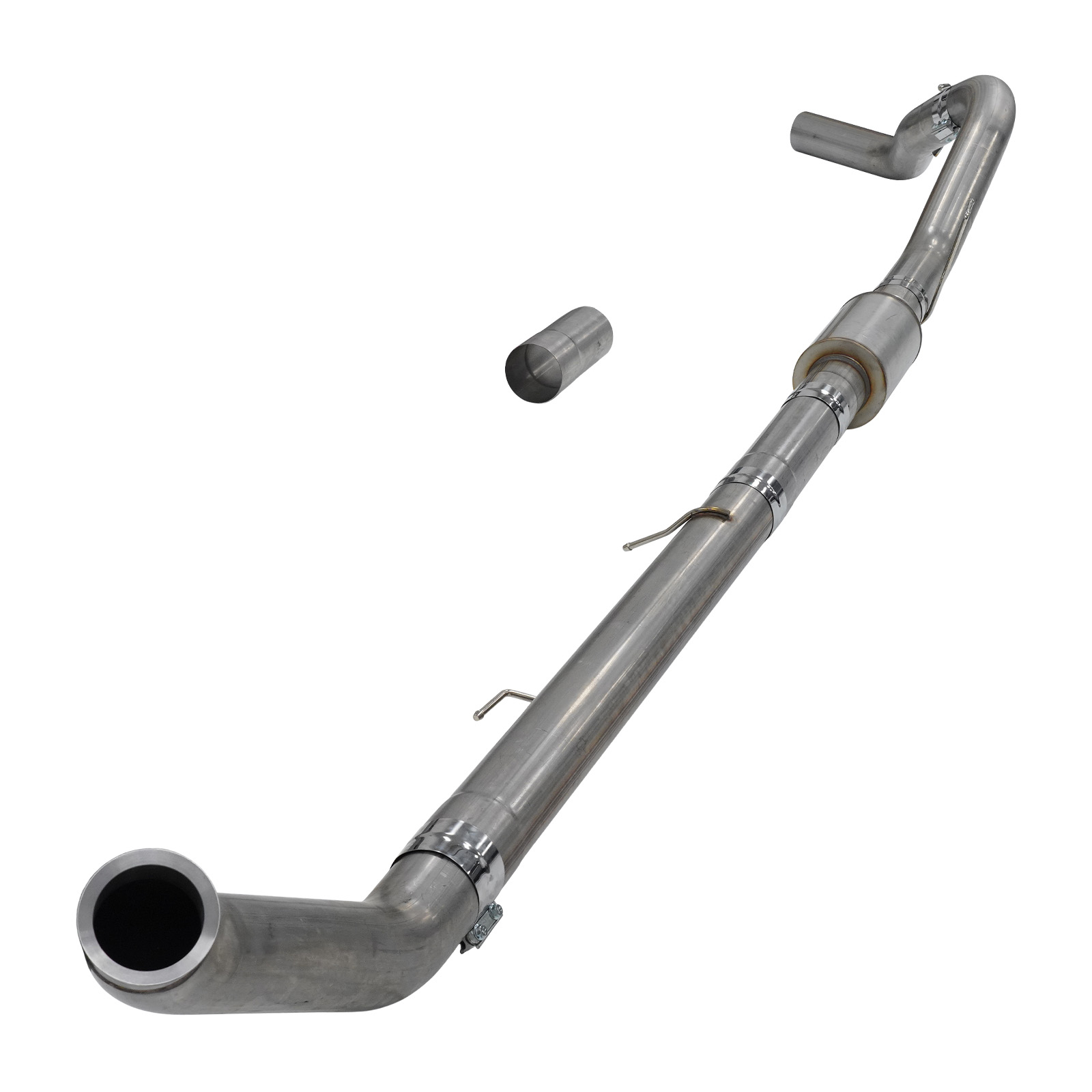
Many truck owners choose a Suncent High-Flow DPF Delete solution because, at its core, it acts like a protective shield for the engine.
- It cuts off fuel dilution at the source: Once the DPF and its complex regen strategy are removed, the truck no longer relies on post-injection. That means B20’s high boiling point and poor vaporization are no longer the same threat.
- It drops system backpressure: Remove the restrictive DPF, and exhaust backpressure falls by more than 90%. No matter what kind of ash or combustion residue B20 leaves behind, it can no longer choke the system, kill power, or trigger constant warning messages.
- It restores mechanical simplicity: Your truck returns to the kind of durable, “built-tough” state associated with engines like the 7.3L Powerstroke or 5.9L Cummins— with true resistance to fuel-related drama.
Suncent’s Promise
What we provide is not just a set of High-Flow DPF Delete Pipes. We provide a complete long-life strategy for the truck.
- Precision tuning: Our software optimization ensures injection timing stays efficient across different fuel blend conditions.
- Durable hardware: Our hardware is designed with extreme conditions in mind, so older trucks can stay ready for a more complicated fuel future.
Conclusion
Fuel quality varies by region, and so do driving habits. What year is your truck? Have you tried filling up with B20 yet? Did the engine feel smoother, or did you notice more frequent regen cycles?
Share your truck’s year and your real-world experience in the comments. Your story may answer the exact question another diesel owner is trying to solve.