 Contents
Contents
For many turbocharged car owners, the core difference between a catted vs catless downpipe really comes down to whether the catalytic converter is retained. One keeps the catalytic converter and aims for a more balanced street experience; the other removes it completely in pursuit of more aggressive flow and performance.
That is exactly why enthusiasts upgrading their exhaust are always torn between a high-flow catted downpipe and a straight-through catless downpipe. This article will provide a comprehensive explanation.
What Does a Downpipe Do?
A downpipe is the key component that connects the turbocharger outlet to the mid-section of the exhaust system.
Functionally, the downpipe has a simple job:
- Carry exhaust gases away from the turbo outlet as quickly as possible
- Direct exhaust gases into the rest of the exhaust system
- Help the turbo release exhaust more quickly and efficiently
In other words, a downpipe is not just an ordinary pipe. It is one of the most critical "bottleneck points" in the entire turbo exhaust system.
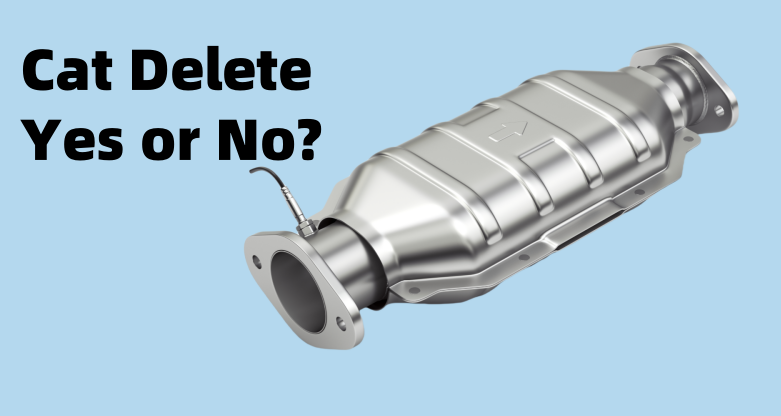
What role does the catalytic converter play here?
A stock downpipe usually contains a catalytic converter. Its main purpose is not to improve performance, but to meet emissions requirements while also balancing noise control.
However, while it is better for emissions, the stock catalytic converter is usually denser and more conservative, which creates a noticeable restriction in exhaust flow and generates significant exhaust backpressure.
This is exactly why many owners choose to upgrade to an aftermarket downpipe. The main goal is to reduce backpressure so exhaust gases can flow out more smoothly and release more horsepower.
Catted vs. Catless Downpipe: Core Definition Comparison
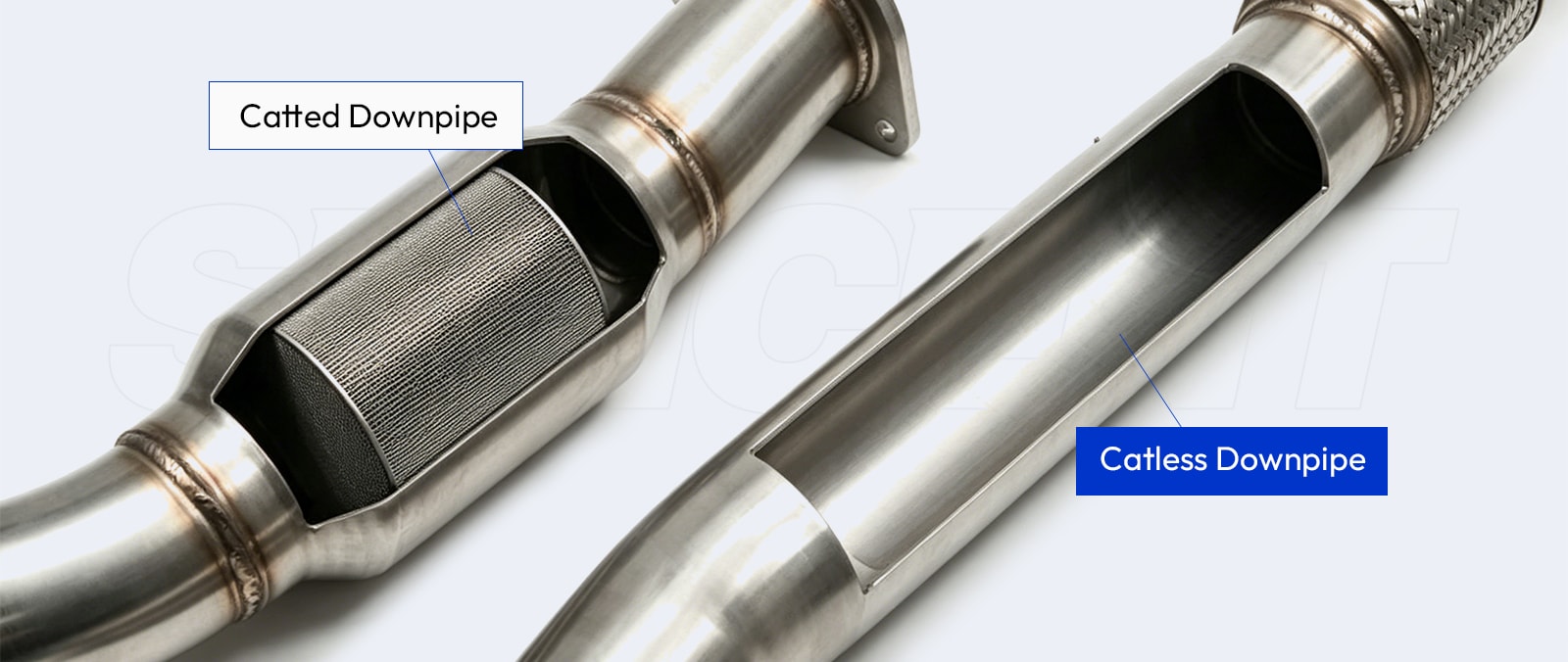
1. What Is a Catted Downpipe?
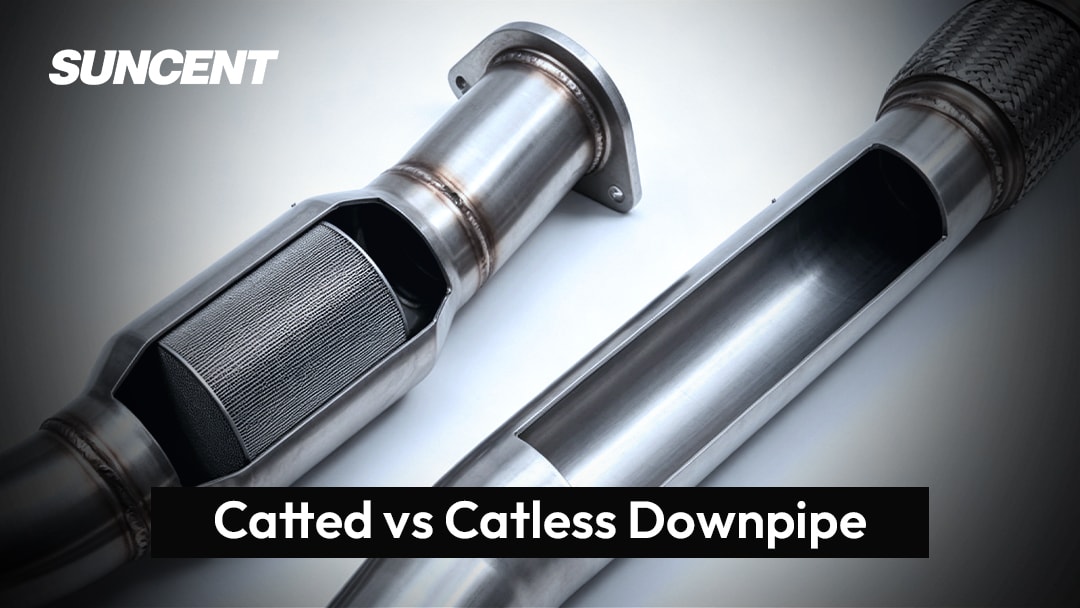
A catted downpipe is equipped with a high-flow cat. It usually uses a 200 or 300 CPSI (cells per square inch) design, which is far less dense than the stock 600+ CPSI setup.
Its advantages include reducing exhaust odor, greatly lowering the risk of a check engine light (CEL), and producing a more refined exhaust note without being overly loud.
2. What Is a Catless Downpipe?
A catless down pipe is completely hollow inside and has no catalytic converter. Its core logic is very simple: remove the catalytic converter, the biggest restriction point, so exhaust gases can flow more freely. It can eliminate backpressure to the greatest extent possible and provide the highest flow ceiling.
Core Differences at a Glance
| Category | Catted Downpipe | Catless Downpipe |
| Has catalytic converter | Yes | No |
| Horsepower gains | Excellent | Maximized |
| Turbo response | Significantly improved | Fastest |
| Exhaust smell | Almost odorless | Noticeable gasoline smell |
| Sound | Deep and relatively restrained | Louder and more aggressive |
| CEL risk | Lower | Very high |
| Street compliance | Better | Track/competition only |
| Price | Higher | Lower |
In-Depth Comparison: Catless vs. Catted Downpipe
Now let's break down catless vs catted downpipe from several of the most practical angles.
1. Performance
A catless downpipe completely removes the catalytic converter, naturally reducing backpressure even further, so it usually has the advantage. Horsepower gains are typically 5–10 HP higher than a catted downpipe.
That said, in the real world, the gap is not always dramatic. For many street builds, a high-quality catted downpipe can already deliver performance that is very close to catless.
2. Sound
A catless downpipe brings a rawer, sharper, more track-like exhaust note, and you may even hear a very obvious turbo whistle. A catted setup filters out some of the higher-frequency harshness, making the sound deeper and fuller without becoming excessively loud.
3. Smell & Emissions
Because a catless downpipe has no catalytic converter, there are more untreated fuel vapors and hydrocarbons in the exhaust, so the raw exhaust smell is more obvious at idle and easier to notice in traffic.
A catted downpipe, on the other hand, filters out most of the odor. This is why many daily drivers ultimately give up on catless and choose catted instead.
4. Legality
A catted downpipe is generally more street-friendly, while a catless downpipe carries much higher risk. However, whether it will pass inspection or whether it is fully legal still depends on local laws, inspection rules, and the specific vehicle platform.
5. Price
In most cases, a catted downpipe is more expensive. The reason is simple: the precious-metal catalyst core itself costs more, especially when a higher-quality metallic high-flow cat is used, which makes the price difference even more noticeable.
Do You Need a Tune for a Catted or Catless Downpipe?
In most cases, both are generally recommended to be tuned.
Whether you install a catted downpipe or a catless downpipe, you are changing the stock exhaust flow and backpressure characteristics. The ECU’s original strategy is based on the factory exhaust system. After upgrading the downpipe, if the ECU is not recalibrated accordingly, the following may happen:
- Incomplete power delivery
- Rougher driving feel
- Fault codes
Catless relies more heavily on software matching
A catless setup completely removes the catalytic substrate. Therefore, compared with catted, catless is more likely to trigger a CEL.
Catted can also benefit from a tune
Many people think a catted downpipe does not need a tune. Strictly speaking, it is not that the car cannot be driven, but without a tune, performance will not be fully realized and you cannot fully take advantage of the benefits of a high-flow front section.
Catted: Although some brands claim they will not trigger a light, tuning is still strongly recommended if you want to achieve 100% of the available performance.
Which One Should You Choose? (Practical Recommendations)
On popular platforms such as catless vs catted downpipe B58 applications (like the BMW M340i or Supra), if you are planning a Stage 2 tune and want the most aggressive shove in the seat, catless is the shortcut to higher horsepower gains.
Our buying recommendations:
Choose Catted if:
- It is your daily commuter
- You occasionally drive spirited mountain roads
- You do not want neighbors complaining about noise
- You live in a city with strict emissions testing
Choose Catless if:
- It is a dedicated track car
- You are not sensitive to exhaust smell
- You want the most hardcore driving feedback
- You are chasing the most extreme cost-effective performance gain
Conclusion
Ultimately, there's no absolute winner between exhaust pipes with and without catalytic converters—it's simply a matter of which one suits your needs better. Exhaust pipes with catalytic converters offer balance and a refined street driving experience, while those without represent a pure pursuit of maximum horsepower.
Whichever you choose, be sure to pair it with a high-quality ECU tuning to ensure the engine operates safely in high-flow environments.
Want to upgrade to a high-quality 304 stainless downpipe ? Choose us at SuncentAuto!