 Contents
Contents
- What Is a Downpipe?
- How Does a Downpipe Work?
- Benefits of an Upgraded Downpipe
- How Much HP Does a Downpipe Add?
- Do You Need a Tune After Installing a Downpipe?
- Catted vs. Catless Downpipe: The Core Comparison
- Are Downpipes Legal?
- Popular Downpipe Applications: Is Your Car on the List?
- Downpipe Installation Essentials and Cost
- Conclusion: Should You Upgrade Your Downpipe?
- FAQs
For many turbocharged vehicles, a downpipe is often one of the most cost-effective basic performance upgrades.
Why is the first section of pipe after the exhaust manifold often called the "best bang-for-the-buck" upgrade for turbo cars? Whether you are a track enthusiast chasing maximum power or a street driver who simply wants your car to breathe more freely, this in-depth guide will walk you through everything you need to know about downpipes.
What Is a Downpipe?
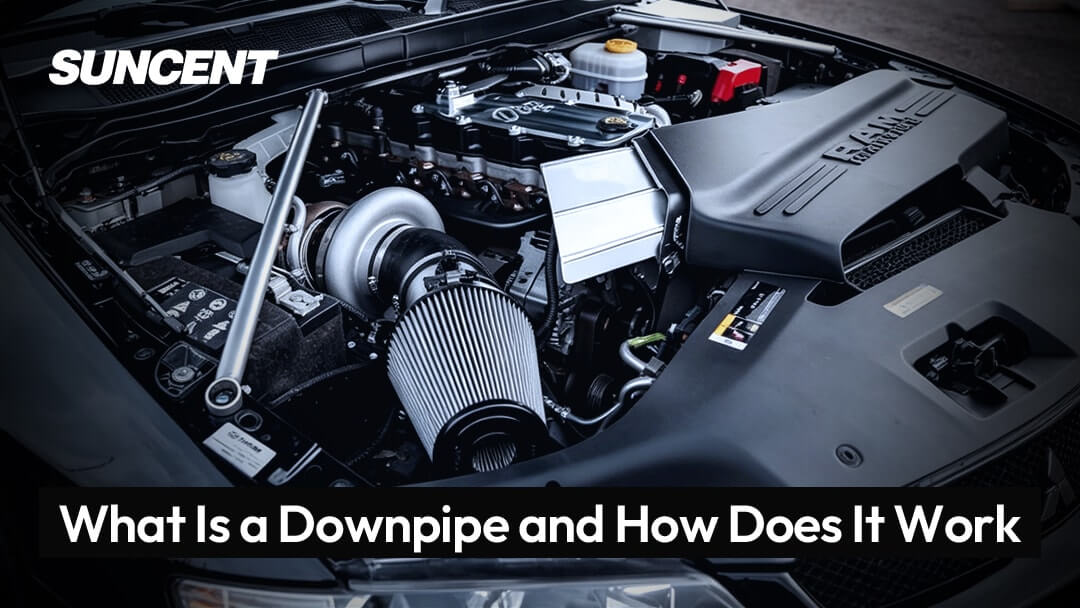
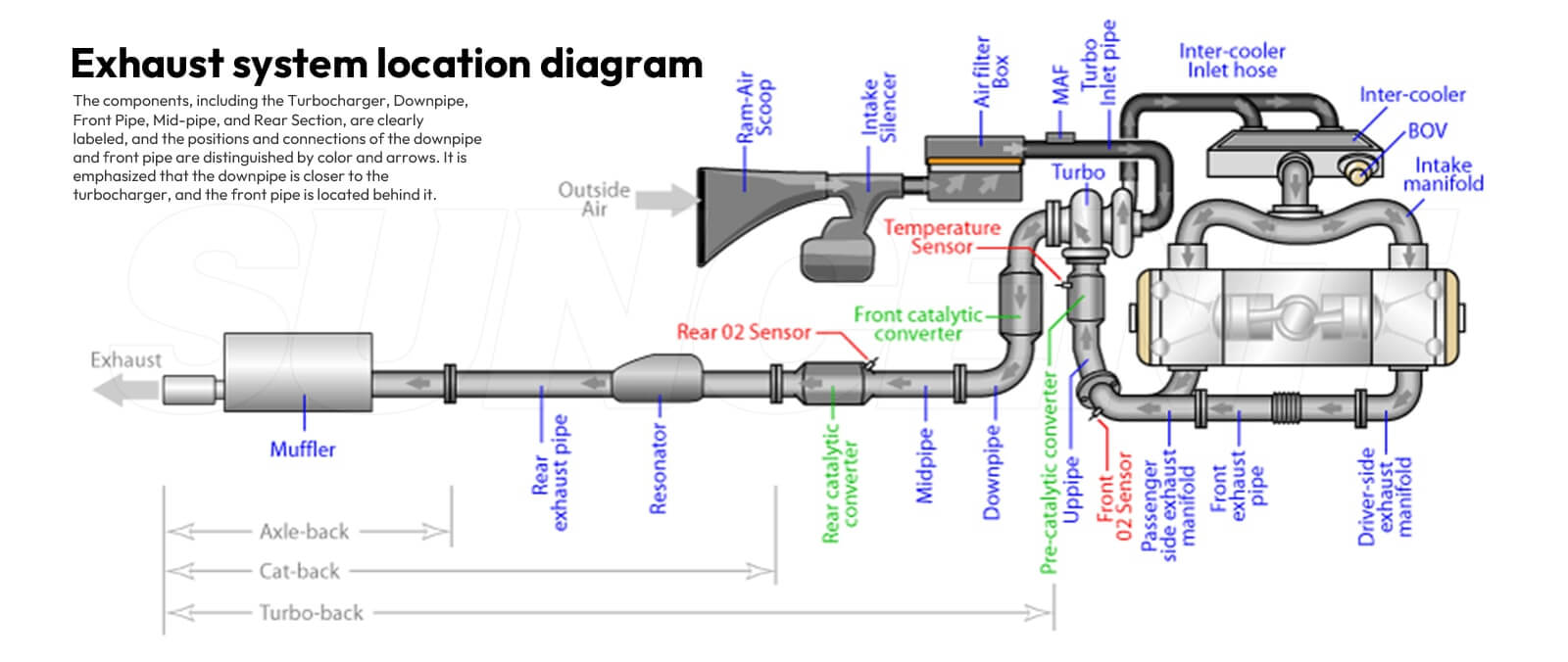
A downpipe is the section of piping that connects the turbocharger outlet to the mid-section of the exhaust system. On most turbo cars, it sits at the front of the exhaust system and is responsible for carrying high-temperature, high-pressure exhaust gases away from the turbo as quickly as possible, which is why it is so important.
From a structural standpoint, a typical turbocharged exhaust system usually looks like this:
Engine → Exhaust Manifold → Turbocharger → Downpipe → Mid-pipe → Rear Section → Exhaust Tip
Common Misconception: Not Every Car Has a Downpipe
Here is one of the most common misunderstandings in the tuning world: not every front exhaust section is called a downpipe. Strictly speaking, downpipe is a component specific to turbocharged vehicles. Naturally aspirated (NA) engines send exhaust gases directly out through the exhaust manifold (headers), and their front exhaust section is usually not discussed as a typical “turbo downpipe.”
How Does a Downpipe Work?
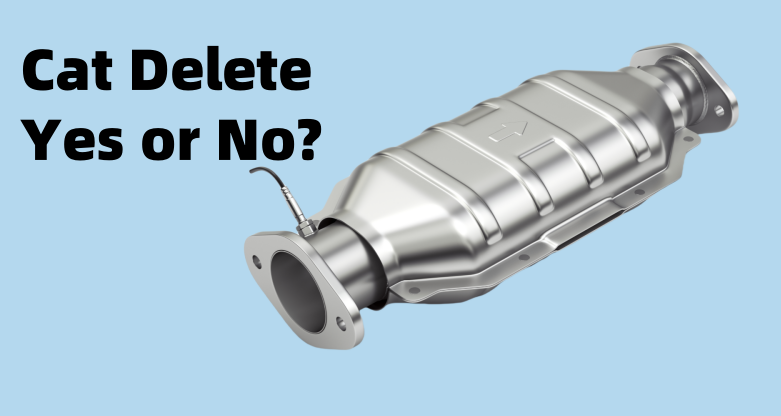
The primary job of the factory downpipe is compliance. To meet strict emissions and noise regulations, it is usually mounted very close to the turbo outlet and contains a very dense catalytic converter inside, which is responsible for converting harmful exhaust gases into less harmful ones.
However, while factory parts contribute to environmental protection, from a performance perspective, they are like a "wet rag":
- Catalytic restriction: The dense catalyst core slows exhaust flow and creates significant backpressure.
- Heat buildup: Exhaust gases trapped at the turbo outlet can cause excessively high exhaust gas temperatures (EGT).
- Physical design limitations: Due to cost and packaging constraints, factory piping often uses smaller diameters or crush bends, which physically reduce exhaust efficiency.
Benefits of an Upgraded Downpipe
The section above explains how the factory downpipe works and where its limitations come from. Now let's look at how a higher-flow aftermarket downpipe improves the situation.
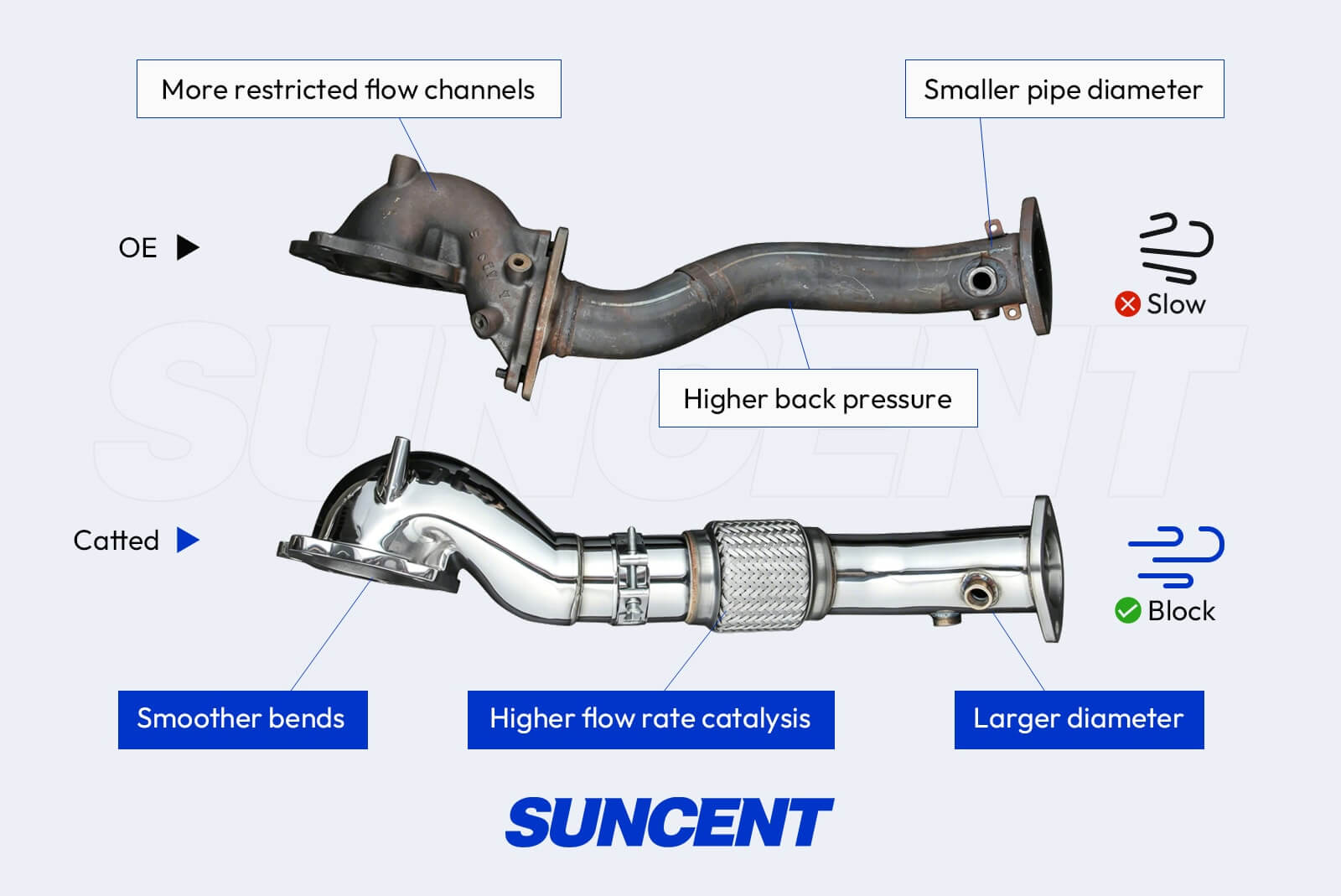
Improvements in Physical Design
Increased Diameter:
Aftermarket downpipes usually use 3-inch piping or even larger. A larger diameter means greater exhaust flow capacity.
Smoother Flow Path Design (Mandrel Bends):
A quality downpipe improves the bend angles, welds, and internal flow path. A more direct, smoother pipe allows exhaust gases to exit more easily.
High-Flow Catalytic Converter (Catted) or Straight-Through Design (Catless):
- High-flow catted: Uses a lower-density catalyst core, which greatly reduces restriction while still retaining basic emissions functionality.
- Catless: Completely removes the catalyst substrate, creating a near-zero-restriction exhaust environment.
The Performance Results
These physical improvements ultimately translate into more noticeable improvements in real driving:
- Reduced backpressure
- Improved exhaust efficiency
- Faster turbo spool
- Better throttle response
- Reduced turbo lag
- More horsepower and torque when paired with tuning
How Much HP Does a Downpipe Add?
How much power can a downpipe actually add? Generally speaking, for turbocharged vehicles, the gains can be significant. With the hardware alone, a downpipe typically adds around 10–20 HP, but when paired with a Stage 2 tune, gains are usually in the 20–50 HP range or even more, depending on engine displacement.
Do You Need a Tune After Installing a Downpipe?
In many cases, the answer is: it is highly recommended, and on many platforms it is almost necessary. Here is why:
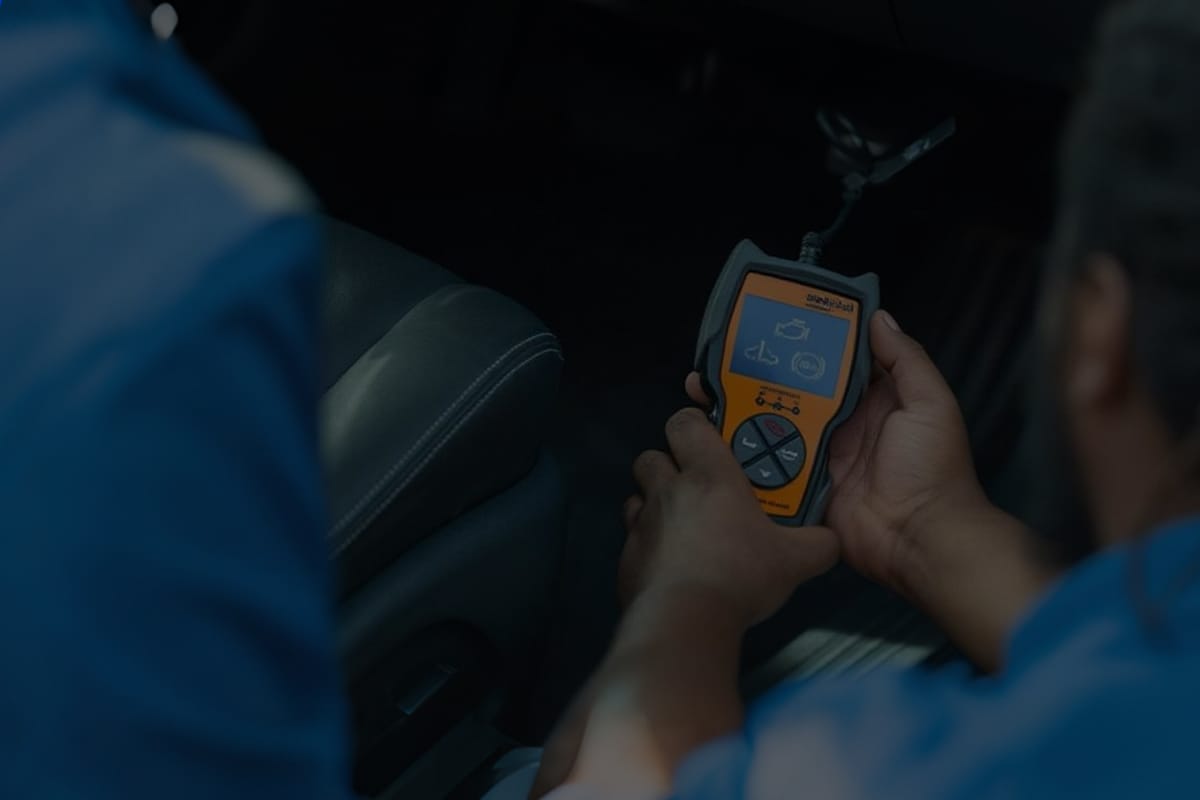
Check engine light
When the factory catalytic converter is replaced—especially with a catless downpipe—the rear oxygen sensor may interpret the changed exhaust flow characteristics as catalyst inefficiency, causing the check engine light to stay on.
Limp mode
If the hardware and software are not properly matched, fault codes or protective logic may be triggered, affecting normal power output.
You will not get full performance
You can still drive the car, but because the ECU is still running the factory's conservative boost and ignition strategy, you may only feel slightly quicker spool. That extra 20–40 horsepower simply will not be fully realized.
⚠️ Professional warning: On most platforms, a catless downpipe is generally not recommended without proper supporting tuning.
Catted vs. Catless Downpipe: The Core Comparison
This is one of the most classic debates in the downpipe world. Catted downpipes and catless downpipes each have very clear pros and cons. There is no one-size-fits-all answer—the right choice depends on your goals.
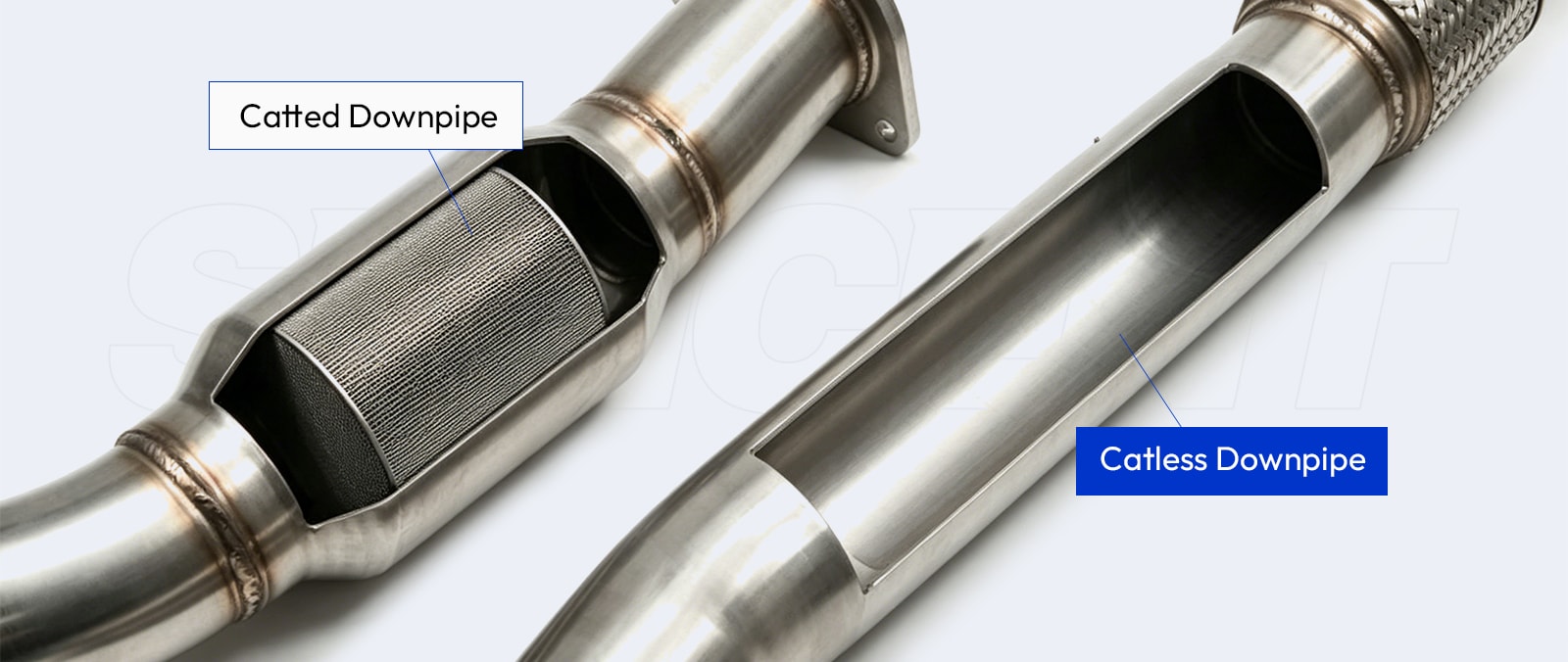
The Short Answer
- Catless downpipe: More extreme, more aggressive, louder, smellier, and more likely to trigger a CEL
- Catted downpipe: More balanced, better for street use, easier to live with, but usually more expensive
| Category | Catless Downpipe | Catted Downpipe |
| Power gains | Maximized (lowest backpressure) | Excellent (slightly lower than catless) |
| Sound | Extremely sharp and aggressive | Deep and louder than stock |
| Smell | Noticeable fuel/exhaust smell | Almost no noticeable smell |
| Check Engine Light (CEL) | Very likely to trigger (usually requires software suppression) | Less likely to trigger (can often be avoided with high-quality products) |
| Emissions compliance | High risk, not suitable for street use in many areas | More emissions-friendly, but not guaranteed to be legal or pass testing everywhere |
| Price | Lower | Higher (due to precious-metal catalyst core) |
Are Downpipes Legal?
That depends on the laws and regulations in your area, as well as whether you choose a catted or catless downpipe.
Generally speaking, a catless downpipe carries a higher emissions compliance risk. In the United States, removing original emissions-control equipment can involve both federal and state-level emissions compliance issues, which is why a catless downpipe is often not suitable for public road use.
A catted downpipe is relatively more street-friendly, but that does not mean it is automatically legal everywhere.
Whether a vehicle can pass inspection, OBD testing, or emissions testing is closely tied to local regulations. That is why I strongly recommend confirming your local laws before making any modifications.
Popular Downpipe Applications: Is Your Car on the List?
If you own one of the following popular platforms, upgrading the downpipe is often considered a must-do modification for unlocking its potential:
BMW enthusiasts
Demand for the B58 downpipe is extremely high, and it is one of the hottest options in the current tuning scene. In addition, classic N54/N55 downpipes (such as the VRSF downpipe) are still very popular in the used performance parts market.
VW/Audi enthusiasts
Whether it is the MK7 GTI, Golf R, or Audi S3/RS3, the stock downpipe is usually designed very conservatively to meet strict European and U.S. emissions standards. Replacing it is not only the gateway to Stage 2 tuning, but also a key step for unlocking turbo pops and bangs and improving mid-range acceleration response.
Other popular platforms
For platforms like Infiniti and Nissan, upgrading the downpipe can also significantly improve exhaust flow and throttle response. For example, this downpipe for the G37 / 370Z platform is a common upgrade option:
👉 https://www.suncentauto.com/product/downpipe-exhaust-for-2008-2013-infiniti-g37-nissan-370z-37l-v6-cylinder-kax
Downpipe Installation Essentials and Cost
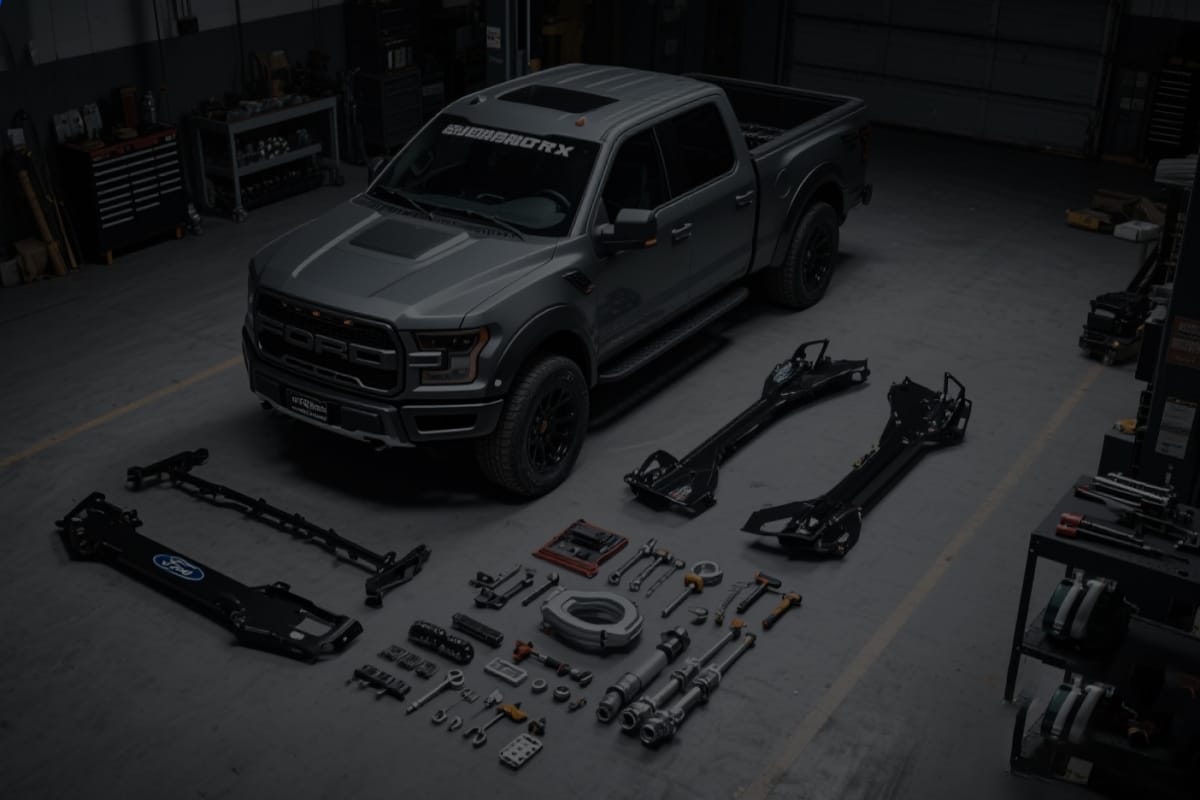
A lot of people search for “downpipe installation” or “downpipe install near me”, because this is not as simple as changing an air filter. It involves high-temperature areas, oxygen sensors, flange sealing, and limited chassis space, so installation quality has a direct impact on long-term usability.
Key Installation Components
Gasket:
Do not reuse the old gasket. It is recommended to use a high-quality downpipe gasket, or apply Copper RTV high-temp sealant to help prevent exhaust leaks.
Heat Wrap:
The downpipe sits very close to the engine and wiring. Using downpipe heat wrap can effectively reduce engine bay temperatures and protect nearby plastic components from heat damage.
The turbo area is often located deep in the engine bay or in tight spaces near the underbody, which makes fasteners difficult to access. In many cases, splash shields or brackets also need to be removed during installation.
Installation Time
Depending on the vehicle, labor typically takes around 2–4 hours. On some transverse-engine vehicles, especially certain AWD platforms with tighter packaging, installation costs may be higher.
Installation Cost
The total cost usually consists of:
- The price of the downpipe itself
- Shop labor charges
- ECU tuning cost
It is best to consult a professional performance shop for an accurate estimate.
Conclusion: Should You Upgrade Your Downpipe?
Upgrading your downpipe is a high-return modification. If you want quicker acceleration and a more exciting exhaust note, it is hard to ignore.
- Noticeable power gains, especially when paired with an ECU tune
- Reduced backpressure means quicker turbo response and more immediate throttle response
- The exhaust note usually becomes deeper and sharper after the upgrade
- Smoother exhaust flow helps protect the engine under high load
- Some platforms may trigger a check engine light after installing a downpipe
- It may affect the manufacturer's powertrain warranty
- In regions with strict laws, a catless downpipe may result in penalties
For pure performance: Choose catless.
For street use with some environmental consideration: Choose a high-performance catted downpipe.
Ready to unlock your car's potential? Before buying, make sure to consult a professional technician to confirm compliance and the right tuning plan.