 Contents
Contents
- How an Aftermarket Downpipe Works: Can It Really Add Horsepower?
- The Core Question: How Much Horsepower Does a Downpipe Add?
- How Much HP Does a Catless Downpipe Add?
- How Much HP Does a Catted Downpipe Add?
- Factors That Affect How Much Power a Downpipe Adds
- Pros and Cons of Upgrading a Downpipe
- Final Answer
When modifying the exhaust system, one of the most common questions car owners ask is: how much HP can a downpipe actually add?
Here is the direct answer first: for turbocharged vehicles, replacing only the downpipe can usually bring a small horsepower gain; if paired with an ECU tune, the power increase is often much more noticeable. On most platforms, a common reference range is 5–15 HP (downpipe only) and 15–40+ HP (downpipe + tune).
However, this number is not fixed. It depends on your vehicle, whether it is paired with ECU tuning, and the type of downpipe. Today, we will discuss this issue in detail.
- Turbocharged vehicles: replacing only the downpipe usually adds about 5–15 HP; if paired with a tune, it can usually add about 15–40+ HP.
- Naturally aspirated vehicles: replacing only a similar front-section component usually brings much smaller gains, often closer to 2–8 HP.
- Catless downpipes usually make it easier to achieve higher power than catted downpipes.
- Catted downpipes usually make slightly less power, but are generally better suited for street use and daily driving.
How an Aftermarket Downpipe Works: Can It Really Add Horsepower?
The answer is yes.
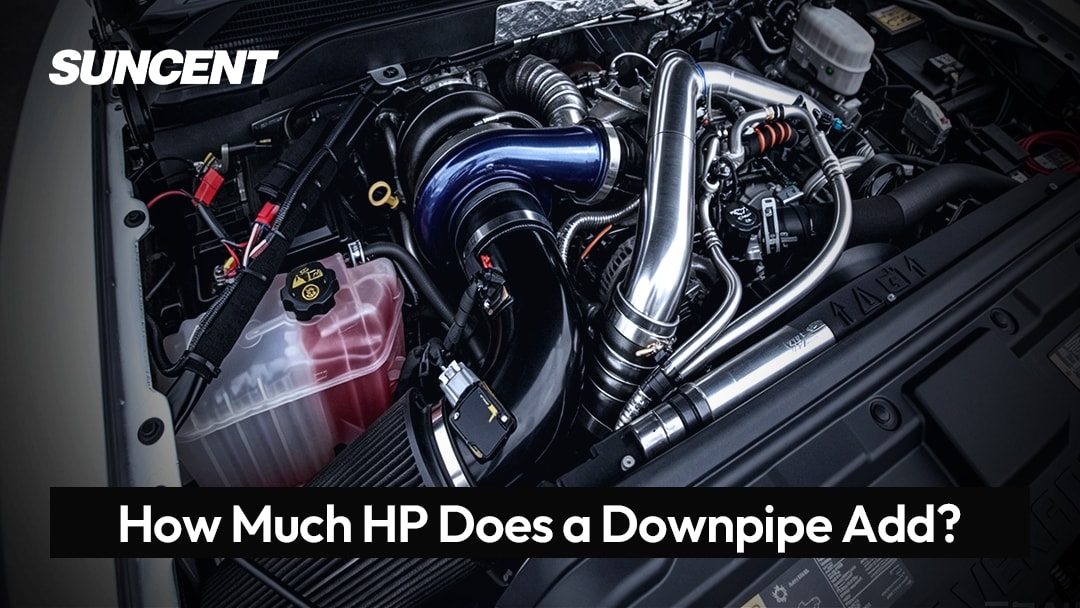
In turbocharged vehicles, a downpipe usually refers to the section of exhaust pipe that connects behind the turbo to the front part of the exhaust system. It is located after the turbo outlet and is one of the first key passages that exhaust gases pass through after leaving the engine. In order to meet strict emissions regulations, it usually contains a very dense catalytic converter. This is like making an athlete wear a mask, increasing exhaust backpressure.
Why can it add horsepower? Aftermarket performance downpipes greatly reduce exhaust restriction by using a larger-diameter pipe or a high-flow catalytic converter. When exhaust restriction is reduced, it usually leads to these changes:
- The turbo builds boost faster, and spool becomes more responsive.
- Engine load is reduced.
- It helps lower EGT under certain operating conditions.
- It is more favorable for increasing power when paired with a tune.
The Core Question: How Much Horsepower Does a Downpipe Add?
Here is the overall answer first:
Downpipe HP Gain Table
| Modification Setup | Common Horsepower Gain Range |
| Turbo car, downpipe only, no tune | 5–15 HP |
| Turbo car, downpipe + tune | 15–40+ HP |
| NA car, only front section / similar component replaced | 2–8 HP, often not very noticeable in real-world driving |
| NA car, header + full tuning | 5–15 HP, depending on displacement and platform |
This range is not fixed, because different platforms vary greatly, but it is enough to help most car owners build a correct expectation: turbo cars do gain power, and the gains are more obvious when paired with a tune. Naturally aspirated cars, on the other hand, usually see smaller increases.
Naturally Aspirated Cars: Gains Are Usually Very Limited
Naturally aspirated cars are completely different from turbocharged cars.
In naturally aspirated vehicles, strictly speaking, what many people refer to as a "downpipe" is not actually a downpipe in the turbocharged sense, because NA cars do not have a turbo. Exhaust gas flows directly from the cylinder head into the exhaust manifold/header. Since there is no turbo, there is no such direct benefit from releasing post-turbo backpressure.
In other words, when discussing whether the "front section" can add HP on a naturally aspirated car, the truly more important component is usually the header, not the downpipe as defined in a turbocharged context.
That is also why you may notice that when many naturally aspirated cars upgrade the so-called “front section,” the gains are not nearly as obvious as they are on turbo cars.
How Much HP Does a Catless Downpipe Add?
A catless downpipe refers to a downpipe without a catalytic converter. Because it removes the catalytic converter, which is one of the main restrictions, a catless downpipe usually has lower exhaust restriction and greater flow potential.
- Catless downpipe only, no tune: usually about 5–15 HP
- Catless downpipe + tune: usually about 20–40+ HP
- On platforms like the BMW B58 or other high-output turbo cars, the gains can be even higher
However, although a catless downpipe is more focused on extreme performance, it is not necessarily suitable for everyone.
Because there is no catalytic converter, exhaust treatment capability is significantly reduced, and exhaust smell is usually much more noticeable.
A catless setup also tends to sound more direct, harsher, and louder, and is more likely to produce drone.
In many areas, catless setups are not suitable for street use and carry obvious compliance risks.
After installing a catless downpipe, some vehicles may trigger a check engine light or rear O2 sensor codes. In many cases, if you want to deliver stable power and avoid abnormal issues, tuning is almost necessary.
How Much HP Does a Catted Downpipe Add?
A catted downpipe refers to a downpipe with a catalytic converter. However, unlike the factory unit, many aftermarket products use a high-flow catted downpipe. The idea is to reduce the excessive restriction caused by the factory catalytic converter while still preserving a certain level of emissions treatment capability and street friendliness.
The performance of a high-flow catted downpipe is slightly lower than that of a straight-through version, but the difference is usually only around 3–5 HP. When paired with tuning, it can add 15–25 HP.
Although a catted setup usually makes slightly less peak power, for most daily-driven vehicles it is often a more balanced option.
Compared with catless, a catted downpipe usually has more controllable sound, lighter exhaust smell, and is more friendly for daily driving.
Factors That Affect How Much Power a Downpipe Adds
Why do some people gain only a few horsepower after installing a downpipe, while others feel a major improvement? Because how much HP a downpipe adds is never a fixed number — it is determined by multiple factors together.
1. Engine Type: Turbocharged or Naturally Aspirated
As mentioned above, this is one of the biggest variables. Turbo cars are usually more sensitive to downpipe upgrades, while naturally aspirated cars usually see smaller gains because they do not benefit from releasing turbo backpressure in the same direct way.
2. Catless or Catted
Generally speaking:
- Catless: higher flow and greater ultimate power potential
- Catted: slightly less power, but more balanced and more suitable for street use
3. Whether the Car Is Tuned
This is one of the key factors affecting the result. Many cars will still gain some power with just a downpipe and no tune, but the gain is limited. Once paired with a tune, the ECU can be re-optimized for the freer-flowing exhaust. So when many people truly feel that “the car is much faster,” it is often not from the downpipe alone, but from the combined effect of downpipe + tune.
4. How Restrictive the Factory Exhaust Is
Some platforms have a very conservative factory exhaust, so the gains after upgrading are more obvious. Other platforms already have a relatively good factory setup, so the gain is naturally smaller.
5. Whether Other Supporting Mods Are Upgraded at the Same Time
If the car is also equipped with supporting modifications such as a high-flow intake, intercooler, and cat-back exhaust, these can further amplify the advantages of the downpipe.
Pros and Cons of Upgrading a Downpipe
Upgrading a downpipe does not only have advantages, and it is not suitable for every owner. Here is a full breakdown of the pros and cons.
Pros
- Potential to increase horsepower and torque.
- Improves turbo response and makes acceleration feel more immediate.
- Releases an appealing engine and turbo sound.
- Improves exhaust flow and makes future upgrades easier.
Cons
- May trigger a check engine light or error codes unless tuned.
- May fail emissions testing.
- Straight-through versions can produce a strong exhaust smell.
Final Answer
Back to the most important question: how much horsepower does a downpipe add? Whether it can noticeably increase HP depends on whether your vehicle is turbocharged, whether you choose a catless or catted downpipe, whether it is paired with a tune, and whether the whole setup is properly matched. If your goal is only to make a small improvement in sound and response, replacing the downpipe alone may already be enough; but if you are chasing a more noticeable power increase, downpipe + tune is often the more effective combination.