 Contents
For Ford Super Duty owners, upgrading the exhaust system is one of the most classic modifications for improving the performance and sound of the 6.7L Powerstroke diesel engine. Among the many options on the market, 5-inch Turbo-Back exhaust systems have become a preferred choice for many owners thanks to their deep, rich sound and excellent exhaust efficiency. However, the real value of a 6.7L PowerStroke 5 inch exhaust is not about "bigger is better," but about choosing the right type first, then matching it to the correct model year. This article takes an in-depth look at different exhaust types, 4" versus 5" pipe diameters, considerations before buying, and key model-year fitment guidelines to help you choose the most suitable modification for your truck.
Common Types of 6.7 Powerstroke Exhaust Systems
Before choosing a specific product, you first need to understand the exhaust types and the sections they replace. The table below provides a quick reference to the differences in replacement boundaries among the three main types:
| Category | Turbo-Back | Downpipe-Back | DPF-Back |
| Replacement scope | Replaces nearly everything after the turbo outlet flange | Replaces everything after the factory downpipe | Replaces only the rear exhaust section after the DPF, retaining the DPF, DOC, and SCR |
| Installation complexity | Highest | Moderate | Lowest |
| ECU tuning required | Yes | Yes | Usually not |
| Compliance status | Off-road / competition use only | Off-road / competition use only | Lowest compliance risk |
Below are the application boundaries and key considerations for each type.
Turbo-back
Turbo-back starts at the turbo outlet flange and replaces the downpipe, midsection, DPF/CAT section, muffler, and tailpipe, replacing the entire exhaust path. It can reduce exhaust backpressure to the greatest extent, delivering the most comprehensive improvement in airflow and change in sound. This is the most thorough option for improving flow, but it is also the most sensitive to model-year differences and carries the greatest compliance risk.
Downpipe-back
Downpipe-back starts at the outlet of the factory downpipe, retaining the section from the turbo through the factory downpipe and replacing everything after the downpipe through the tailpipe. Installation is simpler than turbo-back, making it suitable for owners who do not want to change the downpipe but still want to remove the DPF/CAT section.
DPF-back
DPF-back starts after the diesel particulate filter, retaining all emissions hardware, including the DPF, DOC, and SCR. It changes the sound, appearance, and flow characteristics after the DPF, rather than the complete emissions-system path. It is mainly used to make a slight change in exhaust sound while making minimal changes to the factory emissions system.
Compliance reminder: Turbo-Back and Downpipe-Back systems involve removing factory emissions hardware such as the DPF/CAT and are intended only for closed-course or competition use (Off-Road / Competition Use Only). Compliance considerations are discussed further below.
Comprehensive Comparison of 4-Inch vs. 5-Inch Exhaust 6.7 Powerstroke
Sound
A 4-inch exhaust has a relatively crisp, full sound, with less in-cabin drone during highway cruising. Its tone is tighter and more metallic, with more high-frequency content and a clear turbo whistle.
A 5-inch 6.7 Powerstroke exhaust has a noticeably deeper, lower tone. In terms of volume, a 5-inch system is noticeably louder than a 4-inch system under load, with a stronger presence at idle and during acceleration.
Flow and Horsepower
EGTs with a 4-inch exhaust are noticeably lower than stock, making it sufficient for light everyday towing and daily commuting. A 5-inch system provides greater exhaust flow and can lower EGTs more quickly with high-horsepower tuning or heavy towing.
Below 650–700 HP, there is no measurable difference in peak horsepower between 4-inch and 5-inch systems; a 4-inch pipe does not create a bottleneck for the factory single turbo. Only with a custom twin-turbo setup or a build producing significantly more than 700 HP does a 5-inch system begin to "earn its place" in terms of flow. At low RPM, a 4-inch system may actually retain better low-end torque response and turbo spool because of its higher exhaust velocity.
Brief conclusion: If you want a powerful, deep exhaust sound and your truck frequently tows heavy loads or has performance tuning, choose a 5-inch exhaust directly. If you care more about quiet daily driving and a straightforward installation process, a 4-inch system is the safer choice.
Installation Difficulty
A 4-inch system generally follows the factory routing and usually requires no modifications, making installation close to a true bolt-on. The challenge with a 5-inch system on a Super Duty chassis is clearance: space around the spare tire and near the heat shields is tight, so a 5-inch system requires more patience and potentially some adjustment.
Price
A 4-inch system uses less material and costs less to manufacture than a 5-inch system. With the same material, such as stainless steel, 5-inch kits are usually priced higher.
What Should You Check Before Ordering?
Before purchasing an exhaust kit, be sure to confirm the following five key details to ensure smooth installation and use:
1. Confirm the Model Year, Model, and Body Configuration
Check the exact year, model, and cab-and-bed combination, as these directly determine whether the kit fits. Most 5-inch kits are designed for pickups and do not fit Cab & Chassis models.
2. Confirm the Exhaust Type and ECU Tuning
Determine the exhaust type you need and the sections you want to replace. In addition, Downpipe-back / Turbo-back systems replace the DPF/CAT section, so you must confirm that the vehicle has the corresponding ECU tuning to avoid warning lights or an inability to drive. DPF-back systems retain all emissions hardware, including the DPF, DOC, and SCR, and usually do not require tuning.
3. Choose the Right Pipe Material
Aluminized steel is mild steel coated with an aluminum-silicon layer. Once the coating is damaged, corrosion develops underneath, with a lifespan of approximately three years in harsh environments. If your budget is limited, it can be suitable for short-term ownership in dry regions. For cold regions with heavy snowfall and road salt, T409 or T304 stainless steel is strongly recommended.
4. Evaluate Installation Space Under the Chassis
The larger diameter of a 5-inch pipe requires more chassis space. Clearance around the downpipe, above the rear axle, and around the spare tire is tight, so allow room for adjustment during installation to prevent unwanted noise or contact. Installation space needs to be considered when choosing the pipe diameter.
5. Choose With or Without a Muffler
- With Muffler: Produces a deep, low exhaust tone and effectively reduces in-cabin drone during cruising.
- Without Muffler (Straight Pipe): Produces an extremely loud, high-pitched exhaust sound, but drone is more noticeable during highway cruising.
6.7 Powerstroke 5 Inch Exhaust Buying Guide by Model Year
The Ford 6.7L Powerstroke has undergone multiple chassis, turbo, and transmission upgrades throughout more than a decade of production, and exhaust components are not fully interchangeable across model-year ranges. Below are specific buying considerations and recommendations for good-value 5-inch exhaust systems for different model years:
2011–2022 Models
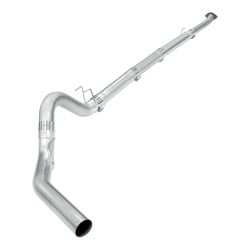
If you drive a model within this range, the recommended option is the 2011–2022 Ford 6.7L Powerstroke 5" Downpipe-Back Exhaust System. This system replaces the exhaust from the existing downpipe outlet rearward, making it suitable for owners who want to retain the front downpipe and replace the piping behind it as a complete system. Made from strong, durable T-409 stainless steel, it fits the factory hanger locations perfectly, effectively reduces exhaust backpressure, and delivers a rich diesel exhaust sound.
2023–2026 Models
This generation features an updated chassis crossmember structure and an extremely complex sensor layout, placing strict requirements on exhaust-pipe bends and sensor bung locations.
For the latest models, it is recommended to choose the vehicle-specific 2023–2026 6.7L Powerstroke 5" Turbo-Back Exhaust Kit. It fully opens up exhaust flow starting behind the turbo and uses precision mandrel-bent construction and T-409 stainless steel to ensure installation without modifications on the latest Super Duty chassis.
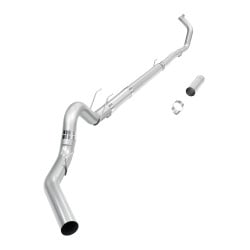
Note: For the 2023–2026 6.7L PowerStroke, stainless steel Downpipe-Back systems are not compatible with the factory OEM downpipe, and an aftermarket downpipe must be purchased separately for installation. A Turbo-Back kit already includes the downpipe and replaces the complete system from the turbo outlet, eliminating the need for additional purchases or compatibility checks—this is the fundamental reason Turbo-Back is recommended for 2023–2026 models.
Both systems feature T-409 stainless steel and mandrel-bent tubing. They come with a 45-day return policy, customer support responses within 24 hours, and free shipping on U.S. domestic orders.
Before placing your order, visit SuncentAuto Deals & Coupons to check current discounts and available coupon codes.
Compliance Considerations
Before modifying your exhaust, make sure you understand the laws and regulations in your area:
- Road legality: Under relevant U.S. EPA and state regulations, such as California CARB rules, modifying or removing factory emissions-control equipment, such as the DPF/SCR/EGR, for use on public roads is illegal.
- Intended use: Most aftermarket 5-inch full exhaust systems are intended only for closed-course or competition use (Off-Road / Competition Use Only).
- Annual inspections and emissions testing: In areas that require annual OBD scans or smoke-opacity testing, installing a noncompliant exhaust may cause the vehicle to fail inspection. Review local regulations carefully before purchasing.
Conclusion
Upgrading to a 5-inch exhaust system is one of the most effective modifications for unlocking the performance potential and rich exhaust sound of the Ford 6.7L Powerstroke diesel engine. Before purchasing, carefully confirm your vehicle’s exact model year, body configuration, and the exhaust sections you need, and choose a high-quality T-409 / T-304 stainless steel kit. After a thorough assessment, a properly matched exhaust system can deliver a meaningful improvement to your Super Duty.