 Contents
- What Is an Exhaust Resonator and a Resonator Delete?
- Resonator Delete vs Muffler Delete: What's the Difference?
- What Happens After a Resonator Delete?
- Pros and Cons of Resonator Delete
- Exhaust Sound Before and After: The Modification Experience
- How Much Does a Resonator Delete Cost?
- Legality and Warranty
- Conclusion
- FAQs
For many car enthusiasts, the factory exhaust system is often too quiet and lacks the excitement that makes driving engaging. However, replacing it with a complete performance exhaust system (cat-back or axle-back) can easily cost thousands of dollars. This is where resonator delete becomes a highly cost-effective entry-level option in the modification community. So, what is a resonator delete? How will it change your vehicle's exhaust sound? Will it add horsepower? And how much does it cost? This article explains this modification in detail to help you make the most informed decision before getting started.
What Is an Exhaust Resonator and a Resonator Delete?
1. The Role of an Exhaust Resonator
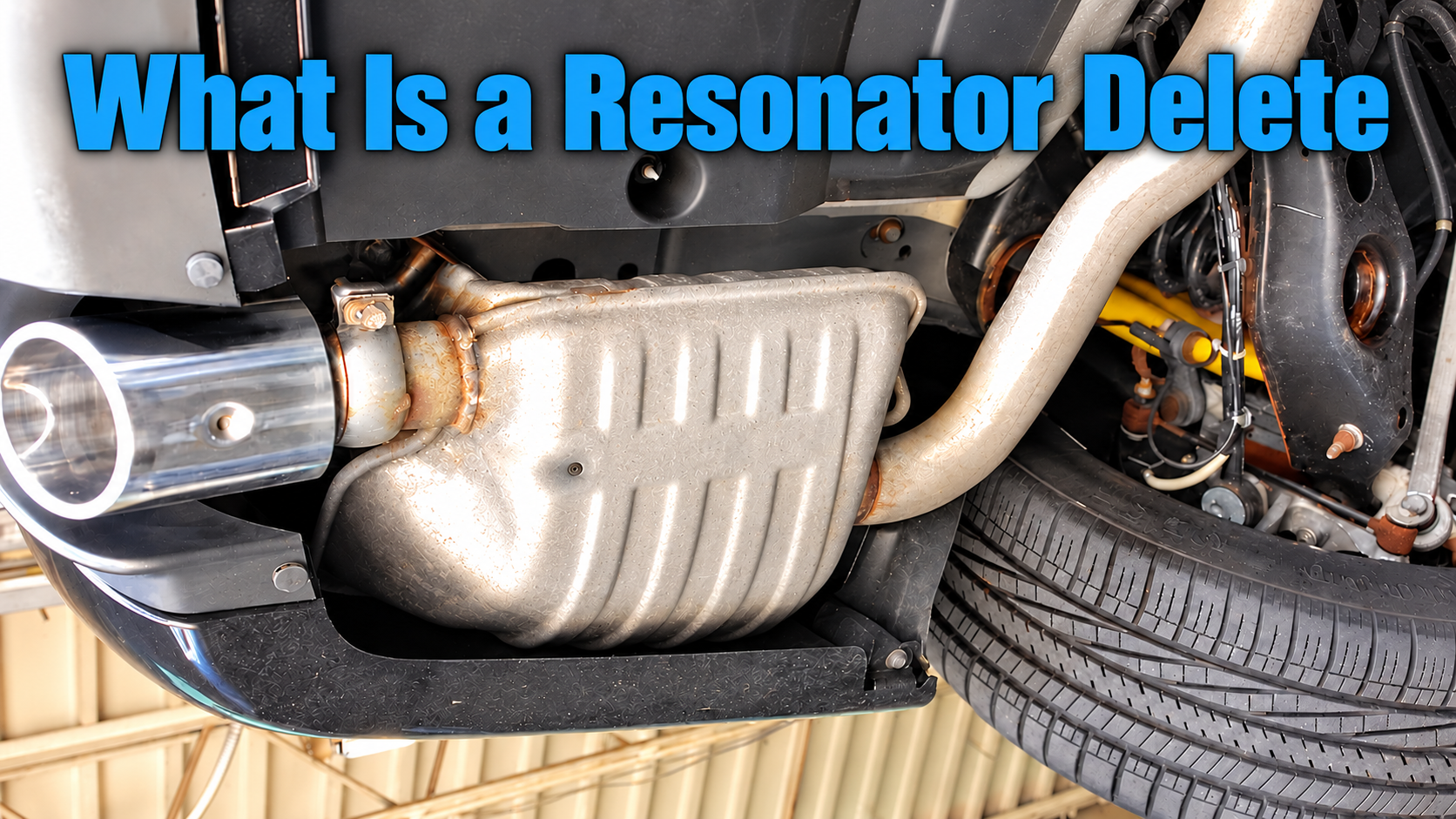
An exhaust resonator is a metal chamber installed in the middle of the exhaust piping, usually after the catalytic converter and before the rear muffler. Its primary function is to eliminate sounds and noise within specific frequency ranges.
When the engine runs, exhaust gases flow out at high speed and generate sound waves. The resonator's specially designed acoustic chambers cause sound waves within certain frequency ranges to interfere destructively, eliminating unpleasant high-frequency noise and the in-cabin drone that can occur during highway cruising.
2. Resonator vs. Muffler
- Muffler: Primarily responsible for reducing overall volume, keeping exhaust noise within legally permitted decibel limits.
- Resonator: Primarily responsible for shaping sound quality, filtering out rough, harsh frequencies to produce a smoother sound.
3. What Is a Resonator Delete?
A resonator delete involves removing the factory chamber from the exhaust pipe using cutting tools, then welding in a straight metal pipe with the same diameter as the factory piping or installing a vehicle-specific bolt-on pipe kit.
4. Why Do People Remove It?
Factory resonators typically make exhaust sound quieter, smoother, and more subdued. Removing one makes the exhaust sound more direct, raw, and deep, with a noticeably stronger character during cold starts, idling, and full-throttle acceleration. For owners who want "a little more sound without being as loud as a muffler delete," a resonator delete is a common choice.
Resonator Delete vs Muffler Delete: What's the Difference?
Many beginners confuse a resonator delete with a muffler delete. Although both involve cutting out factory exhaust components, the results are very different:
| Comparison | Resonator Delete | Muffler Delete |
| Primary change | Changes the tone, producing a deeper sound | Significantly increases volume, making the exhaust very loud |
| Volume increase | Slight to moderate increase; relatively restrained | Substantial increase; may even disturb others |
| In-cabin drone | Lower risk of drone; more comfortable for daily driving | More noticeable in-cabin drone during highway cruising |
| Best suited for | Owners who want better sound detail while maintaining daily driving comfort | Enthusiasts seeking high volume and an aggressive exhaust note |
A resonator delete is more like "sound tuning": it gives the exhaust more character without turning the car into an obnoxiously loud machine.
A muffler delete is more like "turning up the volume": it dramatically increases exhaust sound but is also more likely to cause in-cabin drone, attract police attention, and fail vehicle inspections.
If you do a muffler and resonator delete together, the sound will be the loudest and most aggressive, but the drawbacks will also be the most noticeable: stronger drone, greater legal risks, and reduced daily driving comfort. For this reason, most daily drivers first consider a resonator delete alone or choose a cat-back exhaust system for a more balanced result.
What Happens After a Resonator Delete?
Removing the resonator will bring several key changes to your vehicle:
1. Improved Exhaust Sound Quality
This is the main reason most owners choose this modification. Removing the resonator releases the engine's previously muted bass and mechanical exhaust notes, creating a deeper, rougher, and more aggressive sound. Drone may occur during highway cruising, especially between 2,000 and 3,000 rpm. However, the volume increase is usually less dramatic than with a muffler delete. It is more like partially "unlocking" the factory exhaust than converting it directly to a straight pipe.
2. Does It Add Horsepower?
The answer is: almost none.
Many people mistakenly believe that removing exhaust components will significantly increase horsepower. In reality, the factory resonator has a negligible effect on exhaust backpressure. A resonator delete typically adds 0–5 HP, a difference that is almost impossible to notice while driving. It is essentially a sound modification. The components that truly affect horsepower are the catalytic converter, downpipe, muffler, and ECU tuning.
3. A Small Weight Reduction
A resonator typically weighs around 5–15 pounds, depending on the vehicle. Removing it provides a small weight reduction, but the effect on overall performance is minimal.
Pros and Cons of Resonator Delete
Before deciding on this modification, it is essential to weigh its advantages and disadvantages:
Pros
- Improved exhaust tone: Deeper, sportier, and more distinctive.
- Lower cost: Much cheaper than a complete exhaust system.
- Weight reduction: Removing an exhaust component typically saves 5–15 pounds.
- Slightly improved exhaust flow: Offers a small improvement in exhaust flow at high rpm.
- Relatively reversible: Many resonator delete kits allow the vehicle to be returned to its factory configuration.
- Suitable for those who do not want excessive noise: More restrained than a muffler delete and easier to live with during daily driving.
Cons
- Potential highway drone: At certain engine speeds, such as during highway cruising, a continuous low-frequency resonance may be heard inside the cabin.
- Potential reduction in resale value: Some buyers may prefer a completely stock exhaust system that has never been cut.
- May violate local noise regulations: Especially in cities or areas with strict rules.
- May affect warranty coverage for related components: Repairs may be denied if the failure can be attributed to the modification.
- Does not significantly increase horsepower: If your goal is more power, other modifications should take priority.
Exhaust Sound Before and After: The Modification Experience
Before: Factory Configuration
Factory exhaust systems are typically carefully tuned to be quiet, smooth, and free of drone. The resonator suppresses certain frequencies, making conversations inside the cabin and highway cruising more comfortable. The exhaust note is relatively subdued, cold starts are quiet, and acceleration produces some sound without being overly attention-grabbing.
After: Resonator Delete
- Cold starts: Louder, clearer sound with fuller bass.
- Idling: More noticeable exhaust pulses, with a slight rumble on some vehicles.
- Low-speed driving: More direct sound, making throttle changes easier to hear.
- Cruising: Drone may occur, especially between 2,000 and 3,000 rpm.
- Full throttle: A more aggressive exhaust note, freer-flowing exhaust at high rpm, and potentially more backfire sounds.
- Letting off the throttle: Some vehicles may produce a slight burble or pop.
The Modification Experience
Most resonator delete installations take around 1–2 hours. There are two common methods:
- Cutting the factory pipe and installing a replacement straight pipe or kit: Lower cost, but requires cutting.
- Using a bolt-on or clamp-on kit: More convenient, with some options being reversible.
If you are unfamiliar with exhaust welding and lifting a vehicle, professional installation is recommended. After the modification, check for exhaust leaks and listen at different engine speeds for any unacceptable drone.
How Much Does a Resonator Delete Cost?
A resonator delete is one of the most cost-effective exhaust modifications. The total typically consists of parts and labor:
- Parts Cost:
- Custom Steel Pipe: $30–$60, supplied and bent on-site by the shop.
- Brand-Name Delete Kit: : $100–$250, such as direct-fit kits from CTS, 034Motorsport, and other brands.
- Labor Cost:
- Cutting and welding at a professional exhaust shop generally costs $80–$200, with around one hour of labor.
Total Cost: Typically $110–$350.
Legality and Warranty
Before modifying their vehicles, many owners worry about legal issues and warranty coverage. Here are detailed answers:
Legality: Is a Resonator Delete Legal?
An exhaust resonator is not an emissions control device, so removing it generally does not constitute an emissions violation. Legality primarily depends on noise regulations rather than emissions regulations.
- Most areas allow some exhaust modifications, provided they do not exceed local noise limits.
- Vehicle inspections: Most states' safety inspections do not specifically check for a resonator, but inspectors can determine whether the exhaust is “unreasonably loud.”
- If your area has strict noise limits, consider keeping the factory resonator or choosing a quieter cat-back exhaust.
Warranty: Does a Resonator Delete Void Warranty?
Under applicable laws, such as the Magnuson-Moss Warranty Act in the United States, automakers cannot cancel your entire vehicle warranty simply because you modified an exhaust component. Unless the manufacturer can prove that your modification directly caused damage to an engine or exhaust component, warranty coverage for the remaining components stays in effect.
Conclusion
What is a resonator delete? It is more than simply "removing a part." It is a low-cost, relatively reversible modification to the exhaust tone. It can provide a deeper, sportier, and more direct exhaust sound while avoiding the excessive noise of a muffler delete. However, it may also introduce cruising drone, noise regulation risks, and warranty-related complications.
For most owners, a resonator delete is an entry-level exhaust modification. If you want a more complete balance of sound and performance, you can explore a cat-back exhaust, muffler delete, or resonator delete kit. Listening to before-and-after recordings of the same vehicle model and consulting a professional shop before modifying your exhaust can help you avoid regrets.