 Contents
Contents
- The Quick Answer
- How often should you change oil in a diesel truck?
- Is 3,000 miles too early for a diesel oil change?
- Is 5,000 miles the best oil change interval for most diesel pickups?
- Can full synthetic diesel oil really go 10,000 miles?
- Does city driving shorten diesel oil life?
- Does oil type matter for diesel oil change intervals?
- Should diesel oil changes be based on mileage or engine hours?
- Is the oil filter just as important as the oil?
- Why does diesel oil turn black so fast?
- Is Used Oil Analysis Worth It for a Diesel Truck Maintenance Plan?
- Do CCV or PCV issues affect diesel engine maintenance?
- Should you use SeaFoam, Marvel Mystery Oil, or ATF before a diesel oil change?
- What is a practical diesel oil change plan?
- Final thoughts: What diesel oil change interval should you choose?
The Quick Answer
For most light-duty diesel trucks (e.g., Ford Powerstroke, Ram Cummins, GM Duramax), the ideal oil change interval depends on usage:
- Standard Duty: 5,000–7,500 miles.
- Severe Duty (Towing, Short Trips, Excessive Idling): 3,000–5,000 miles.
- Pro Tip: Do not rely solely on mileage; engine hours are a more accurate measure of oil degradation if you idle frequently.
If you just bought your first diesel truck, especially a Ford Powerstroke, Ram Cummins, or GM Duramax, one of the first questions you’ll probably ask in a truck group is:
“Alright guys, how often should I change the oil in this thing?”
And just like that, the comment section splits in two.
One guy says, “Every 3,000 miles. Oil is cheap. Engines aren’t.” Another guy says, “It’s 2026. Full synthetic oil can go 10,000 miles all day.”
So who’s right?
Here’s the honest answer: there is no one-size-fits-all diesel oil change interval. If you blindly follow a random number from the internet, you may either waste money dumping perfectly usable oil, or push your engine harder than you should.
The right oil change interval depends on your truck, your oil, your driving habits, your engine condition, and how much real work the truck actually does.
How often should you change oil in a diesel truck?
For most light-duty diesel pickups, a practical starting point is usually 5,000–7,500 miles. But that number changes fast once towing, city driving, idle time, short trips, or engine condition come into play.
| Driving condition | Suggested oil change interval | What matters most |
|---|---|---|
| Normal commuting / mixed driving | 5,000–7,500 miles | A practical middle ground for most light-duty diesel trucks |
| Short trips, city driving, long idle time | 3,000–5,000 miles | Severe duty, moisture buildup, and fuel dilution |
| Frequent towing, heavy loads, hot weather | 3,000–5,000 miles | Higher oil temperature, heavier load, and engine hours |
| Full synthetic oil + mostly highway driving | 7,500–10,000 miles | Easier operating conditions, but used oil analysis is recommended |
| Low-mileage or seasonal truck | Every 6–12 months | Oil ages even when the truck sits |
| Commercial diesel / fleet use | Based on OEM, engine hours, and oil analysis | Cost control, uptime, and long-term engine life |
3,000 miles is conservative, 5,000 miles is practical, and 10,000 miles needs the right conditions.
Is 3,000 miles too early for a diesel oil change?
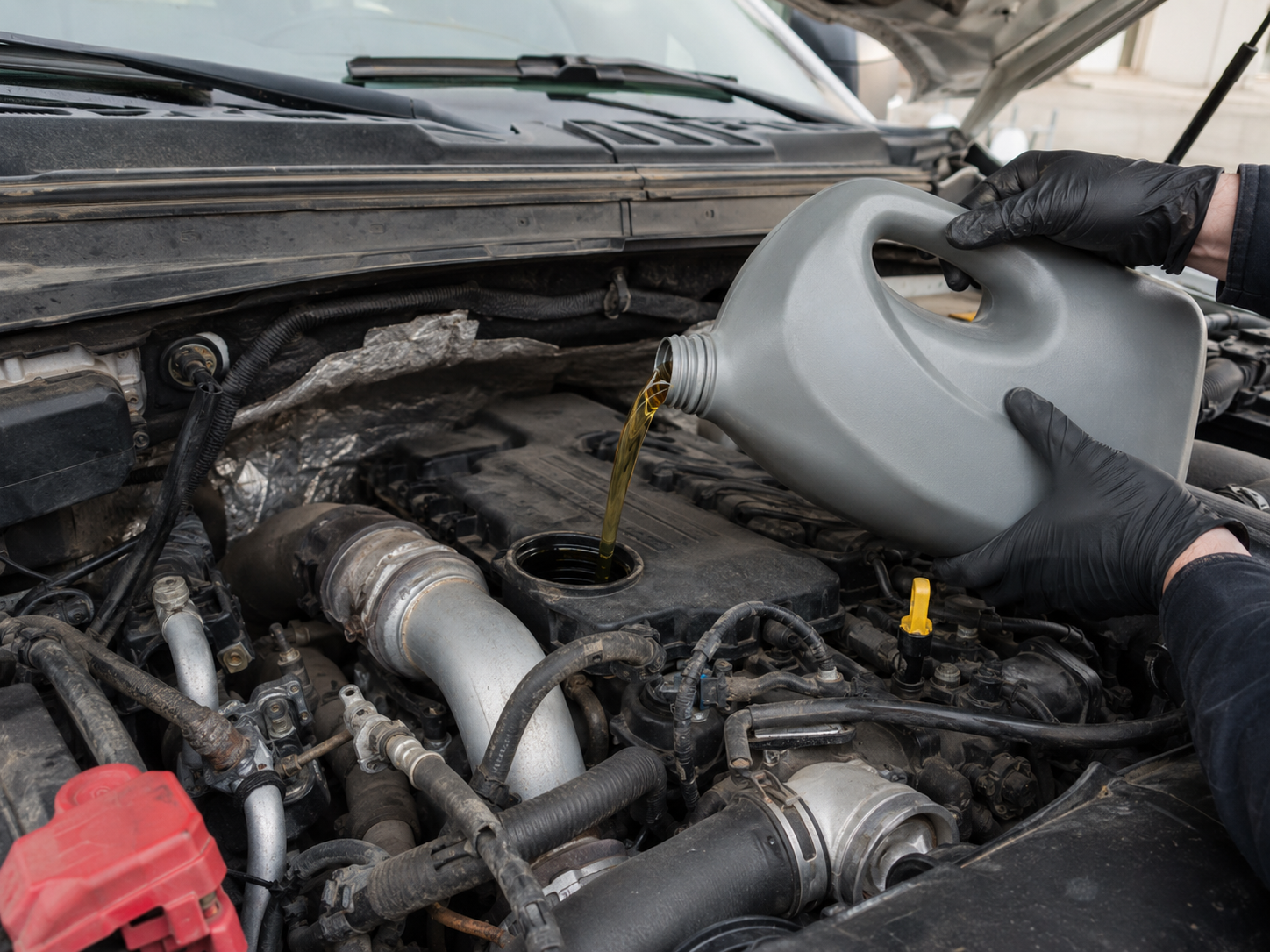
The old 3,000-mile oil change rule comes from an earlier era of oil technology. It is not useless, but it should not be treated like gospel for every diesel truck.
If you have an older diesel, do a lot of cold starts, drive one or two miles at a time, tow often, idle a lot, or just bought a used Powerstroke, Cummins, or Duramax with no maintenance records, then a 3,000-mile interval can absolutely make sense. It is safe, simple, and conservative.
But let’s say you have a healthy Ford F-350 with around 100,000 miles, the engine runs clean, and you are using a common full synthetic heavy-duty diesel oil like Rotella T6 15W-40. If you are not constantly towing heavy or idling for hours, dumping that oil every 3,000 miles may simply be throwing away oil that still has life left in it.
A more practical move is not jumping from 3,000 miles straight to 10,000 miles. Start by trying 5,000 miles, use a quality oil filter, and pay attention to the dipstick, engine sound, fuel economy, and any signs of fuel dilution.
If you own a 6.7 Powerstroke, you can also check this more specific guide: 6.7 Powerstroke Oil Change Guide: Intervals, Costs & DIY Tips. It helps apply the general diesel oil change interval discussion to that specific engine platform.
Is 5,000 miles the best oil change interval for most diesel pickups?
For a lot of diesel owners, 5,000 miles is the sweet spot. It is the “safe but not wasteful” answer you hear all the time in diesel forums, truck groups, and real-world garage talk.
It is cheaper than changing full synthetic oil every 3,000 miles, but still conservative enough for a truck that sees mixed driving, some towing, a little idle time, and normal real-world use.
Take that same 100,000-mile F-350 as an example. If the truck runs well, sees mostly normal mixed driving, and uses Rotella T6 15W-40 or another full synthetic diesel oil, then 5,000 miles is often a very reasonable starting point.
It protects the engine without treating every oil change like an emergency. Even if you occasionally tow a small trailer or haul tools, 5,000 miles is still a pretty safe diesel oil change interval as long as the truck is healthy and not living in severe duty every day.
5,000 miles is conservative enough to sleep well, but not so conservative that you feel like you’re pouring money down the drain.
Can full synthetic diesel oil really go 10,000 miles?
Yes, but not every truck should do it.
If you want to stretch your synthetic oil change interval to 10,000 miles, your truck should ideally check most of these boxes:
- The engine is healthy, with fuel dilution under control.
- The injection system is working properly.
- Most miles are steady highway miles.
- The engine regularly reaches full operating temperature.
- The truck does not tow heavy very often.
- Idle time is low.
- Used oil analysis supports the interval.
The real question is not, “How long can full synthetic oil last on paper?” The better question is:
Does your truck’s engine condition and driving style actually support that long of an oil change interval?
If your diesel truck spends most of its life in stop-and-go traffic, short trips, long idle time, or heavy towing, even expensive full synthetic diesel oil can get contaminated faster than you think. Running it to 10,000 miles just because someone online does it may allow fuel dilution, soot, oxidation, and wear to build up over time.
That is why a lot of experienced diesel owners will say the same thing: if you want to go longer, do not just guess. Send a sample to a reputable oil analysis lab and let the report tell you what is really happening inside the engine.
Does city driving shorten diesel oil life?
Yes. City driving, short trips, and long idle time can shorten diesel oil life faster than many owners expect.
Two identical diesel trucks can both run 5,000 miles and have completely different oil conditions. The odometer is only part of the story. What really matters is whether your truck lives in severe duty conditions.
Short trips
If your drive is only 10–15 minutes or less, the engine oil may not reach and stay at full operating temperature long enough to burn off moisture.
City driving and idling
Stop-and-go traffic and long idle time are hard on oil. The mileage may barely move, but the engine hours keep adding up.
Heavy towing and hauling
Pulling a camper, boat, work trailer, or heavy load puts more heat and stress into the oil.
Dusty, hot, or cold environments
Work sites, desert roads, extreme heat, and freezing cold starts can all shorten oil life.
Low-mileage storage
A truck that sits for months still ages its oil. Mileage may be low, but moisture and oxidation can still happen.
If your truck fits these conditions, 3,000–5,000 miles is usually safer than trying to stretch every oil change to 7,500–10,000 miles.
Does oil type matter for diesel oil change intervals?
Absolutely. When diesel owners talk about oil change intervals, they almost always bring up oil type and viscosity: Rotella T6 15W-40, 15W-40, 5W-40, synthetic blend, and full synthetic diesel oil.
Conventional oil, synthetic blend, and full synthetic oil do not handle heat, oxidation, cold starts, and shear the same way. In general, full synthetic diesel oil gives you more room to work with, especially in turbocharged diesel engines, highway driving, and longer synthetic oil change intervals.
But good oil is not a free pass.
A full synthetic diesel oil like Rotella T6 15W-40 may give you confidence to move from 3,000 miles to 5,000 miles, and maybe longer under the right conditions. But if your truck short-trips all the time, idles for hours, tows heavy, has fuel dilution, injector issues, or burns oil, even great oil will have a harder life.
- Unknown truck or conventional oil: stay conservative.
- Healthy truck with full synthetic diesel oil: 5,000 miles is a good starting point.
- Want to run 7,500–10,000 miles: verify it with used oil analysis.
- Choosing an interval based only on oil brand: risky.
Should diesel oil changes be based on mileage or engine hours?
Both matter.
A lot of pickup owners only watch mileage. Fleets and commercial operators pay close attention to engine hours too.
Why? Because a truck can sit still and idle while the engine keeps working.
For example, a diesel pickup that spends a lot of time idling at a jobsite or warming up in cold weather may only show 3,000 miles on the odometer, but the engine hours may tell a very different story. The oil has still been exposed to heat, soot, fuel, and combustion byproducts.
If your truck idles often, do not judge oil life by mileage alone. Pay attention to:
- Mileage;
- Engine hours;
- Towing frequency;
- Idle time;
- Fuel economy changes;
- Oil condition;
- Used oil analysis results.
For trucks that idle often or work commercially, engine hours can be a better way to manage oil change intervals than mileage alone.
Is the oil filter just as important as the oil?
In diesel trucks, yes, the oil filter matters a lot.
Some owners feel that dumping expensive full synthetic oil like Rotella T6 15W-40 at 3,000 miles is less useful than running a quality oil filter and changing filters on time.
Oil lubricates, cools, cleans, and protects. The oil filter catches soot, fine metal particles, and contaminants. In a diesel engine, where soot and combustion byproducts are part of the game, filter quality matters.
A cheap filter may not support longer intervals well. A quality filter helps the oil stay cleaner throughout a reasonable interval.
But this does not mean, “Just change the filter and never change the oil.”
A quality oil filter helps your oil survive a reasonable interval, but it does not replace regular oil changes.
If you want to move from 3,000 miles to 5,000 miles, start with a good oil filter. Do not run a bargain filter and then try to stretch your oil change interval to 10,000 miles.
Diesel owners should also pay attention to the fuel filter. A restricted or neglected fuel filter can affect injection performance, combustion quality, starting, and long-term maintenance costs. Oil, oil filter, and fuel filter all work together as part of the bigger maintenance picture.
Why does diesel oil turn black so fast?
If you are new to diesel trucks, black oil can be scary. You change the oil, drive for a little while, pull the dipstick, and it already looks dark.
That does not always mean the oil is bad.
Diesel engines produce soot. The oil’s job is to hold those tiny soot particles in suspension so they do not settle inside the engine. In that sense, dark oil can simply mean the oil is doing its cleaning job.
What matters more than color is what is happening inside the oil:
- Is fuel dilution too high?
- Is soot level excessive?
- Has viscosity changed?
- Are wear metals elevated?
- Is there coolant contamination?
- Is the additive package depleted?
- Does the oil level rise or smell strongly like diesel?
Black diesel oil by itself is not an automatic reason to change oil early. But if the oil smells like fuel, the level is rising, the engine sounds different, or oil analysis comes back poorly, then it is time to take it seriously.
Is Used Oil Analysis Worth It for a Diesel Truck Maintenance Plan?
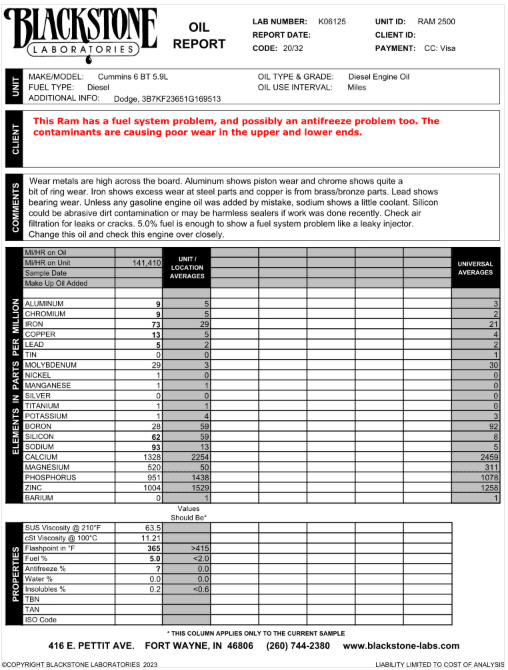
If you really want to know whether 3,000 miles is too early or 10,000 miles is too long for your specific truck, used oil analysis is one of the most scientific tools you can use to make data-driven maintenance decisions.
In the diesel truck community, Blackstone Laboratories is a trusted name for detailed testing. Sending a sample to a reputable lab like Blackstone Laboratories helps you determine the actual remaining life of your oil, identify hidden fuel dilution issues, and monitor if your engine components are experiencing abnormal wear metals.
A comprehensive used oil analysis report reveals critical engine health indicators that you simply cannot see on a standard dipstick:
- Fuel dilution: Checking for excessive diesel fuel entering the crankcase.
- Soot level: Measuring carbon buildup that turns oil black.
- Viscosity change: Ensuring the oil maintains the correct thickness to protect engine parts.
- Oxidation and additive life: Determining how much protective chemistry remains in the oil.
- Wear metals and coolant contamination: Early warning signs of internal engine issues.
For example, if you currently change Rotella T6 15W-40 every 3,000 miles, you could try extending it to 5,000 miles and verify the results with a lab report. If the analysis shows stable viscosity and low wear, 5,000 miles may be a perfectly safe interval for your truck. If not, you have clear data to stay conservative and investigate potential issues like injector health or idling habits.
Lubricants — An Integrated Methodological Approach for Interpreting Used Oil Analysis Results in Diesel Engines — is a useful non-commercial reference. You do not need to read a research paper to maintain your truck, but it reinforces the same idea: oil analysis is about making maintenance decisions with data instead of guessing.
Do CCV or PCV issues affect diesel engine maintenance?
When you are thinking about your diesel oil change interval, it is also worth checking the crankcase ventilation system, often called the CCV/PCV system.
On some Powerstroke, Cummins, and Duramax engines, CCV/PCV issues can allow oil mist into the intake system. Over time, that may contribute to intake oil mist, CCV filter concerns, and carbon buildup.
If your diesel truck has visible oil mist in the intake, recurring CCV filter issues, or more intake buildup as mileage climbs, the CCV/PCV system deserves a spot on your maintenance checklist.
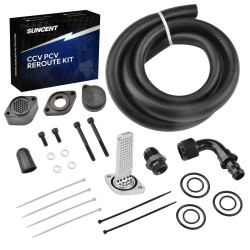
SuncentAuto offers CCV/PCV Reroute Kits for Powerstroke, Cummins, and Duramax diesel engines as part of a broader maintenance and upgrade plan.
To be clear: a CCV/PCV Reroute Kit is not a replacement for oil changes, and it should not be treated as a guaranteed way to extend your oil change interval. It is better understood as a related upgrade when dealing with oil mist, CCV filter issues, and carbon buildup.
If you are building a long-term diesel maintenance plan, look at your oil change interval, oil filter, fuel filter, and CCV/PCV system together instead of focusing only on mileage.
Should you use SeaFoam, Marvel Mystery Oil, or ATF before a diesel oil change?
Some owners think about adding SeaFoam, Marvel Mystery Oil, ATF, or other cleaners before an oil change to “flush” the engine.
For routine maintenance, that is usually not necessary.
Modern diesel engine oil already contains a carefully balanced additive package for cleaning, anti-wear protection, oxidation control, and deposit control. Adding extra chemicals can change how the oil behaves, especially in turbocharged engines, high-mileage engines, or trucks with emissions systems.
If you suspect sludge, fuel dilution, coolant contamination, or unusual wear, do not guess. Diagnose it.
- Check maintenance history.
- Inspect oil level and smell.
- Check the injection and cooling systems.
- Run a used oil analysis.
- Have a qualified technician inspect the truck if needed.
Additives are not magic, and they should not replace real maintenance or diagnosis.
What is a practical diesel oil change plan?
If you are not sure how often to change oil in your diesel truck, use this simple process.
1. Check the owner’s manual or OEM recommendation
Online advice should never replace factory maintenance requirements.
2. Confirm the correct oil specification and viscosity
This may include 15W-40, 5W-40, Rotella T6 15W-40, or another diesel-rated engine oil approved for your application.
3. Be honest about how you use the truck
Mostly highway? City driving? Occasional towing? Daily heavy towing? Lots of idle time? Your actual use matters more than someone else’s interval.
4. Use a quality oil filter
If you want to extend your oil change interval, do not cheap out on filtration.
5. Start conservatively
If you currently change oil every 3,000 miles, try 5,000 miles first instead of jumping straight to 10,000 miles.
6. Verify with used oil analysis
If you want to extend the interval, use data instead of guessing. A lab report can help you understand fuel dilution, soot, viscosity, wear metals, and whether your current interval is actually working.
7. Inspect related maintenance items
That includes the fuel filter, CCV/PCV system, intake oil mist, oil consumption, injection system condition, and engine hours.
Start conservative, verify with data, then extend carefully.
Final thoughts: What diesel oil change interval should you choose?
There is no perfect diesel oil change interval for every truck.
3,000 miles is conservative and makes sense for older trucks, short trips, towing, high idle time, and unknown maintenance history. 5,000 miles is often the best practical middle ground for many diesel pickups. 7,500–10,000 miles can work for healthy engines running full synthetic diesel oil, mostly highway miles, and ideally backed by used oil analysis.
And if your Powerstroke, Cummins, or Duramax is dealing with intake oil mist, CCV filter issues, or carbon buildup, consider adding CCV/PCV Reroute Kits to your long-term diesel maintenance plan.
The best diesel owners are not the ones who blindly change oil the earliest. They are the ones who understand how their truck is actually used.