 Contents
Contents
- The 2026 Diesel DPF Market: A "Perfect Storm" for Sellers
- The Rise of DPF Take-offs: Why "New-in-Box" Performance Matters
- 2026 DPF Take-off Market Valuation Table
- Strategic Trading: How to Verify and Protect Your DPF’s Value
- Professional Storage: Preventing "Invisible Depreciation"
- Where to Sell: Connecting with High-Value Buyers
- Is Your Garage Asset Gaining Value?
- FAQs
If you've ever walked into a scrap yard hauling a soot-covered Diesel Particulate Filter (DPF) only to treat it like a "pile of scrap metal," you’re likely leaving thousands of dollars on the table. In 2026, your factory exhaust system is no longer just an emissions component—it’s a high-yield "garage investment."
This guide breaks down the real-world market value of DPFs in 2026. We will show you how to maximize the returns on your hardware while staying within legal boundaries.
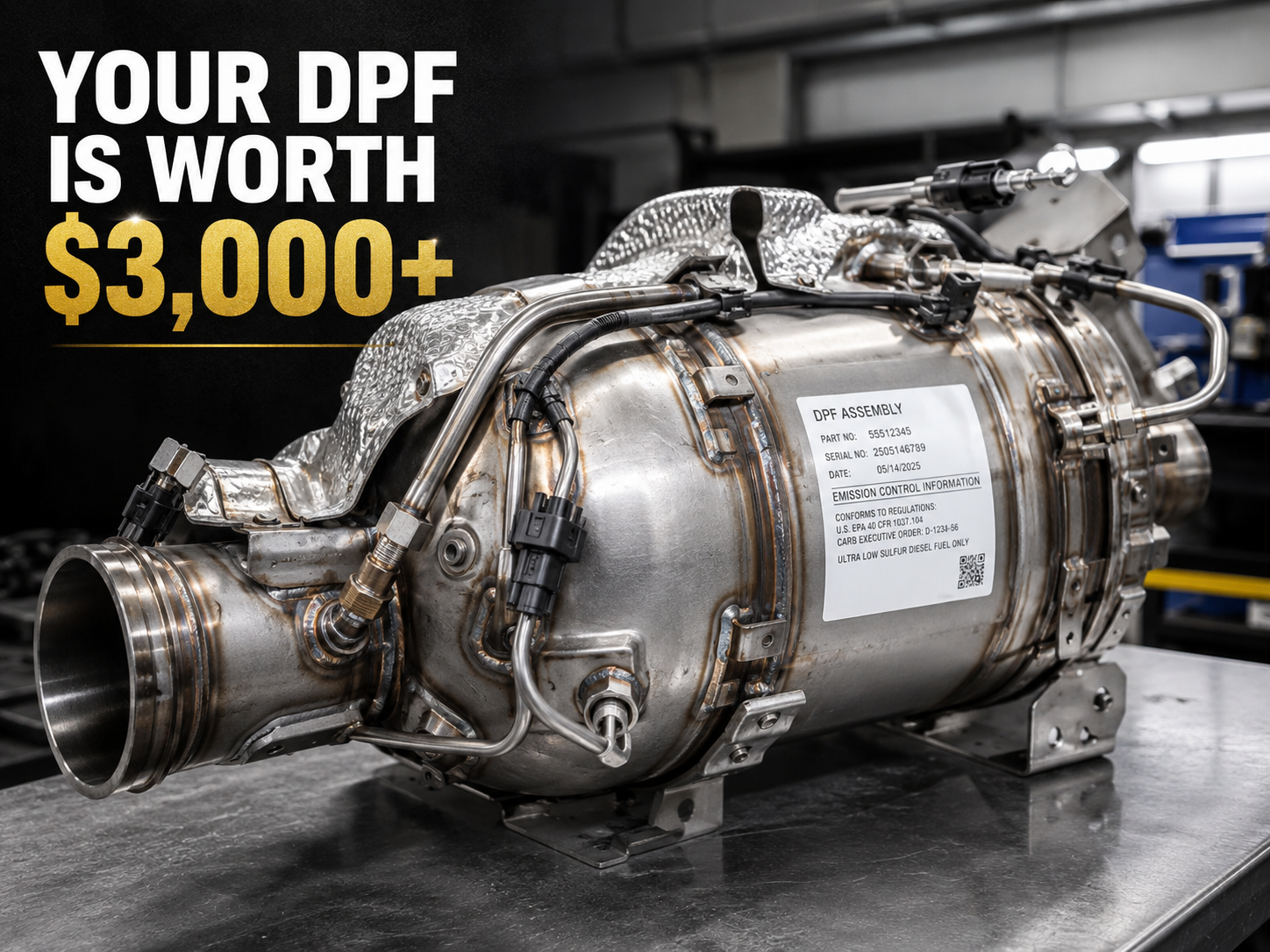
The 2026 Diesel DPF Market: A "Perfect Storm" for Sellers
The secondary market for diesel emissions hardware is currently seeing unprecedented demand. This "double-win" for owners is driven by two major factors:
1. Skyrocketing Precious Metal Values
Every OEM DPF is essentially a miniature mineral deposit. The internal honeycomb substrate is coated with Platinum-Group Metals (PGMs), specifically Platinum, Palladium, and Rhodium. Due to 2026 global supply chain volatility, these metals have hit multi-year highs.
Pro Tip: According to the latest Johnson Matthey PGM Market Report, the "Scrap Value" for a complete OEM DPF can range from $300 to $800, depending on the engine platform and PGM loading.
2. Compliance Pressure Creating Instant Demand
Why shouldn't you rush to the scrap yard? Because the hardware itself is becoming more valuable than the metal inside. Modern diesel aftertreatment systems have become incredibly sophisticated. As detailed in this study on 2026 EPA architectural shifts, replacing a failed unit with a new dealer part is now more expensive than ever.
While the DOJ adjusted enforcement priorities in early 2026, civil penalties and local roadside inspections remain aggressive. This has created a surge of buyers desperate for "Return-to-Stock" hardware.
The Bottom Line: When you sell to a recycler, you are selling "Metal." When you sell to a fellow truck owner, you are selling "Compliance."
The Rise of DPF Take-offs: Why "New-in-Box" Performance Matters
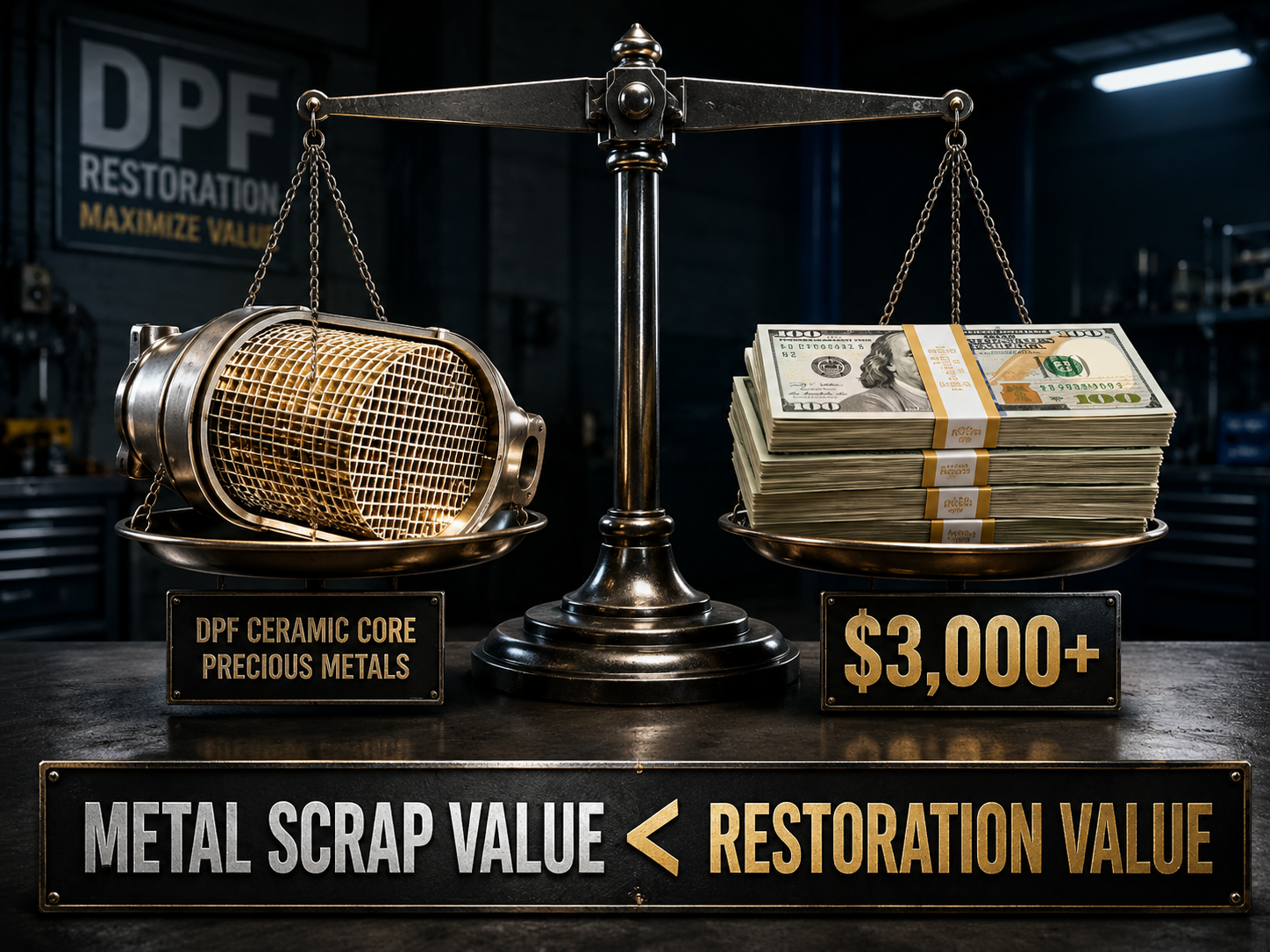
In the diesel community, a "Take-off" refers to an OEM exhaust system removed by the owner shortly after purchasing the vehicle—often with near-zero miles. In 2026, these pristine components are trading at a massive premium over their raw recycling value.
The "Return to Stock" Wave
While federal enforcement has shifted focus, state-level mandates like California’s CARB HD I/M program have become increasingly rigorous. This has triggered a massive "Return to Stock" movement among diesel owners.
- The Resale Barrier: In most jurisdictions, a truck without its factory emissions equipment cannot be legally sold or pass annual inspections.
- Supply Chain Crises: With dealership replacement parts often stuck on backorder and quoted at $6,000+, a mint-condition Take-off is often a buyer's only solution to stay on the road.
Why 2025+ Model Year Units Command Top Dollar
Beginning in 2025, diesel manufacturers moved from "sensor-heavy" to "model-predictive" emissions logic. This shift made the hardware significantly more complex and expensive to manufacture.
Integrated Sensor Arrays: A modern 2026 DPF is no longer just a filter. It is a high-tech module featuring:
- High-performance NOx Sensors (Retailing at $400+ each).
- Multi-point EGT (Exhaust Gas Temperature) probes.
- Advanced PM (Particulate Matter) sensors.
Selling your Take-off with these sensors intact can effectively double your payout compared to selling the bare canister.
2026 DPF Take-off Market Valuation Table
To give you a baseline for your "garage assets," here is an estimate of current market values based on May 2026 transaction data:
| Engine Generation | Model Years | Scrap (Recycle) | Take-off (Resale) | Dealer OEM Price |
|---|---|---|---|---|
| Early 6.7L / LML | 2011-2016 | $300 - $600 | $800 - $1,200 | $3,500+ |
| Late L5P / 6.7 v3 | 2017-2023 | $400 - $800 | $1,500 - $2,500 | $5,000+ |
| 2025+ Platforms | 2025-2026 | $500 - $1,000 | $2,500 - $3,500+ | $7,500+ |
*Prices vary by engine manufacturer (Ford, GM, Cummins) and geographic demand.
Strategic Trading: How to Verify and Protect Your DPF’s Value
In the 2026 market, selling a DPF isn't just a transaction—it's a high-stakes negotiation. To walk away with top dollar, you need to prove your hardware's integrity and leverage the "Information Gap" against low-balling core buyers.
1. Valuation Tactics: Beyond the "Flat Rate" Offer
Many roadside buyers offer a "flat rate" based on the oldest, least valuable scrap. To maximize your payout, use these two leverage points:
- The OEM Serial Number (PN) Advantage: For 2025+ models, the internal Washcoat (the layer containing the precious metals) is highly optimized. Before talking to a buyer, photograph the serial number on the canister. A professional buyer can use this to verify the exact PGM loading, giving you the leverage to demand a premium above "standard" scrap rates.
- Honeycomb Integrity Check: The core's condition determines if your DPF is "Gold" or "Trash." Use a high-lumen flashlight to inspect the internal Honeycomb structure.
- Pristine: Uniform cells with no cracks or melting.
- Devalued: Any signs of "Face Plugging," cracking, or melting from extreme heat can drop the resale value by 80% or more.
2. The Essential "Value-Add" Checklist
Buyers looking for "Drop-in Ready" solutions will pay significantly more if the package is complete. Ensure your Take-off includes:
- Complete Aftertreatment Stack: The DOC, DPF, and SCR modules (ideally as one un-cut assembly).
- The Sensor Suite: This is your 2026 profit-maker. Ensure the NOx sensors, EGT probes, and PM sensors are included. As noted in the 2026 EPA System Shift, these sensors are now critical for vehicle-specific ECU handshakes.
- OEM Clamps & Gaskets: These small parts are often backordered. Including them builds trust and commands a "convenience fee."
- Uncut Wiring Harness: NEVER cut the wires to save time during removal. An intact harness is the only way to prove a "Zero-Mile" Take-off status.
⚠️ 2026 Legal Alert: Repair vs. Tampering
While the DOJ has de-prioritized criminal charges for emissions tampering (see our 2026 Compliance Update), civil enforcement remains. Selling your hardware as a "Replacement Part for Repair" is a safer legal posture than selling it as part of a "Delete Package." Always document your sale as a parts transfer for restoration purposes.
Professional Storage: Preventing "Invisible Depreciation"
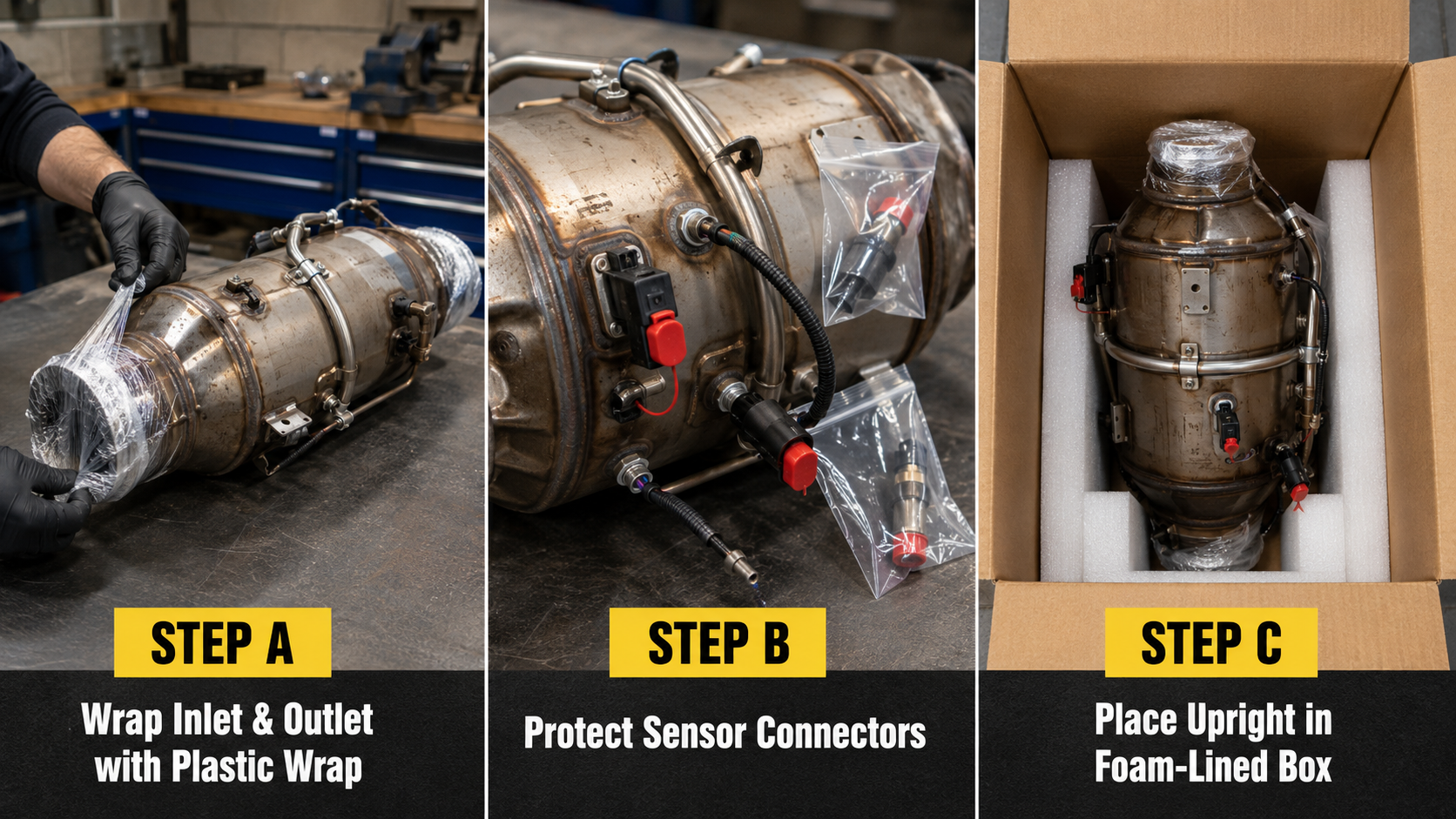
The core of your DPF is a fragile ceramic substrate (Cordierite or Silicon Carbide) that is highly susceptible to moisture and impact. If you plan to hold your Take-off for a future "Return to Stock" or a high-value sale, proper storage is non-negotiable.
1. Hermetic Sealing: Fight the Humidity
Once removed, immediately seal the inlet and outlet ports using heavy-duty plastic wrap or the original OEM caps.
- The Risk: If moisture enters the ceramic pores and undergoes freeze-thaw cycles or long-term stagnation, it can cause the substrate to crack.
- Pro Tip: Place silica gel desiccant packs inside the wrapping to ensure the internal environment remains bone-dry.
2. Shock & Vibration Protection
Think of the DPF core as fine china. A single drop can shatter the internal honeycomb, rendering it useless for emissions filtration.
- Vertical Storage: Always store the unit vertically in a foam-lined, heavy-duty box.
- No Concrete Contact: Never store the metal canister directly on a concrete garage floor. Temperature fluctuations and moisture wicking can cause external corrosion and internal thermal stress.
3. Corrosion Mitigation for Sensors
The stainless steel shell is durable, but the 2026-gen sensor connectors are prone to pin oxidation.
- Dielectric Grease: Apply a small amount of high-quality dielectric grease to the sensor pins before capping them with moisture-proof bags.
- Wiring Management: Coil the harnesses loosely. Tight kinks can cause internal wire fatigue, leading to "ghost" sensor codes that are impossible to troubleshoot later.
Why This Matters: A "mint condition" 2026 DPF with zero external oxidation and a verified clean core can command a 25% premium over one that has been left to sit in a damp corner of a shop.
Where to Sell: Connecting with High-Value Buyers
In 2026, the highest payouts don't come from generic scrap yards; they come from niche diesel enthusiasts and commercial fleets facing compliance deadlines. Here is where to find them:
- Specialized Diesel Communities: Platforms like The Diesel Marketplace, Duramax Forum, or Powerstroke.org are gold mines. These users understand the $7,000+ dealer replacement cost and are willing to pay a premium for a "Plug-and-Play" OEM Take-off.
- Local "Return-to-Stock" Buyers: Search Facebook Marketplace or Craigslist using keywords like "DPF replacement" or "Stock exhaust needed." You will likely find local owners desperate to pass their annual CARB or EPA inspections.
- Avoid the "Scrap Trap": Unless your DPF is physically shattered or melted, avoid "weight-based" recyclers. They pay for the metal, not the engineering—meaning they’ll offer you $600 for a part you could sell for $2,500.