 Contents
Contents
- What Is a Straight Pipe on a 6.0 Powerstroke?
- 6.0 Powerstroke Straight Pipe Exhaust Type Comparison
- Which 6.0 Powerstroke Straight Pipe Setup Is Best for You?
- How to Choose: 3.5 Inch, 4 Inch or 5 Inch Straight Pipe?
- What Does a Straight Piped 6.0 Sound Like?
- Is a 6.0 Powerstroke Straight Pipe Legal?
- Does a Straight Pipe Exhaust Require Tuning?
- Conclusion
- FAQs
For owners of the Ford 6.0L Powerstroke diesel engine, upgrading to a straight pipe exhaust system is one of the most popular modifications. The 6.0 Powerstroke engine is well known for its distinctive VGT (Variable Geometry Turbocharger) whistle and strong performance potential. By removing restrictive factory exhaust components, a straight pipe exhaust can significantly improve engine breathing, lower exhaust gas temperatures (EGT), and deliver a much more aggressive exhaust sound.
This article will take an in-depth look at every aspect of a 6.0 Powerstroke straight pipe exhaust to help you choose the modification setup that best suits your vehicle.
What Is a Straight Pipe on a 6.0 Powerstroke?
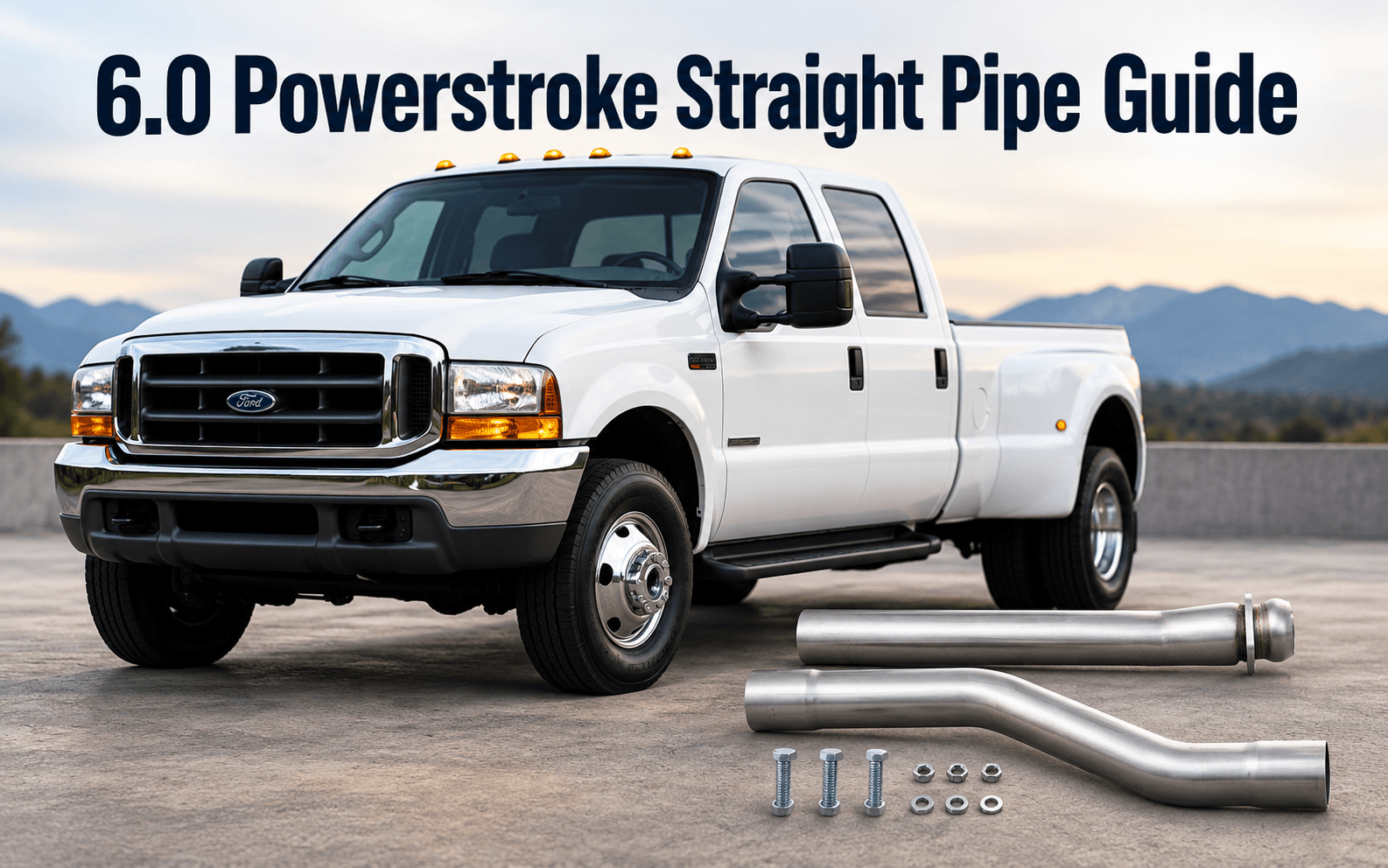
A " straight pipe exhaust" refers to removing or replacing components in the exhaust system that restrict airflow, allowing exhaust gases to exit from the turbocharger with as little restriction as possible.
The exhaust flow of a 6.0 Powerstroke is:
Turbo outlet → Downpipe → Catalytic Converter (Cat) → Mid-Pipe/Muffler → Tailpipe
Key Point: The 6.0 Powerstroke (2003–2007 model years) did not come with a DPF (Diesel Particulate Filter) from the factory. The DPF was not introduced until the 2008 6.4L engine. Therefore, exhaust modifications on the 6.0 Powerstroke do not involve a DPF Delete at all. The main components being discussed are the Catalytic Converter (Cat) and the Muffler.
On a 6.0 Powerstroke, the components commonly removed include:
- Catalytic Converter (Cat): Located between the downpipe and the mid-section of the exhaust. Its internal honeycomb structure is one of the primary sources of restriction in the exhaust system.
- Muffler: Its main function is to reduce noise, and it creates relatively little airflow restriction.
6.0 Powerstroke Straight Pipe Exhaust Type Comparison
Depending on where the replacement begins and how many components are replaced, 6.0 Powerstroke straight pipe exhaust modifications mainly fall into the following configurations:
| Type | What It Replaces | Sound | Performance / EGT | Legality | Best For |
| Muffler Delete Pipe | Muffler only | Louder, slightly more turbo whistle | Very little change | May violate noise laws | Low-cost sound upgrade |
| Cat Delete / Test Pipe | Catalytic converter only | More turbo whistle | Slightly lower backpressure and EGT | Not legal for street use | Track / off-road use |
| Cat-Back Exhaust | Exhaust after the Cat | Louder, but Cat still limits whistle | Small improvement | Usually street-friendly if Cat is retained | Daily driving |
| Downpipe-Back Exhaust | Cat and exhaust behind the downpipe | Louder with stronger whistle | Moderate improvement, lower EGT | Not street legal if Cat is removed | Mid-level exhaust upgrade |
| Turbo-Back Exhaust | Entire exhaust from turbo outlet | Loudest, strongest turbo whistle | Lowest backpressure and EGT | Depends on whether Cat is retained | Maximum sound and performance |
The main difference between Cat-Back and Downpipe-Back is the starting point. A Cat-Back system begins after the Cat and retains both the Cat and downpipe; a Downpipe-Back system begins after the downpipe, retaining the downpipe but replacing/removing the Cat. Because the factory Cat on the 6.0 Powerstroke is also one of the restrictive components, a Downpipe-Back system performs better than a Cat-Back system in both sound and airflow.
Which 6.0 Powerstroke Straight Pipe Setup Is Best for You?
Choosing the right exhaust configuration depends on your modification budget, how you use the truck, and how much noise—especially cabin drone—you are willing to tolerate:
- Maximum performance and extreme exhaust sound: Choose a 4-inch or 5-inch complete Turbo-Back straight pipe kit. It fully opens up exhaust flow and delivers the loudest exhaust sound.
- Daily commuting / towing balance: If you do not want excessive cabin drone during highway cruising, consider a Turbo-Back kit with a high-flow muffler, or retain the downpipe and only perform a Muffler Delete.
- Best value option: Purchase a Muffler Delete replacement pipe, keeping the rest of the factory exhaust system to achieve a noticeable increase in exhaust volume at the lowest cost.
Option 1: Turbo-Back + Retain Muffler (Cat Delete Optional)
- Features: The most balanced setup. It replaces the highly restrictive downpipe, delivering performance benefits and lower EGT. Retaining a high-flow muffler effectively controls highway drone while still producing a much more noticeable turbo whistle than stock. If emissions testing is required in your area, you can choose a version that retains the Cat.
- Best for: Daily driving, long-distance towing, and areas with emissions inspection requirements.
Option 2: Full Turbo-Back Straight Pipe (Cat Delete + Muffler Delete)
- Features: The maximum in both sound and performance. The entire exhaust is straight-through, producing the loudest possible turbo whistle, especially at idle and low speeds. The tradeoff is significantly increased cabin drone, particularly during highway cruising at 1800–2200 rpm.
- Best for: Non-daily-driven trucks, owners seeking maximum turbo whistle, and areas without emissions inspections.
Option 3: Muffler Delete Only
- Features: A low-cost way to improve sound. However, because the Cat remains in place, the increase in turbo whistle is limited and there is almost no performance benefit. The primary change is increased exhaust volume.
- Best for: Owners on a limited budget who only want more exhaust sound.
How to Choose: 3.5 Inch, 4 Inch or 5 Inch Straight Pipe?
This is one of the most common questions among 6.0 Powerstroke owners. The conclusion can be summarized simply: the difference between 4-inch and 5-inch systems is mainly about sound rather than performance.
1. Muffler Delete / Cat Delete: 3.5 Inch
If you do not plan to replace the entire exhaust system and only want to cut out the factory muffler or catalytic converter and weld or clamp in a straight section of pipe, we recommend choosing 3.5 inches.
Why choose 3.5 inches? Because most of the factory exhaust tubing on the 6.0 Powerstroke chassis has a basic outside diameter of 3.5 inches. Purchasing a 3.5-inch Delete Pipe allows it to connect properly with the remaining factory exhaust tubing.

2. Downpipe-Back / Turbo-Back: 3.5, 4, or 5 Inches
If you plan to replace the mid- and rear exhaust or the entire exhaust system, you have significantly more options:
| Pipe Diameter | Compatible Setup | Sound | Performance / EGT | Installation | Best For |
| 3.5 Inch | Downpipe-Back / Turbo-Back / Cat or Muffler Delete | Closer to stock, milder whistle | Limited improvement | Easiest fit | Stock-power or quieter builds |
| 4 Inch(Most Recommended) | Downpipe-Back / Turbo-Back | Sharp, clear turbo whistle | Strong flow and lower EGT | Fits most trucks easily | Daily driving, towing, and performance |
| 5 Inch | Downpipe-Back / Turbo-Back | Deeper and louder, more drone | Best suited to high-power builds | Tightest fit | 500+ HP builds and deep exhaust sound |
From a performance perspective, a 4-inch system can easily support around 400–450 hp. Only when the turbo, injectors, and tuning have all been heavily upgraded and the target exceeds 500 hp does a 5-inch system begin to show a flow advantage.
From a sound perspective, a 4-inch system sounds "tighter," with a sharper and more penetrating high-frequency whistle; a 5-inch system sounds deeper and fuller, but produces more noticeable drone during cruising.
What Does a Straight Piped 6.0 Sound Like?
A straight-piped 6.0 Powerstroke has one of the most recognizable exhaust sounds in the pickup truck world:
Idle: A noticeable "jet engine" - like turbo whistle. Because the 6.0 uses a VGT turbo, changes in the vanes at idle create a distinctive breathing-like sound.
Acceleration: When you step on the throttle, the high-frequency turbo whistle quickly transitions into a rough, aggressive V8 diesel roar.
Cruising: During highway cruising, the sound is relatively steady, but with a 5-inch straight pipe, noticeable low-frequency cabin drone may be present.
Is a 6.0 Powerstroke Straight Pipe Legal?
Short answer: At the federal level, removing the catalytic converter is illegal . Removing the muffler itself is not federally illegal, but it may violate local noise laws.
U.S. federal law (Clean Air Act Section 203(a)(3)(B)) explicitly prohibits removing or rendering ineffective any factory emissions control device, including the catalytic converter. This means a Cat Delete used for street driving is federally illegal throughout the United States, regardless of whether your state conducts emissions inspections.
The legal risk of a Muffler Delete is much lower. A muffler is not considered an emissions control device, so removing it does not create a federal emissions violation. However, many states and local municipalities have noise ordinances, and an excessively loud exhaust may result in a citation.
Actual enforcement varies by location. In states without emissions inspections, cat deletes are rarely actively checked during everyday driving. However, in states or areas with emissions testing, such as California, parts of Colorado, Pennsylvania, and others, the vehicle will not pass inspection, and owners often need to retain the factory exhaust so they can reinstall it before testing.
A practical recommendation is: if your area requires emissions inspections, choose a Turbo-Back system that retains the Cat. This type of system replaces the restrictive downpipe while retaining the catalytic converter mounting position, allowing you to gain the performance benefits without creating inspection problems.
Does a Straight Pipe Exhaust Require Tuning?
Tuning is not absolutely required for an exhaust-only modification, but it is strongly recommended. The 6.0 Powerstroke does not have diesel oxygen sensors, so removing the Cat (catalytic converter) will not trigger a downstream oxygen sensor fault like it would on a gasoline vehicle. Most older 6.0 trucks can operate normally with a full straight pipe exhaust. However, because backpressure drops significantly after installing a straight pipe, the VGT turbo builds boost more quickly, and the computer (PCM) on some later model years—especially 2005–2007—may detect abnormal exhaust backpressure (EBP) and boost readings and trigger fault codes such as P0299.
When Is Tuning Required?
When an EGR Delete has been performed: If the EGR system is removed at the same time, the PCM will detect insufficient EGR flow or an electrical disconnection and immediately illuminate the Check Engine light. In this situation, a tuner is required to disable the EGR-related fault codes.
When you want to address VGT turbo control and fault codes: Tuning can recalibrate the control strategy for the VGT turbo vanes to prevent overboost or fault codes caused by the sudden reduction in backpressure.
What Can a Tuner Provide?
If you only replace the exhaust without tuning, you gain smoother exhaust flow, lower exhaust gas temperatures (EGT), and an extreme turbo whistle. However, if you want to truly take advantage of the exhaust system's increased flow capacity to make more power, tuning is essential. Tuning can optimize fueling and boost control, converting the improved exhaust flow into actual horsepower and torque.
Conclusion
Installing a straight pipe exhaust on a 6.0 Powerstroke is an excellent way to unlock the potential and distinctive sound of this classic diesel engine. Whether you choose the well-balanced 4-inch system or the more aggressive 5-inch system, a straight pipe exhaust can deliver lower EGT, faster throttle response, and an exhilarating exhaust sound. Before making the modification, be sure to carefully consider your sound preferences, installation difficulty, and local emissions regulations.