 Contents
Contents
- Which Ford Trucks Are Affected by the Fuel Pump Recall?
- What Is Wrong With the 6.7 Power Stroke High-Pressure Fuel Pump?
- What Are the Warning Signs of a Failing High-Pressure Fuel Pump?
- How Is Ford Addressing the 24S78 High-Pressure Fuel Pump Recall?
- What Changed With Ford Recall 26S17 in 2026?
- How Do You Check Whether Your Ford Still Has an Open Recall?
- What Should You Do If Your 6.7 Power Stroke Still Has an Open Recall?
- Final Checklist
- FAQs
The Ford 6.7L Power Stroke fuel pump recall has once again become a major topic among Super Duty owners.
Ford's 24S78 / NHTSA 24V957 safety recall potentially covers about 295,449 diesel trucks, including certain 2020–2022 Ford Super Duty models and 2021–2022 medium-duty trucks. In severe cases, the issue could cause a truck to lose motive power while driving, making this more than a minor mechanical problem.
More importantly, the recall story did not end with 24S78. In 2026, Ford issued 26S17 / NHTSA 26V158, requiring some trucks that had already received the earlier 24S78 repair to return for additional service.
So which 6.7 Power Stroke trucks are actually affected? What is going wrong inside the fuel pump? What warning signs should owners look for? Why is Ford using software updates as part of the repair? And if your truck already had 24S78 completed, do you need to check again?
Let's start with the affected trucks.
Which Ford Trucks Are Affected by the Fuel Pump Recall?
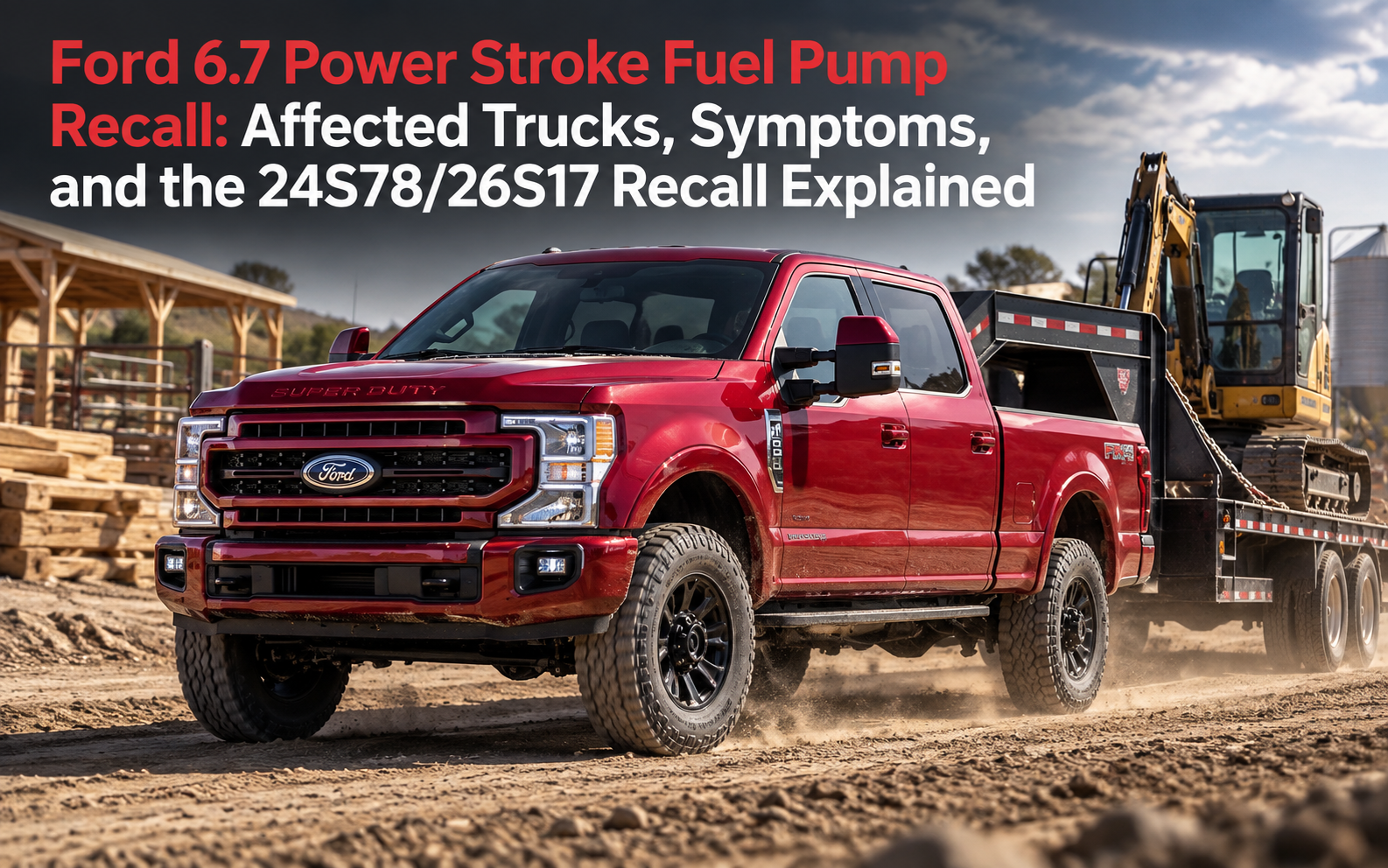
If you drive a 2020–2022 Ford Super Duty, especially an F-250 or F-350, Ford's 24S78 / NHTSA 24V957 high-pressure fuel pump recall deserves your attention.
According to Ford's official NHTSA safety recall filing, the recall potentially affects 295,449 vehicles equipped with the 6.7L Power Stroke diesel engine and the RP7 high-pressure fuel pump. Because many of these heavy-duty trucks are used for towing, hauling, and long-distance work, a fuel-system failure can have a much greater real-world impact than it would on a typical commuter vehicle.
Affected Models and Production Periods
| Model | Model Years | Main Production Period |
|---|---|---|
| Ford F-250 Super Duty | 2020–2022 | Feb. 19, 2019 – Aug. 23, 2021 |
| Ford F-350 Super Duty | 2020–2022 | Feb. 19, 2019 – Aug. 23, 2021 |
| Ford F-450 Super Duty | 2020–2022 | Feb. 19, 2019 – Aug. 23, 2021 |
| Ford F-550 Super Duty | 2020–2022 | Feb. 19, 2019 – Aug. 23, 2021 |
| Ford F-600 | 2020–2022 | Feb. 19, 2019 – Aug. 23, 2021 |
| Ford F-650 / F-750 | 2021–2022 | Certain 2021–2022 model-year trucks |
Important: Being within the listed model range does not automatically mean your truck needs repair.
Ford has stated that the affected vehicles were not built in a consecutive VIN sequence. That means two seemingly identical 2021 F-350 trucks can have completely different recall statuses.
Ford estimated that roughly 4% of the vehicles included in the recall population may actually contain the defect. In other words, being included in the recall population does not mean the fuel pump is guaranteed to fail.
The most accurate way to know is to check your VIN through Ford or contact a local Ford dealer.
What Is Wrong With the 6.7 Power Stroke High-Pressure Fuel Pump?
To understand why recall 24S78 matters, it helps to understand the role of the high-pressure fuel pump in the 6.7L Power Stroke.
The engine uses a high-pressure common-rail diesel injection system. The high-pressure fuel pump, or HPFP, pressurizes the diesel fuel before supplying it to the injectors. If the pump can no longer maintain sufficient pressure, the engine may lose power, become difficult to start, or shut down.
The pump involved in this recall is the Bosch CP4 RP7. Ford's investigation found that, over time, aged biodiesel deposits can accumulate around critical areas inside the pump, including the drivetrain roller and tappet-body cooling passages.
These deposits can contribute to increased component wear and the production of metal debris inside the fuel system.
Why Does Ford Specifically Mention Aged Biodiesel?
A common question is: “Does using biodiesel automatically mean the CP4 pump will fail?”
No. It is more complicated than that.
Ford began seeing increased warranty claims involving the pump in 2021. During its investigation, Ford found aged deposits while examining failed components. The investigation also looked at fuel aging during periods when many vehicles remained parked for extended periods, including during the pandemic.
A more accurate way to describe the issue is this: On this specific group of trucks equipped with the RP7 pump, aged biodiesel deposits may contribute to abnormal internal wear. That does not mean biodiesel itself will damage every Ford diesel truck.
This is also why the recall focuses on trucks built during a specific production period rather than every Ford diesel vehicle.
One important date is Aug. 23, 2021. Ford replaced the RP7 with the updated RP8 version in production. The RP8 uses revised internal clearances intended to improve fuel flow and cooling. That date also corresponds with the end of the primary production period covered by this recall.
Why Can High-Pressure Fuel Pump Failure Be Dangerous?
This is not only a repair-cost issue. It can also become a safety issue.
F-250 and F-350 owners often use their trucks for fifth-wheel towing, heavy hauling, long-distance travel, or demanding jobsite work.
If the high-pressure fuel pump fails during highway driving or while towing a heavy load, the truck may lose motive power. In that situation, the risk is significantly different from a truck simply refusing to start in a driveway.
Ford estimated that only about 4% of the roughly 295,000 trucks included in the recall population may contain the defect. Rather than assuming the worst, owners should understand the warning signs that may appear before a more serious failure.
What Are the Warning Signs of a Failing High-Pressure Fuel Pump?
A failing 6.7L Power Stroke high-pressure fuel pump may show warning signs before a severe failure occurs. Ford's 24S78 / NHTSA 24V957 recall documentation and the later 26S17 notice identify symptoms that can range from early warnings to more serious drivability problems.
| Stage | Possible Symptom | What the Driver May Notice |
|---|---|---|
| Early Warning | Extended Cranking | The engine takes noticeably longer than usual to start. |
| Early Warning | Check Engine Light | The PCM detects an abnormal condition and illuminates the CEL. |
| Early Warning | Unusual Mechanical Noise | The engine or fuel system develops a new mechanical noise. |
| Early Warning | Reduced Power / Derate | Throttle response weakens, especially under load or while climbing a grade. |
| Severe Failure | No-Start | The engine cranks but cannot start because adequate fuel pressure cannot be established. |
| Severe Failure | Loss of Motive Power | The truck may lose drive power while traveling or towing. |
1. Early Warning Stage: The Truck Still Runs, but Something Is Wrong
Ford identifies several warning signs that owners may notice before complete fuel-pump failure.
- Extended Cranking: A healthy 6.7 Power Stroke normally builds the fuel pressure needed to start quickly. If the high-pressure pump begins losing performance, the engine may take longer to start. If your truck is within the recall population and has recently become consistently harder to start, it deserves attention.
- Check Engine Light: When fuel pressure falls outside its expected range, the PCM may store a Diagnostic Trouble Code and illuminate the Check Engine Light. This is also why Ford's 26S17 service procedure includes checking certain DTCs while updating the software.
- Unusual Mechanical Noise: Increased wear around the pump's roller and tappet areas may be accompanied by unusual mechanical noise. A new noise does not automatically confirm a CP4 failure, but it deserves attention when combined with hard starting, a CEL, or changing engine performance.
- Reduced Power or Engine Derate: If fuel pressure becomes unstable, throttle response may feel weak. The loss of power can be especially noticeable while towing, climbing a grade, or carrying a heavy load. The truck may also enter a reduced-power or derate condition.
2. Severe Failure Stage
If the problem progresses, high-pressure fuel-pump failure can lead to more serious drivability problems.
- Crank but No Start: The engine can still crank, but the fuel system cannot build enough pressure for the engine to start.
- Loss of Motive Power While Driving: This is the primary safety concern behind the recall. If the high-pressure pump fails while the truck is traveling at highway speed, passing, or towing a trailer, the truck may lose motive power.
Do these symptoms automatically mean the CP4 pump has failed?
No.
Low-pressure fuel-system problems, a restricted fuel filter, sensor failures, and other engine or fuel-system issues can also cause hard starting, a Check Engine Light, or reduced engine power.
The more useful approach is: affected vehicle + relevant symptoms → dealer diagnosis, rather than assuming every warning light means the CP4 has failed.
Important: Warning Signs Do Not Automatically Mean the Fuel Pump Is Already Destroyed
Extended cranking, a Check Engine Light, and reduced power are not symptoms exclusive to the Bosch CP4 high-pressure pump. Low-pressure fuel supply problems, a clogged diesel fuel filter, a faulty fuel-pressure sensor, or injector problems can cause similar symptoms.
The most reasonable diagnostic approach is:
Do not assume the CP4 is completely failed just because the Check Engine Light comes on.
That leads to one of the biggest questions owners have: If Ford identified a mechanical high-pressure fuel pump problem, why does the 24S78/26S17 remedy focus so heavily on software instead of automatically replacing every pump?
How Is Ford Addressing the 24S78 High-Pressure Fuel Pump Recall?
One of the biggest questions among owners is simple: If a mechanical CP4 component is wearing out, why is Ford primarily using a software update instead of replacing every pump?
The key is that Ford's strategy is not to use software to physically repair metal parts that are already damaged. Instead, Ford is using software changes to address the operating conditions believed to contribute to the problem.
The official 24S78 remedy includes having an authorized Ford dealer update the PCM (Powertrain Control Module) and TCM (Transmission Control Module) software.
Can Software Really Replace a Mechanical Repair?
It helps to separate trucks into two situations.
- Trucks with no symptoms or confirmed mechanical damage: The updated strategy is preventive. It improves the pump's operating environment and is intended to interrupt the deposit-and-wear cycle before serious damage develops.
- Trucks that already have significant wear or fuel-system damage: If internal components are already worn and producing metal debris, a software update obviously cannot make damaged metal parts repair themselves. Ford's recall process is identified as “Software, Inspect, Replace.” If relevant fuel-pressure faults or DTCs are found, the dealer may inspect and replace damaged components as needed.
In short, being included in the recall does not automatically mean the truck receives a brand-new HPFP. For many trucks with no existing failure symptoms, completing the required PCM/TCM software update is the primary recall procedure.
2026 Update: Why Do Some Trucks Need a Second Recall?
In 2026, Ford identified another problem: some trucks that had already completed the 24S78 recall may not have actually received the correct software version.
Ford therefore issued 26S17 / NHTSA 26V158, requiring dealers to verify and reinstall the correct software on affected trucks.
What Changed With Ford Recall 26S17 in 2026?
Many owners assumed that once 24S78 was completed, the HPFP issue was finished. In 2026, however, Ford issued another safety recall: 26S17 / NHTSA 26V158.
This was not a newly discovered fuel-pump failure mode. The issue was that some trucks may not have received the correct 24S78 software.
In other words, some trucks could show that 24S78 had been completed, while the correct software intended to address the original fuel-pump risk may not have actually been installed.
24S78 vs. 26S17: What's the Difference?
| Category | 24S78 / 24V957 | 26S17 / 26V158 |
|---|---|---|
| Core Issue | RP7 high-pressure fuel pump has a potential wear and failure risk. | Some trucks may have received the wrong software during the earlier 24S78 repair. |
| Failure Type | Original hardware/operating-condition issue. | Not a new HPFP defect. It corrects an earlier recall repair that may not have been properly completed. |
| Main Goal | Reduce and address the original high-pressure fuel-pump risk. | Install the correct PCM/TCM software and verify the repair. |
| What Owners Should Check | Whether the truck falls within the original recall population. | Even if 24S78 was already completed, check the VIN again. |
Recall 26S17 covers certain 2020 F-250 through F-550 trucks, 2021 F-250 through F-600 trucks, and 2022 F-250 through F-750 trucks. As with the earlier recall, owners should confirm eligibility by VIN.
What Does Ford Do Under Recall 26S17?
- Install the correct PCM/TCM software: This ensures the intended HPFP cooling and fuel-flow strategy is actually active.
- Check specific DTCs: The dealer checks the PCM for diagnostic trouble codes that may indicate a related fuel-system problem.
- Follow the appropriate repair path:
- No related DTCs: Complete the software update.
- Related DTCs found: The truck may require additional diagnosis or damaged-component replacement.
Why Should You Care About 26S17 If 24S78 Was Already Completed?
“24S78 Completed” does not automatically mean your truck cannot be included in 26S17.
If you have an old repair order showing 24S78 as completed, do not try to guess whether the dealer installed the correct software at the time. The practical step is to check the VIN again for a current open recall.
If your VIN does not show an open 26S17 recall, there is no reason to assume your truck is affected simply because another owner with a similar model received a notice.
If 26S17 does show as open, schedule the repair even if the truck currently drives normally.
The simplest way to understand the relationship is: 24S78 addresses the original HPFP risk; 26S17 addresses cases where the 24S78 remedy may not have been correctly completed.
How Do You Check Whether Your Ford Still Has an Open Recall?
Model year and vehicle type can tell you whether your truck may fall within the recall population. They cannot confirm the recall status of your specific truck.
For recalls such as 24S78 and 26S17, two trucks with the same model year and seemingly identical equipment may have different recall statuses. The most reliable method is to check the vehicle's current Open Recall status by VIN.
- Find your 17-digit VIN. You can usually find it at the lower driver's-side corner of the windshield, on the driver's-side door-jamb label, on the vehicle registration, or on your insurance card.
- Use the NHTSA Recall Lookup. Enter the 17-digit VIN and look for open recalls, especially 24S78 / NHTSA 24V957 and 26S17 / NHTSA 26V158.
- Confirm the result with Ford or an authorized Ford dealer. This is especially important if your truck previously had 24S78 completed. A Ford dealer can check the latest Field Service Action status associated with your VIN.
If NHTSA shows “0 Unrepaired Recalls”: that means there is currently no unrepaired safety recall associated with the VIN in the database.
Keep in mind that completed recalls usually no longer appear as open recalls, and newly announced campaigns can sometimes take time to populate across all affected VINs.
Recommended Recall-Check Process
What If the VIN Shows an Open Recall?
If your truck has an open safety recall, you do not need to buy parts yourself. Recall-related software updates, diagnosis, and covered repairs are handled by an authorized Ford dealer.
- If the truck currently drives normally: schedule recall service as soon as reasonably possible.
- If the truck already has warning symptoms: tell the dealer about hard starting, a CEL, unusual noise, or reduced power when scheduling the appointment.
What Should You Do If Your 6.7 Power Stroke Still Has an Open Recall?
If your VIN shows an open 24S78, 26S17, or another related recall, do not assume that “the truck still drives fine” means the issue can be ignored indefinitely.
The best approach is to identify the specific recall and then determine the urgency based on whether the truck is already showing symptoms.
Confirm the Recall Number Before Scheduling Service
Instead of simply telling the dealer, “I have a recall,” provide the VIN and the specific recall number.
- 24S78: The truck needs the remedy associated with the original HPFP risk.
- 26S17: The truck may have previously received incorrect software and needs the updated repair procedure.
Giving the dealer the recall code allows the service department to pull the correct Field Service Action procedure before your appointment.
If the Truck Already Has Symptoms, Tell the Dealer
If your truck has an open recall and is also experiencing extended cranking, a Check Engine Light, unusual mechanical noise, reduced power, or engine derate, mention those symptoms when scheduling the appointment.
A software update is part of the recall remedy, but a truck that has already developed mechanical wear or fuel-system damage may require additional DTC checks and diagnostic work.
Do Not Push a Truck With Noticeable Power Loss Into Heavy Towing or Long-Distance Work
An F-250 or F-350 that still moves normally when empty is not necessarily ready for heavy-duty towing or a long highway trip if it is already showing reduced power or derate symptoms.
If the truck is already showing clear drivability problems, avoid forcing it through demanding towing, fifth-wheel, or heavy-haul use until the issue has been evaluated.
Keep Your Recall Repair Records
After recall service is completed, keep the dealer's Repair Order and confirm that it documents:
- Recall number — 24S78 or 26S17
- Date completed
- Software update performed
- Whether relevant DTCs were found
- Whether any hardware was repaired or replaced
These records can be useful for future warranty questions, later diagnosis, and verifying maintenance history when selling the truck.
Final Checklist
Do not panic simply because you see “high-pressure fuel pump recall,” but do not ignore the issue just because your truck currently seems to run normally.
- Step 1: Check whether your VIN shows an open recall.
- Step 2: Schedule free recall service with an authorized Ford dealer.
- Step 3: Tell the dealer about hard starts, warning lights, noise, or power loss.
- Step 4: Complete the software update, DTC checks, and any required repair.
- Step 5: Keep the final repair order for your records.