 Contents
Contents
- What Does It Mean to Delete a Truck?
- Is It Legal to Delete a Diesel Truck Now? Recent Changes in 2026
- Legal Status and Real-World Enforcement Are Not the Same
- Can You Legally Delete a Diesel Truck Now?
- Why Legal and Financial Risks Still Matter?
- Is Every Type of Delete Equally Risky?
- Will Deleting Diesels Ever Be Legal?
- National Compliance Risk Map Analysis: Which Color Zone Are You In?
- Practical Advice for Truck Owners and Industry Professionals
- Summing Up
Are you following diesel shop talk, YouTube videos, or forums? If yes, you must have heard claims like “diesel deletes are legal now.” Right? Well, it is only half the story and can be dangerously misleading.
Emissions systems can be unreliable and costly, which frustrates truck owners. At the same time, recent changes in the US Department of Justice policy have made it even more confusing. Owners wonder what is less aggressively enforced and what is legal now.
This article clears up the confusion associated with the debate: Is it legal to delete a diesel now?, explain the legal changes in 2026 and the risks that still exist, so that you can make an informed decision.
What Does It Mean to Delete a Truck?
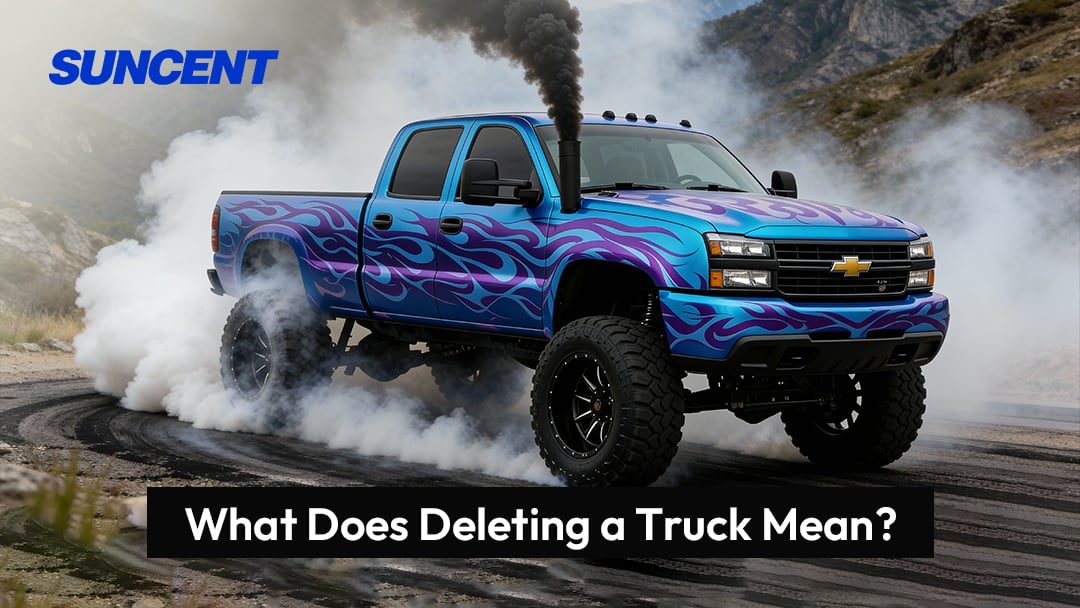
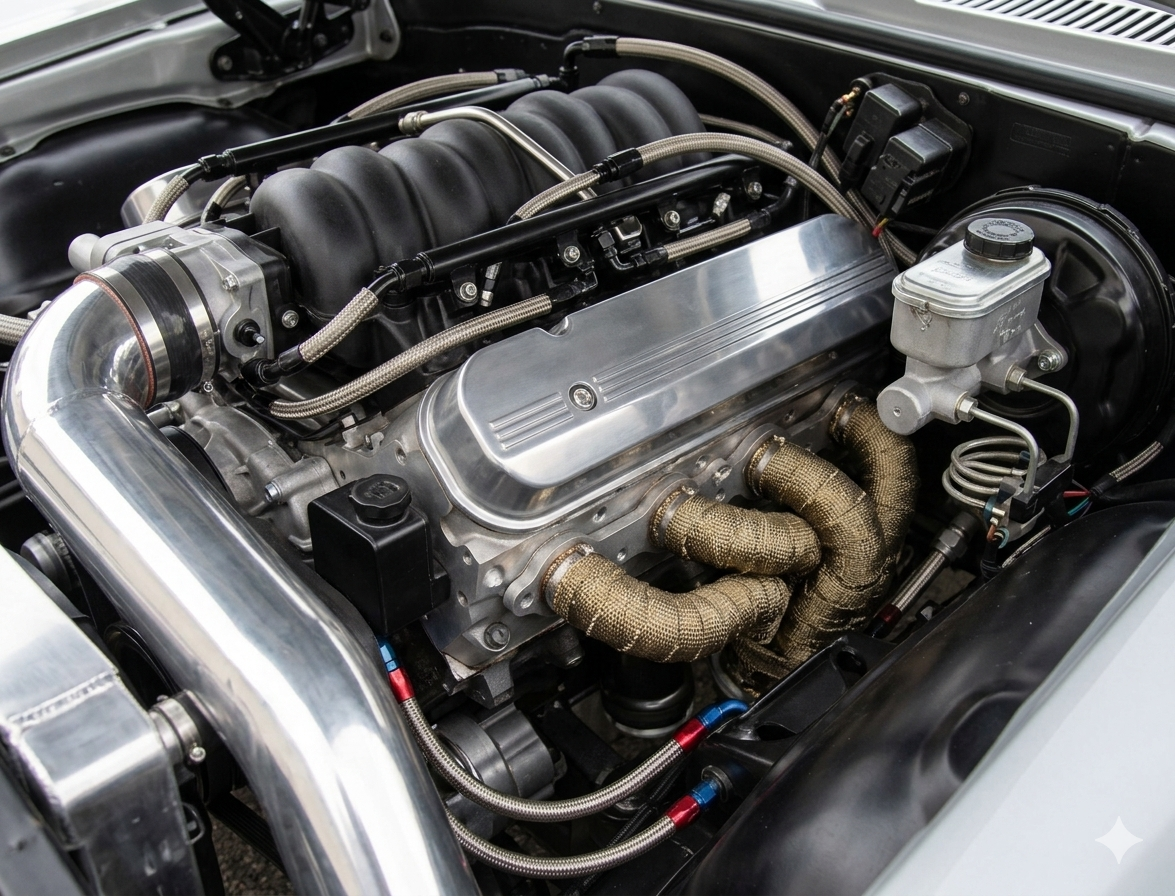
A diesel truck is commonly described as " deleted" when one or more factory emissions-control systems have been removed, bypassed, or electronically disabled. In legal terms, this is generally treated as emissions-system tampering.
Generally, the following emission controls are removed.
- Diesel Particulate Filter (DPF) removal
- Exhaust Gas Recirculation (EGR) system bypass or removal
- Selective Catalytic Reduction (SCR) system removal
- Recalibrating the ECU with a custom tune to avoid error codes and keep the vehicle running smoothly
Why Do People Delete Diesel Trucks?
This subject has not gained popularity randomly. There are solid reasons behind it. Common motivations are as follows.
- Reduced fuel economy
- Costly repairs
- Downtime affecting commercial vehicles
- Frequent regen problems
- Restricted engine performance due to emissions tuning
The Purpose & Drawbacks of Emissions Systems
Modern diesel emissions systems reduce NOx and soot (harmful pollutants). It plays a crucial role in improving air quality and environmental compliance. At the same time, these emissions systems may result in:
- Higher long-term ownership expenses
- More complex maintenance
- Frequent sensor failures and limp mode issues
Managing these expenses while helping the environment is what sparks the diesel delete debate.
Is It Legal to Delete a Diesel Truck Now? Recent Changes in 2026
Let's get into the deeper specifics of "are diesel deletes legal now" by understanding the US Department of Justice’s position and what civil enforcement covers.
Department of Justice Reduces Criminal Prosecutions
Recently, in January 2026, the Department of Justice (DoJ) changed its policy, creating one of the biggest confusions for many owners.
DoJ announced on X that they will no longer pursue criminal cases related to emissions systems deleted under the Clean Air Act. Their main focus is on those violating the emissions laws on a larger scale, e.g., major distributors and manufacturers.
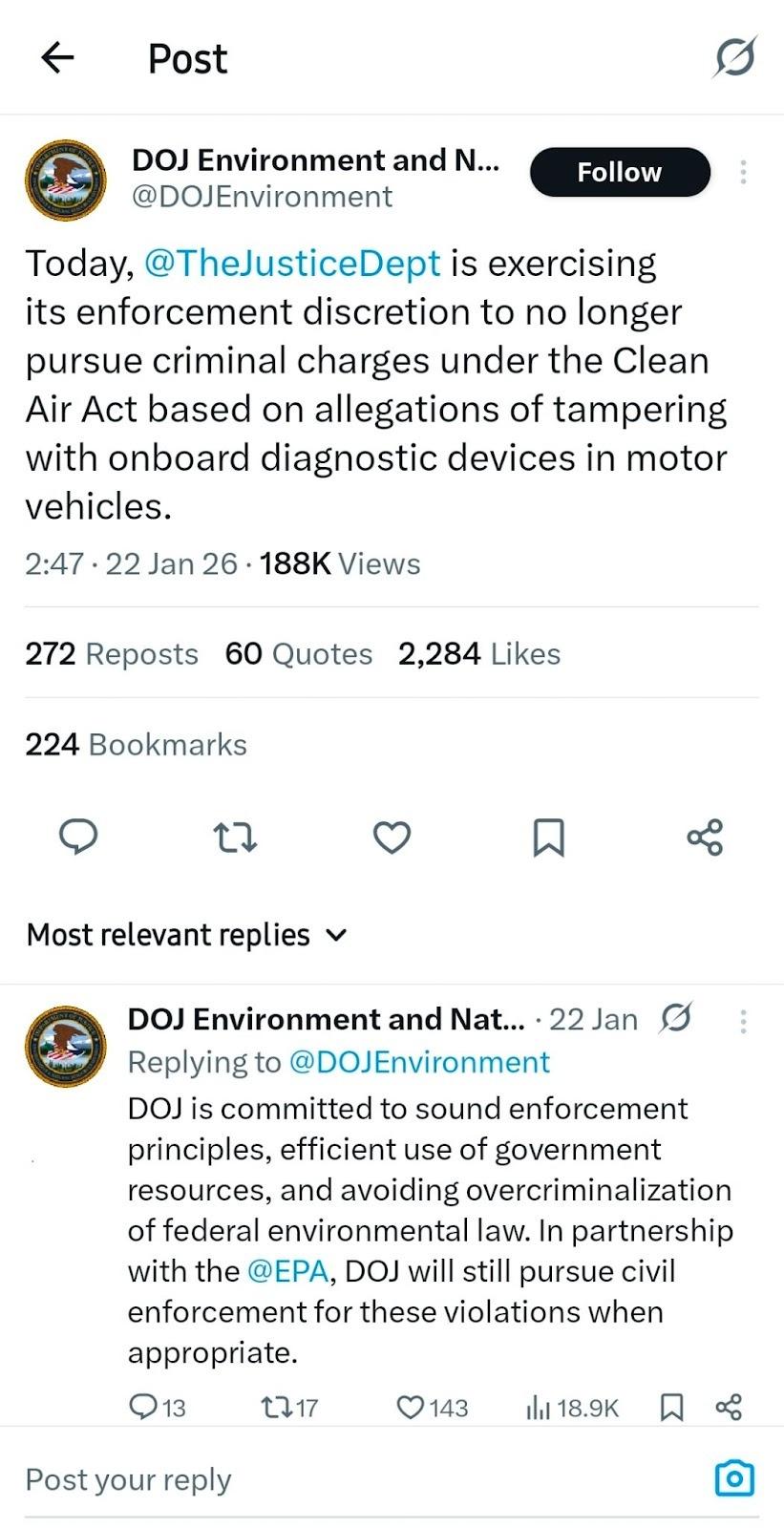
Important Note: It is an adjustment to the enforcement strategy—not a change in the law. Removing emissions systems is still illegal under federal law.
Civil Enforcement Still Exists
Although criminal prosecutions are less common, civil enforcement remains active. The Environmental Protection Agency (EPA) has the right to:
- Issue civil fines
- Target car owners, dealers, and businesses
- Penalize shops, parts sellers, and tuners
- Work alongside state environmental agencies
Under the Clean Air Act, tampering with emissions systems is strictly prohibited. Each violation may lead to thousands of dollars in fines.
Legal Status and Real-World Enforcement Are Not the Same
In 2026, one of the biggest misunderstandings is that a no-test state is not the same as a legal state. Even if your county does not require emissions testing, a diesel delete can still be considered non-compliant under federal law.
What has changed is mainly enforcement priority, not the legal standard itself. For truck owners, the more practical questions are whether the vehicle must pass an OBD scan, a visual inspection, or face problems during registration renewal, resale, or out-of-state title transfer.
Understanding the difference between legal status and real-world enforcement risk is essential before making any emissions-related decision.
Can You Legally Delete a Diesel Truck Now?
Below is a clear breakdown for better understanding.
Not Allowed
If your truck is
- Registered
- Driven on public roads
then you are not allowed to delete diesel emissions systems.
Off-Road Declaration ≠ Automatic Protection
Some owners think that labeling their trucks as “off-road only vehicles” makes diesel deletes legal. Well, this is not always true. In fact:
- They should never use the truck on public roads
- Enforcement agencies can investigate if there is a misuse
- Actual usage and documentation matter
Legal Use Cases
Diesel deletes are allowed under specific scenarios, such as:
- Unregistered vehicles that are not operated on highways
- Dedicated racing tracks
- Agricultural equipment
Even then, compliance is determined by how you actually use the vehicle—not simply what you claim.
Why Legal and Financial Risks Still Matter?
Despite the reduced criminal enforcement, the risks still remain significant. Let’s look at the common risks involved in deleting a diesel truck.
1. Civil Penalties
- Fines can be thousands of dollars per violation
- Higher fines for businesses or repeat offenses
2. Buying/Selling Risks
- Buyers may face compliance issues
- Some selling platforms don’t allow sellers to list modified/deleted vehicles
- Selling a deleted truck involved legal risks
If you later need to sell the truck, transfer it across state lines, or restore it for inspection, the cost of returning the emissions system to stock can be substantial—often in the range of $5,000 to $12,000.
3. Registration and Inspection Issues
Based on your state laws:
- You may not be able to renew the vehicle’s registration
- Restoring original parts can be expensive
- Vehicles may fail the emissions test instantly
4. Business and Shop Risks
Shops are at the highest risk. They may:
- Lose their business licenses
- Face legal consequences for offering tuning services or selling delete kits
- Heavy fines from regulatory authorities like the EPA
5. Is Every Type of Delete Equally Risky?
Is Every Type of Delete Equally Risky?
Not every diesel delete carries the same level of inspection risk. In practice, some modifications are much easier to spot than others, especially in states that combine OBD scans with visual inspections.
A DPF delete is often the most visible and most sensitive from a compliance standpoint. Because the DPF system involves major hardware and sensor changes, it is more likely to draw attention during inspections or diagnostics. If the DPF housing has been hollowed out, replaced, or removed, that can create immediate compliance problems.
An EGR delete may be less obvious during a basic visual check because many of its components are located within the engine bay. Even so, it can still be discovered during deeper diagnostics or closer inspection, especially when paired with tuning changes or other emissions-related modifications.
A downpipe or catalytic-related delete can also carry high exposure risk, particularly in stricter states. Non-compliant exhaust components are often easier to identify during visual inspection, even when the truck appears to run normally.
For truck owners, the key takeaway is simple: different delete types may carry different exposure risks, but none should be assumed to be legally safe for road-driven vehicles.
Will Deleting Diesels Ever Be Legal?
Though there is a lot of speculation, let’s discuss reality. Changes in the enforcement strategy do not mean that the removal of emissions systems is legalized. Even if the enforcement is more relaxed:
- The law remains unchanged
- Deleting emissions systems is still illegal
What Changes are Required to Make Diesel Deletes Legal?
If diesel deletes have to become legal:
- Every state will have to adopt its own policies
- Congress should amend the Clean Air Act
- EPA will need regulatory revisions
Overall, it seems a long process and not guaranteed at the same time.
Legal Reality vs. Political Narratives
You may often hear claims that the new administration might roll back existing regulations. Here is the truth:
- They do not override or change federal emissions laws
- Administrative shifts can only impact how rules are enforced
Wondering “will Trump make deleting diesels legal?” As of March 2026, the Trump administration has not taken any steps to make diesel deletes legal. However, the DoJ has pulled back on criminal prosecutions for diesel deletes under his setup.
National Compliance Risk Map Analysis: Which Color Zone Are You In?
Based on the latest enforcement intensity map compiled by SuncentAuto, we can divide the U.S. into five risk levels:
toLax(blue)titledRegulationStrictness-69dde19bd7e1d.png)
Red Zones (Strict): Typical Representatives — California (CA), Maine (ME)
This is a "No-Go Zone" for Delete enthusiasts.
- Core Characteristics: Enforcement of CARB (California Air Resources Board) standards.
- Inspection Methods: Rigorous OBD II scanning (checking if the ECU has masked codes) + Visual Inspection. Even if your exhaust has no black smoke, if an inspector finds the DPF canister hollowed out or replaced, the vehicle will immediately fail registration.
- Risk: Extremely High. The vehicle faces impoundment or massive fines.
Orange Zones (Moderately Strict): New York (NY), Colorado (CO), New Jersey (NJ)
These states follow closely in California's footsteps with robust legal frameworks.
- Core Characteristics: Tight annual inspection systems; highly sensitive to aftermarket parts without a CARB EO Number.
- Reality: If you have deleted your emissions in these areas, Registration Renewal will become a yearly "nightmare."
Yellow Zones (Moderate): Texas (TX), Pennsylvania (PA), Georgia (GA)
These states show significant regional variation.
- Core Characteristics: Usually only major metropolitan areas (e.g., Dallas, Atlanta) require emissions testing.
- Reality: Many owners choose to register vehicles in rural areas to circumvent testing, but be warned: if you enter urban areas and encounter a roadside inspection, the risk remains.
Blue and Light Green Zones (Lax/Moderate-Lax): Florida (FL), Michigan (MI), Montana (MT)
These places are currently seen as "Safe Havens."
- Core Characteristics: No state-level emissions testing, or only basic safety inspections.
- Reality: In these states, deleted vehicles are rarely hindered by the DMV during daily use.
Section Core Viewpoint: While you may be "perfectly fine" in a Blue Zone, remember: many states are not "Legal," they just "don't check much right now." If you plan to sell the vehicle to an out-of-state buyer or need to transfer registration across state lines, these color differences will directly determine whether your vehicle is an "Asset" or a "Liability."
Practical Advice for Truck Owners and Industry Professionals
Understanding emissions regulations in 2026 can be confusing, especially amid changing enforcement priorities and conflicting online information. Whether you are a fleet operator, truck owner, or shop professional, maintaining a good balance between cost, performance, and legal compliance is key.
Bottom-Line Advice for Owners
If your truck is used daily for work (towing or driving):
- Don’t assume relaxed enforcement means legalization and no consequences
- Keep repairs and maintenance records to protect the sale value and stay compliant
- Be cautious of online sellers promoting legal diesel deletes, forums, or misleading claims
- Avoid deletes on road-driven trucks/vehicles
Practical Tips for Industry Professionals
If you work in the diesel industry, you are exposed to even greater risks. Here is what you should do.
- Avoid installing or selling delete kits for road-going vehicles.
- Focus on offering compliant services, such as OEM repairs, diagnostics, and DPF cleaning.
- Always ensure you are well familiar with the state regulations and EPA enforcement strategies
- Build customers’ trust by clearly communicating legal risks to them.
Nowadays, many shops have started focusing on legal performance enhancements and maintenance services. Doing this will help them maintain profitability while mitigating legal risks.
Safe and Compliant Alternatives
Considering smart, safe, and long-term solutions is recommended instead of deleting your diesel trucks. For example, you can:
- Use high-quality diesel and additives to minimize soot buildup
- Upgrade EPA-compliant performance components/parts
- Perform routine DPF cleaning to avoid clogging and expensive replacements
- Fix underlying problems, such as driving patterns, faulty sensors, or injectors.
These approaches not only maintain legality but also improve operational reliability and extend your truck’s service life.
If You Are Considering Delete-Related Products
For vehicles intended solely for off-road, racing, or competitive use—that is, unregistered vehicles that have never been driven on public roads—some owners still choose to remove relevant parts. If your specific use case meets these requirements, consider SuncentAuto, which offers a range of integrated removal kits and individual components suitable for such applications. Please ensure your intended use complies with local, state, and federal regulations.
Summing Up
Wondering, “Can I delete my truck now?” Technically, it is possible, but it involves legal risks, such as federal law violations, civil liability, state-level complications, resale consequences, and warranty or insurance issues.
Shift in the DoJ’s 2026 policy impacts enforcement strategies, not the legality of diesel deletes. They are still illegal under the federal law.
If you are an everyday truck owner, make sure you stay updated and compliant, and don’t believe in misleading claims and catchy headlines like “deleting a diesel truck is legal now.”