 Contents
Contents
- Quick Answer: Is a 2003 Dodge Ram 2500 5.9 Cummins Worth Buying?
- What Makes the 2003 5.9 Cummins Special?
- 2003 5.9 Cummins Specs
- What Should You Check Before Buying a 2003 5.9 Cummins?
- How Many Miles Is Too Many for a 5.9 Cummins?
- Common 2003 5.9 Cummins Problems: Diagnosing Them by Symptoms
- What Are the Most Important Maintenance Items for a 2003 5.9 Cummins?
- What Should You Monitor While Towing With a 2003 5.9 Cummins?
- 4" vs 5" Cummins Exhaust: Which One Should You Choose?
- Conclusion
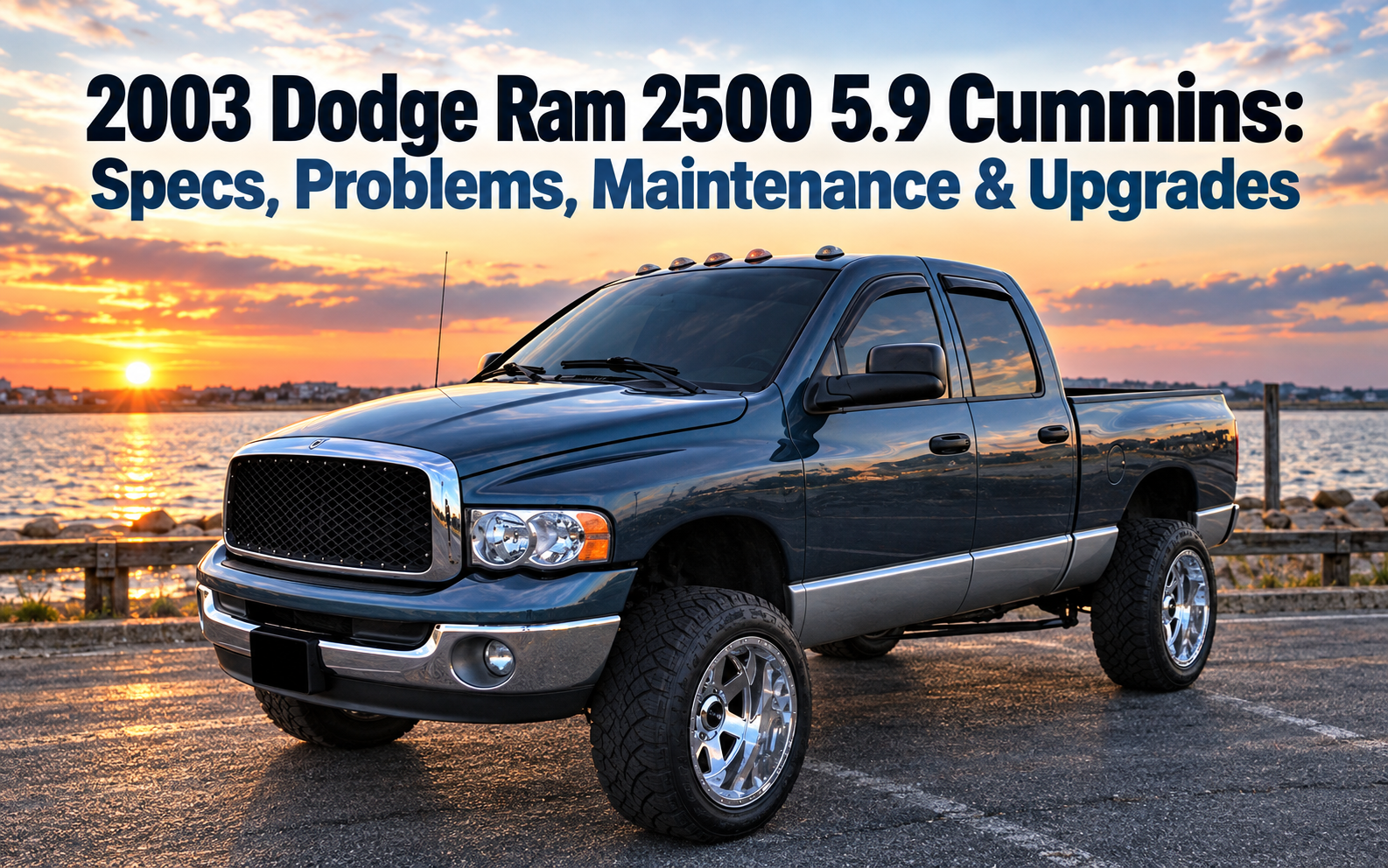
The 2003 Dodge Ram 2500 5.9 Cummins still holds its own today and remains highly sought after in the used-truck market, heavy-duty towing community, and diesel performance scene. As the first model year of the third-generation Ram, one of its biggest upgrades was the move to high-pressure common-rail fuel injection, which improved both power delivery and engine refinement.
That said, this is now a truck that is more than 20 years old. When buying or owning one, you cannot rely on the Cummins engine's reputation for durability alone. Fuel injectors, the transmission, front-end components, rust, and previous modifications all deserve careful attention.
This guide covers the key specs, used-truck inspection points, common problems, maintenance needs, towing considerations, and upgrade options to help you decide whether a 2003 Ram 2500 5.9 Cummins is right for you and where to start when something goes wrong.
Quick Answer: Is a 2003 Dodge Ram 2500 5.9 Cummins Worth Buying?
If you are considering one of these trucks, the appeal goes beyond the 5.9 Cummins' reputation for durability. It combines strong low-end torque, serious towing capability, a huge aftermarket, and a much simpler emissions system than later diesel trucks.
At this age, however, the truck's actual condition and maintenance history matter far more than the mileage shown on the odometer.
- A truck with 200,000 miles that has been properly maintained and has healthy injectors and a solid transmission may be a much better buy than a 120,000-mile truck that spent its life towing heavy loads, has little service history, or was poorly modified.
Key Things to Check Before Buying
- Cold start: Does it start quickly? Is the idle smooth? Is there white or blue smoke?
- Engine condition: Check crankcase blow-by at the oil fill cap.
- Transmission: On an automatic truck, check for slipping or delayed response during acceleration.
- Front end: Look for excessive steering play or looseness in the front suspension.
- Rust: Inspect the frame, bed, and structural areas for serious corrosion.
If these major areas are in good condition, a 2003 Ram 2500 can still be a dependable work truck with plenty of upgrade potential. If the maintenance history is missing or the truck has a long list of questionable performance modifications, factor future repair costs into the purchase price.
What Makes the 2003 5.9 Cummins Special?
2003 was a major milestone in the evolution of the 5.9L Cummins. The Ram 2500 moved away from the previous-generation VP44 injection pump and adopted Bosch high-pressure common-rail fuel injection.
What did the common-rail system change?
- Smoother and quieter operation: It significantly reduced the harsh vibration and diesel clatter associated with earlier engines, making the truck more refined for everyday driving.
- More precise fuel control and greater tuning potential: The Bosch CP3 high-pressure pump and electronically controlled injectors allowed more precise control over injection timing and fuel quantity, while also creating more room for future performance upgrades.
The tradeoff is that the fuel system became one of the most important areas to monitor. If the truck develops hard cold starts, rough idle, white smoke, or unusual diesel knock, the fuel injectors, fuel pressure, and supply system should be checked before assuming there is a serious internal engine problem.
Important: Do not treat a 2003 truck as identical to a 2004.5–2007 model.
Although many owners group all 2003–2007 5.9 Cummins trucks together as third-generation models, 2004.5 was an important dividing point.
- 2004.5 and later versions received changes to power output, turbocharger configuration, and other engine components.
- 2003 and early-2004 engines retained an earlier configuration with a comparatively simpler emissions setup.
This matters when buying parts or modifying the truck. When shopping for a turbo, injectors, exhaust system, or tuner, do not rely on the broad “5.9 Cummins” label alone. Make sure the part is specifically listed for 2003–early 2004 applications. Parts intended for 2004.5–2007 trucks may not be directly compatible.
2003 5.9 Cummins Specs
The 2003 Ram 2500 used the well-known 5.9L inline-six, 24-valve Cummins turbo diesel and introduced Bosch high-pressure common-rail injection with the CP3 high-pressure fuel pump.
One of the most important details for buyers and modifiers is that Standard Output (SO) and High Output (HO) versions were both available. They differed not only in rated power but also in transmission combinations and supporting hardware.
| Item | 2003 Ram 2500 5.9 Cummins Specs |
|---|---|
| Engine | 5.9L Cummins Turbo Diesel |
| Configuration | Inline-six, 24-valve |
| Displacement | 5.9L |
| Fuel System | Bosch High-Pressure Common Rail |
| High-Pressure Fuel Pump | Bosch CP3 |
| SO Output | 235 hp / 250 hp @ 2,700 rpm depending on emissions calibration 460 lb-ft @ 1,400 rpm |
| HO Output | 305 hp @ 2,900 rpm 555 lb-ft @ 1,400 rpm |
| Turbocharger | Holset HY35W |
| Oil Capacity | Approximately 12 qt with filter |
| Intercooler | Air-to-Air Intercooler |
What Transmission Came With the 2003 5.9 Cummins?
When shopping for a used truck, confirming that it has a 5.9 Cummins is not enough. SO and HO versions were paired with different transmission options.
- SO: Commonly paired with the NV4500 five-speed manual or 47RE four-speed automatic. Later in the 2003 model year, the upgraded 48RE began appearing.
- HO: The classic early combination used the NV5600 six-speed manual. Later in 2003, the HO engine also became available with the 48RE four-speed automatic.
Before buying a used truck or ordering drivetrain or performance parts, confirm the SO/HO configuration and transmission using the VIN or engine information. This affects towing capability, future maintenance costs, and upgrade potential.
What Should You Check Before Buying a 2003 5.9 Cummins?
On a diesel truck more than 20 years old, mileage and paint condition should not be your primary decision factors. Cold-start behavior, fuel-system condition, transmission health, the front end, rust, and the previous owner's modifications provide a much better picture of whether the truck will be dependable or become a repair project.
Use the following checklist during your inspection.
1. Insist on a True Cold Start
Ask the seller not to warm the truck up before you arrive. Ideally, inspect it after it has been sitting overnight.
During the cold start, watch for:
- Excessively long cranking before the engine starts
- Rough idle or severe abnormal knocking immediately after startup
- Persistent white exhaust smoke
Important: If these symptoms disappear once the engine warms up, do not automatically assume everything is fine. They may still point to injector leakage, unstable fuel pressure, or another fuel-system problem.
2. Check Crankcase Blow-By
With the engine idling, remove the oil fill cap and place it loosely over the opening.
- Normal: The cap may pulse slightly or remain controllable by hand.
- Warning sign: Strong pressure blows the cap away or produces heavy oil mist. This may indicate reduced ring sealing or cylinder compression and should be followed by a professional compression test.
3. Watch the Exhaust Smoke
Observe the exhaust at idle and during acceleration. Smoke color can provide useful diagnostic clues.
| Smoke Color | What to Check |
|---|---|
| Persistent White Smoke | Poor injector atomization, injector leakage, incomplete combustion, or coolant entering a cylinder |
| Heavy Black Smoke | Restricted airflow, air-filter problems, boost leaks, excessive fueling, or an overly aggressive canned tune |
| Blue / Blue-White Smoke | Oil entering the combustion chamber; inspect turbo seals, piston rings, and valve seals |
4. Check the Engine Oil for Fuel Dilution
Do more than check the oil level. Smell the oil as well.
If the level is unusually high, the oil feels thin, or it has a strong diesel smell, fuel may be leaking into the crankcase. That can reduce lubrication and potentially lead to serious bearing damage or engine failure.
5. Test the Automatic Transmission
If the truck has a 47RE or 48RE automatic transmission, test several starts and acceleration runs.
- Is there a noticeable delay of more than one or two seconds when selecting Drive or Reverse?
- Does engine rpm climb without a matching increase in vehicle speed?
- Are shifts unusually harsh or inconsistent?
6. Inspect the Front Suspension and Steering
Front-end wear is common on third-generation Ram trucks. If possible, raise the front axle and inspect:
- Ball joints and tie rods
- Track bar and wheel hubs
- Steering components and front driveshaft play
If the steering wheel begins to shake violently after hitting a bump around 45–55 mph, or the truck wanders badly and shows uneven tire wear, the front end may require significant work.
7. Inspect for Structural Rust
Surface rust is not necessarily a deal breaker, but carefully inspect the rear frame sections, suspension mounting points, bed floor, rocker panels, and cab corners. Trucks from areas that heavily use road salt deserve extra attention for structural corrosion.
8. Review the Modification History
A modified 5.9 Cummins is not automatically a bad purchase, but properly documented upgrades are very different from random modifications.
Ask the seller:
- What tuner or programmer is installed?
- Have the injectors, turbo, or lift pump been upgraded?
- Has the transmission been upgraded?
- Is an EGT gauge installed?
If the seller cannot explain the modifications or the wiring has been poorly altered, proceed carefully. A well-maintained, mostly stock truck with good records is often a safer purchase than a heavily modified truck with an unknown history.
How Many Miles Is Too Many for a 5.9 Cummins?
For a 2003 5.9 Cummins, there is no fixed mileage at which the truck automatically becomes a bad purchase.
It is not unusual to find 5.9 Cummins trucks with 250,000 or even 300,000 miles still towing and working regularly. What matters more than the odometer is what has already been replaced and how the truck has been maintained.
- Under 150,000 miles — Relatively low mileage
Low mileage does not mean low risk. Age still affects rubber seals, suspension parts, fuel components, and other systems even when the truck has not been driven much.
- 150,000–250,000 miles — Common used-truck range
At this mileage, focus less on the number itself and more on whether major wear items such as injectors, transmission components, front-end parts, and cooling-system components have already been serviced.
- 250,000+ miles — High-mileage truck
The engine may still be healthy, but a complete inspection becomes more important. A truck with recently replaced quality injectors, a rebuilt transmission, and a refreshed front end may be a better buy than a 150,000-mile truck that has received very little maintenance.
The key takeaway: On a high-mileage truck, look closely at the replacement history for wear items. On a low-mileage truck, pay attention to age-related deterioration and problems caused by long periods of sitting. Do not let one mileage number replace a proper evaluation of the truck's overall condition.
Common 2003 5.9 Cummins Problems: Diagnosing Them by Symptoms
Many 5.9 Cummins problems produce similar symptoms, including hard starting, white smoke, power loss, and rough idle. The biggest mistake is replacing expensive parts simply because one symptom appears.
A more effective diagnostic approach is to check low-pressure fuel supply, common-rail pressure, and boost leaks before replacing costly components. Below are seven common problem areas and a practical diagnostic path for each.
1. Long Crank / Hard Start
- Cause: Rail pressure is building too slowly during cranking and may not reach the 3,000+ PSI starting threshold quickly enough.
- Diagnostic steps:
- Read live data: Monitor actual rail pressure while cranking.
- Check the low-pressure side: Measure lift-pump supply pressure and inspect the Fuel Filter for restriction.
- Perform an Injector Return Test: Excessive injector return flow can prevent rail pressure from building.
- Check pressure-control components: Inspect the FCA and Pressure Relief Valve.
- Evaluate the CP3: Only after the other items test normally should the CP3 high-pressure pump become a primary suspect.
Verification tip: If the truck is especially difficult to start after sitting overnight but runs normally once started, inspect the low-pressure fuel lines for air intrusion or small leaks.
2. Abnormal Smoke and Rough Idle
| Smoke Color | Diagnostic Direction | Priority Components to Check |
|---|---|---|
| Persistent White Smoke | Poor atomization, injector leakage, incomplete combustion, or coolant entering the cylinder | Injectors, cylinder compression, head gasket |
| Heavy Black Smoke | Overly rich condition caused by insufficient airflow or excessive fueling | Boost leaks, air filter restriction, tuner calibration |
| Blue / Blue-White Smoke | Engine oil entering the combustion chamber | Turbo seals, valve seals, piston rings |
Verification: If white smoke continues after the engine is fully warm and is accompanied by rough idle or diesel knock, injector atomization or leakage should be investigated.
3. Confirming Failed Injectors and Deciding Whether to Replace One or All Six
- Typical symptom combination: Hard starting, rough idle, persistent warm-engine white smoke, and diesel knock.
- Accurate diagnosis: Use an Injector Return Test together with a Cylinder Contribution Test to identify the affected cylinder.
- Replacement strategy:
- Replace one: Reasonable on a lower-mileage engine when testing clearly identifies only one failed injector.
- Replace the set: On a truck with more than 200,000 miles and six original injectors, one failed injector may indicate that the others are also approaching the end of their service life. Replacing the full set may reduce repeated labor costs.
4. Power Loss Under Heavy Load or While Towing
Diagnostic chain:
Restricted Fuel Filter → Weak Lift Pump Supply → Rail Pressure Drop → Boost Leak → Turbo / Wastegate Problem
Primary checks: A large share of high-load power-loss problems come from a restricted Fuel Filter that prevents the CP3 from receiving enough fuel or from Intercooler Boots that split or leak under boost.
Verification: Pressure-test the intake system with a Boost Leak Tester and listen for leaks around silicone couplers and clamp connections.
5. Automatic Transmission Slipping and Shift Problems
- Typical symptoms: Engine rpm rises without a matching increase in road speed, engagement is delayed by more than two seconds, or the Torque Converter fails to Lock-up.
- Diagnostic path: Check fluid level and condition → scan for transmission fault codes → evaluate the Torque Converter and Valve Body.
- Verification: During hard acceleration, compare engine rpm with vehicle speed. A sudden rpm flare without matching acceleration may indicate clutch slippage.
6. Excessive Steering Play and Front-End Noise
- Cause: Wear in the front axle and steering linkage caused by age, mileage, and heavy-duty use.
- Priority components: Ball Joints, Tie-Rod Ends, Track Bar, and Wheel Hubs.
- DIY check: Have one person move the steering wheel left and right while another watches the steering linkage underneath the truck. If the steering wheel moves before a linkage component responds, or if visible play appears at a joint, that component may be worn.
7. Coolant or Transmission Temperatures Rise While Towing
- Quick checks:
- Fan Clutch: When coolant temperature rises under load, listen for the strong airflow noise that indicates the fan clutch is engaging.
- Thermostat and Water Pump: Check for restricted thermostat opening or insufficient coolant circulation.
Verification: If coolant temperature climbs while towing uphill, manually downshift to increase engine rpm and fan/water-pump speed. Watch whether the temperature begins to drop.
What Are the Most Important Maintenance Items for a 2003 5.9 Cummins?
Maintaining a 20-plus-year-old 5.9 Cummins involves more than simply changing the oil based on mileage. As the truck ages, preventive maintenance for the fuel system, automatic transmission, cooling system, and rubber components often becomes just as important as maintaining the engine itself.
Core Preventive Maintenance Overview
| Maintenance Item | Recommended Service Interval | Key Maintenance Action |
|---|---|---|
| Engine Oil & Filter | Every 5,000–7,500 miles / every 6 months | Replace 15W-40 diesel engine oil and check the dipstick regularly |
| Fuel Filter | Every 10,000–15,000 miles | Replace with a high-efficiency diesel fuel filter and drain water from the separator regularly |
| Transmission Fluid & Filter | Every 20,000–30,000 miles, with more frequent service under heavy towing | Replace ATF+4 fluid and the internal filter; inspect fluid color and odor |
| Coolant System | Every 2–3 years / 50,000 miles | Clean the radiator exterior, replace long-life coolant, and inspect rubber hoses |
| Front-End Grease | Every 5,000 miles, typically with an oil service | Grease serviceable Ball Joints, Tie Rods, and other components equipped with Zerk Fittings |
Preventive Maintenance Checklist
1. Engine Oil & Filter: Monitor Oil Condition, Not Just Mileage
- Service guideline: The 5.9 Cummins requires approximately 12 qt of engine oil. Use a quality diesel-rated oil filter such as a Fleetguard or Mopar replacement.
- Preventive action: Check the dipstick regularly when the engine is cold, keep the oil level within the correct range, and watch for oil that appears unusually thin.
2. Fuel Filter: The First Line of Defense for the Common-Rail System
- Service guideline: The Bosch common-rail system is highly sensitive to dirt and water contamination. Inspect the Fuel Filter during regular oil-service intervals and replace it earlier when necessary.
- Preventive action: Drain the Water-in-Fuel separator regularly. After buying a used truck with an unknown service history, replacing the Fuel Filter along with the engine oil and oil filter is a sensible first step.
3. Transmission Fluid & Filter: Protecting the 47RE / 48RE
- Service guideline: Automatic transmissions should use fluid that meets Chrysler ATF+4 specifications. Avoid mixing it with generic ATF.
- Preventive action: If the truck tows frequently, regularly check the transmission fluid for color and odor. During service, replace the pan filter and inspect the pan magnet for excessive metal debris.
4. Coolant & Radiator: Protecting the Cooling System
- Service guideline: Periodically check coolant freeze protection and corrosion protection. Clean dirt and debris from the Radiator and the space between the Radiator and Intercooler.
- Preventive action: Inspect the Fan Clutch for silicone-fluid leakage and check the Water Pump pulley for excessive play.
5. Prevent Aging Problems in Rubber Components and Hoses
- Service guideline: A 2003 truck is well into the age range where rubber and plastic components can deteriorate even with relatively low mileage. Inspect them every six months.
- Preventive action: Check the Serpentine Belt for cracking, inspect upper and lower Radiator Hoses and Heater Hoses for swelling or softness, and look for cracking or leakage in low-pressure Fuel Lines.
6. Routine Front-End Lubrication and Inspection
- Service guideline: If aftermarket Ball Joints, Tie Rods, Track Bar components, or other parts have Grease Fittings, lubricate them regularly.
- Preventive action: When rotating tires or performing an alignment, inspect steering-linkage bushings and Wheel Hub seals for wear or early damage.
What Should You Monitor While Towing With a 2003 5.9 Cummins?
If you regularly tow heavy loads, pull a travel trailer, or climb long grades, the factory coolant gauge alone does not provide enough information. Heavy loads combined with hot weather can significantly increase thermal stress on the engine, turbocharger, and automatic transmission.
The goal of monitoring is not simply to track the highest number you see. It is to learn your truck's normal baseline readings under both unloaded and loaded conditions. When those values begin to change significantly under similar conditions, something deserves attention.
1. EGT: A Critical Towing Temperature
EGT, or Exhaust Gas Temperature, is one of the most useful measurements when towing. The deeper you push the throttle under load, the more fuel the engine receives and the faster EGT can rise.
- Temperature limit: With the probe installed upstream of the turbo in the exhaust manifold, do not hold EGT above 1,350°F for extended periods.
- Note: A probe installed downstream of the turbo in the Turbo-Back exhaust can read approximately 200°F–300°F lower. Always confirm probe location before comparing temperatures.
If EGT continues climbing:
- Ease off the throttle and reduce speed.
- Manually downshift to raise engine rpm and increase airflow and fan speed.
- Check for a Boost Leak or restricted air filter.
- If the truck has a Tuner, avoid adding more throttle simply to maintain speed while ignoring EGT.
2. Transmission Temperature: Especially Important for Automatic Trucks
The 47RE and 48RE can generate significant heat during heavy launches, stop-and-go towing, slow hill climbs, and situations where the Torque Converter is not in Lock-up. In some cases, transmission temperature can rise significantly before the coolant gauge shows anything unusual.
- Protection strategy: When transmission fluid temperature reaches a critical range, the control system may change Overdrive and Torque Converter Lock-up behavior to protect the transmission.
- If temperature rises:
- Reduce load and manually select a lower gear.
- Confirm the Torque Converter is entering Lock-up properly.
- Inspect the Transmission Cooler and cooler lines for airflow restrictions or debris.
3. Coolant Temperature: Watch the Trend, Not One Number
Coolant temperature shows how well the engine's cooling system is handling the current load. If temperatures remain stable on level ground but continue climbing on a long grade, the cooling system may be approaching its capacity.
- EGT and coolant temperature both rising: Engine load is very high. Reduce speed and downshift.
- EGT remains normal while coolant temperature rises: Look for a cooling-system problem. Check the Fan Clutch, Radiator, and debris trapped between the Radiator and Intercooler.
4. Boost: Useful for Detecting Airflow Problems and Boost Leaks
The value of a Boost Gauge is not simply seeing how much PSI the turbo can make. It allows you to monitor airflow health under load.
- Warning sign: Under the same load and grade, Boost is noticeably lower than normal while black smoke increases, EGT rises, and power drops.
- Primary checks: Inspect Intercooler Boots for splits or loose connections, check Clamps, and inspect the charge-air piping for a Boost Leak.
5. Fuel Pressure: More Important on Modified Trucks
A completely stock truck may not require constant Fuel Pressure monitoring. However, once you install an upgraded Lift Pump, larger injectors, or a Tuner, Fuel Pressure becomes much more important.
- Typical problem: The truck drives normally under light load, but power suddenly drops during a hard pull and Rail Pressure cannot keep up with commanded pressure.
- What it can mean: The low-pressure supply system may no longer be delivering enough fuel to keep the CP3 properly supplied under sustained load.
Recommended Three-Gauge Setup
| Truck Configuration | Recommended Three-Gauge Setup | Main Monitoring Focus |
|---|---|---|
| Automatic Transmission | EGT + Transmission Temp + Boost | Protect the engine and turbo from excessive heat, monitor automatic transmission temperature, and track boost-system health |
| Manual Transmission | EGT + Boost + Fuel Pressure | Focus on engine heat, boost-system condition, and fuel supply |
The most useful habit is to learn your truck's baseline. Know what EGT, Boost, transmission temperature, and fuel pressure normally look like when unloaded and while towing. A noticeable change under the same load and road conditions can provide an early warning before a larger problem develops.
4" vs 5" Cummins Exhaust: Which One Should You Choose?
For a 2003–early 2004 5.9 Cummins, both 4-inch and 5-inch exhaust systems are well-established upgrade options. The right choice depends mainly on how you use the truck, how much highway drone you are willing to tolerate, and how far the engine has been modified. A larger pipe does not automatically mean more horsepower.
4" vs 5" Exhaust Comparison
| Comparison | 4" Exhaust | 5" Exhaust | Owner Recommendation |
|---|---|---|---|
| Best Use | Daily driving, long-distance towing, mild modifications | More aggressive performance builds, show trucks, owners who prioritize a deeper exhaust note | For work trucks and daily drivers, 4" is generally the more practical choice |
| EGT Control | Provides a meaningful reduction in exhaust restriction and is sufficient for most towing applications | Offers very high exhaust flow for higher-horsepower, higher-boost combinations | On stock and mildly modified trucks, 4" is generally enough |
| Sound and Drone | More controlled exhaust note with less low-frequency highway drone | Deeper, louder sound with a stronger presence; more likely to produce highway drone while towing | If you regularly travel long distances with passengers or dislike drone, avoid choosing 5" solely for sound |
| Power Range | Suitable for stock engines through roughly 450–500 hp builds | Better suited to 500+ hp setups with larger injectors and turbochargers | Installing a 5" system on a stock truck will not automatically create a noticeable horsepower increase |
For most stock or mildly tuned 5.9 Cummins trucks, a 4" exhaust provides sufficient flow while also helping manage towing EGT. If highway comfort and overall value are priorities, the 4" system is generally the more balanced option.
5" Turbo-Back Exhaust: Fitment and Buying Considerations
If you specifically want the deep sound of a 5" diesel exhaust or have clear plans for a higher-horsepower build, pay close attention to two common issues when choosing a system:
- Corrosion resistance: Some lower-cost 5" exhaust systems use aluminized steel. In northern climates with heavy winter road salt, joints and welded areas can become more vulnerable to corrosion over time.
- Cab and wheelbase fitment: Exhaust routing and hanger locations vary across 2003–2004 body configurations, including Regular Cab and Cab & Chassis trucks. Choosing the wrong system can create major installation problems.
If you have decided on a 5" system, verify both material specifications and vehicle fitment before ordering.
For example, the SuncentAuto 2003–2004 Dodge Ram 5.9L 5" Turbo-Back Exhaust uses T409 Stainless Steel tubing and replaces the exhaust from the turbo back. It is designed to combine corrosion resistance with freer exhaust flow and clearly identifies its fitment limitations, including exclusions for Regular Cab and Cab & Chassis applications.
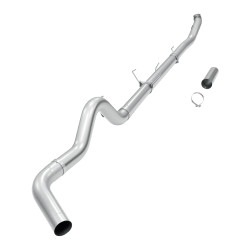
Bottom line: Do not choose an exhaust simply because the pipe is larger. For daily driving and heavy towing, a 4" system offers a more balanced setup. If your priorities are a deeper exhaust note, a higher-boost performance build, and the long-term durability of T409 stainless steel, a properly matched 5" Turbo-Back system may make more sense.
Conclusion
The value of a 2003 Dodge Ram 2500 5.9 Cummins goes beyond engine durability. It still offers strong towing capability, widespread parts and repair support, and plenty of room for future upgrades. For today's owners, the priority should be keeping the fuel system, transmission, cooling system, and front end healthy before chasing more power.
How many miles are on your 5.9 Cummins? What has been your biggest problem with the truck, or which upgrade has made the biggest difference?