 Contents
Contents
- What Is a 6.7 Powerstroke CCV Delete?
- CCV Delete vs Reroute vs Catch Can vs OEM
- How to Choose the Best CCV Delete Kit for Your 6.7 Powerstroke
- How to Install the CCV Delete on 6.7 Powerstroke
- Problems You May Encounter After Installation and Troubleshooting
- Maintenance and Long-Term Considerations
- In Conclusion
Ford 6.7 Powerstroke diesel trucks are powerful, durable, and well suited for heavy-duty towing. However, the factory CCV crankcase ventilation system is a pain point for many owners. Under heavy loads, towing, or off-road use, the factory CCV system may not fully separate the oil mist from crankcase gases. Oil-laden vapors can flow back into the intake system over time, leading to oil buildup in the turbo, carbon deposits in the intake tract, and abnormal oil consumption.
For this reason, 6.7 Powerstroke CCV delete has become a popular modification for high-mileage trucks and trucks used under demanding conditions. If you want to understand how to choose a setup, how to install it, and how to troubleshoot problems afterward, this complete guide covers all the key points.
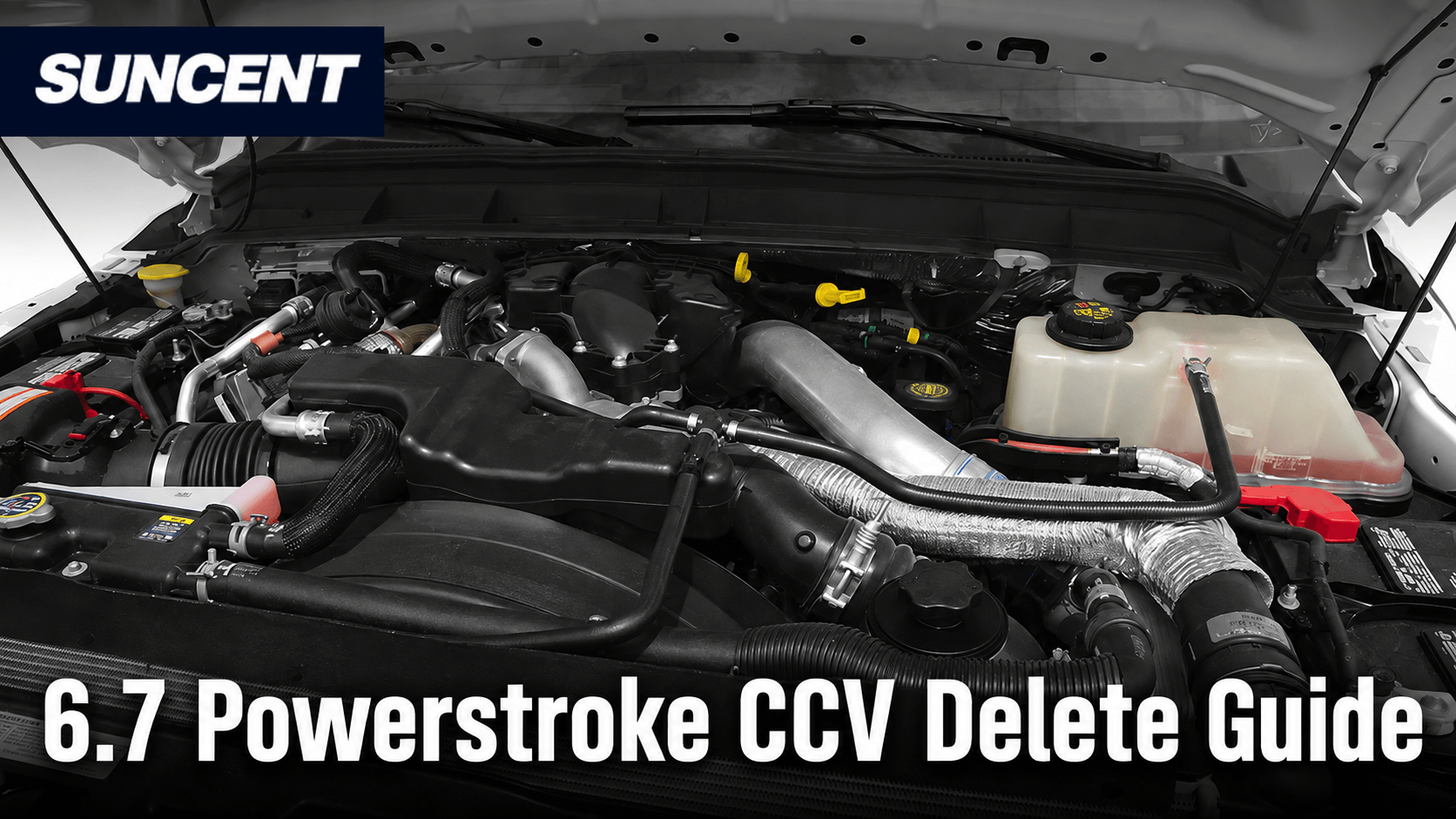
What Is a 6.7 Powerstroke CCV Delete?
CCV stands for Crankcase Ventilation. The factory design is straightforward: it collects blow-by gases and oil vapors produced in the crankcase while the engine is running, filters them through a separator, and routes them back into the intake system to be burned, helping reduce emissions and meet environmental regulations.
However, the large-displacement 6.7 Powerstroke diesel engine operates under heavy loads and produces a high volume of blow-by. The factory oil separator may not keep up under demanding operating conditions, allowing fine oil mist to continue entering the intake piping, intercooler, and turbocharger. Over time, this can form stubborn oily deposits and affect engine operating condition and service life.
Simply put, a CCV delete 6.7 Powerstroke removes the factory CCV oil-separator assembly, eliminates the factory oil-vapor recirculation path, and routes crankcase blow-by gases outside the engine bay for ventilation, preventing oil vapor from contaminating the intake system at the source.
What practical benefits can a CCV Delete provide?
- Cleaner intake system: Oil vapor no longer contaminates the intercooler, intake piping, and intake manifold
- Longer turbo life: Turbo blades and bearings are no longer exposed to oil vapor contamination
- Maintained intercooler efficiency: No oil-soaking issue, helping prevent reduced heat-transfer efficiency
- Easier maintenance: No longer requires regular replacement of the expensive factory CCV filter
- Improved long-term reliability: Reduces sludge buildup and lowers the risk of oil-seal leaks and turbo-seal damage caused by excessive crankcase pressure
Want to learn more about the pros and cons of a CCV Delete? Read our previous in-depth analysis, 6.7 Powerstroke CCV Delete Pros and Cons.
CCV Delete vs Reroute vs Catch Can vs OEM
Many truck owners confuse these concepts. In fact, they represent four different approaches. Understanding the differences is essential before choosing the right setup.
| Option | How It Works | Best For |
| OEM (Factory) | Blow-by gases are separated from oil and routed back into the intake system | Stock vehicles with no modifications |
| CCV Reroute | Blow-by gases are redirected through a Catch Can, where oil is separated before the remaining vapor is vented to the atmosphere | Daily-driven trucks balancing environmental concerns and performance |
| CCV Delete | Completely removes the factory CCV system and vents blow-by gases directly to the atmosphere | Track/off-road trucks focused on maximum performance |
| Catch Can | A standalone filtration device that can be used with a Reroute or Delete setup | Any owner looking to reduce oil-vapor emissions |
Key recommendation: If your truck is a daily driver, choose a CCV Reroute + Catch Can. If it is strictly a track or off-road toy, choose a CCV Delete. Performing a Delete on a vehicle driven on public roads is illegal, so be sure to keep this in mind.
How to Choose the Best CCV Delete Kit for Your 6.7 Powerstroke
There are many low-cost, poor-quality kits online, and they are a major cause of leaks, smoke, and check-engine lights later on. If you are searching for the best 6.7 Powerstroke CCV delete kit, keep the following buying tips in mind.
Step 1: Confirm Your Model Year
Most CCV Delete/Reroute kits on the market cover 2011–2025 models, but not every kit is universal. Before purchasing, make sure the kit clearly states that it supports your specific model year—2011–2014, 2015–2019, and 2020+ models have differences in CCV connection design.
Step 2: Choose the Configuration Type
CCV kits on the market generally come in several configurations:
| Configuration | What's Included | Reference Price |
| Basic Reroute | Reroute hose + fittings | Starting at $70 |
| Reroute + Integrated Catch Can | Reroute hose + integrated oil-vapor separation | $200-$400 |
| Reroute + External Catch Can | Reroute hose + separate Catch Can | $379 (Catch Can only) |
| Full Delete | Factory CCV box removal + direct vent hose | $150-$250 |
Step 3: Materials and Seals
Prioritize kits with a CNC-machined aluminum base and fluororubber seals. They resist heat and vibration and are less likely to deform or leak oil. Thin sheet metal and cheap rubber seals can begin leaking after extended use.
✅ Recommended Kit: SuncentAuto CCV/PCV Delete Kit
If you're looking for a solidly built and widely compatible kit, SuncentAuto is definitely worth considering.
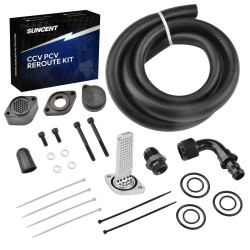
Why buy from SuncentAuto:
CNC Aluminum Alloy Base: Precision machined, fitted with high-temperature resistant fluororubber seals, ensuring long-term durability without deformation or leakage.
Complete Rerouting Solution: Thoroughly exhausts crankcase gases, preventing oil vapor contamination of the turbocharger, intercooler, and intake piping at the source.
Coverage of all models from 2011 to 2025: No need to worry about model year compatibility.
Two Configurations Available: Standard version and version with Catch Can, choose according to your needs.
Significant Price Advantage: Highly competitive pricing compared to similar products.
Fast Shipping: Orders are processed quickly, no long wait times.
Timely Customer Service Response: Professional support for pre-sales compatibility consultation and after-sales installation guidance.
Worry-Free After-Sales Service: Comprehensive return and exchange policy, making your purchase more worry-free.
💰 Savings Tip: Claim coupons before ordering - SuncentAuto Deals & Coupons page
How to Install the CCV Delete on 6.7 Powerstroke
⚠️ Important Disclaimer: CCV Delete/Reroute kits are intended only for off-road, track, or closed-course competition use and must not be installed on vehicles driven on public roads. By installing this product, you assume all related risks and legal responsibilities.
Tools Required
Socket and ratchet set, torque wrench, flathead/Phillips screwdriver, penetrating lubricant, cleaning rags, safety glasses, and protective gloves.
Before Installation
- Allow the engine to cool completely. Never work on a hot engine to avoid burns from hot metal and engine components.
- Bolts on older trucks may be rusted. Apply penetrating lubricant before removal and let it sit for at least 10 minutes to reduce the risk of stripped or broken fasteners.
- Prevent debris from entering the engine while disconnecting hoses or other components.
- Organize screws and removed parts so they can be easily reinstalled.
Step-by-Step Installation Process
Step 1: Prepare – Let the engine cool completely, disconnect the negative battery terminal, and gather all tools and the kit.
Step 2: Remove factory CCV assembly – Take off the engine cover, disconnect hoses and sensor plugs, then loosen the mounting bolts evenly in a diagonal pattern. Carefully lift out the complete CCV unit.
Step 3: Clean the mounting surface (critical!) – Scrape off all old gasket material, oil, and debris. A perfectly clean, flat surface is essential to prevent future leaks.
Step 4: Install the new kit – Position the new gasket and aluminum base, then tighten bolts in a crisscross pattern. Route the ventilation hose away from hot exhaust components, ensuring no kinks or restrictions.
Step 5: Reassemble & test – Reconnect all sensors and the battery. Idle the engine for a few minutes, checking for leaks or unusual noises. After about 100 km of driving, re‑check bolt torque.
📄 For complete, detailed installation instructions – including torque specs, hose routing diagrams, and model‑year variations – download the full manual here:
2011‑2025 Ford 6.7L Powerstroke PCV/CCV Reroute/Delete Kit Installation Manual (PDF)
Problems You May Encounter After Installation and Troubleshooting
Problem 1: Check Engine Light — P04DB Code
This is one of the most common problems after installing a CCV Delete. The P04DB code means: "Crankcase Ventilation System Disconnected."
Why does it happen?
- 2011–2014 models: The factory CCV oil-separator hose has an electrical connector. After removing the CCV system, the sensor no longer detects the expected signal, triggering P04DB
- 2014–2016 models: Some vehicles may have calibration-related issues that can cause false warnings
How do you fix it?
The main solution is to retain the factory CCV electrical connector. Cut off the section of tubing containing the connector, plug it back into the electrical socket, seal it with a silicone cap, and secure it inside the engine bay to eliminate the fault code. (Ford removed this electrical connector starting with the 2015 model year, so 2015+ models generally do not encounter this issue.)
If the fault code remains, some early models may require a PCM reflash or another sensor-retention solution.
Problem 2: White Smoke
Possible causes: Incorrectly installed or blocked hoses, excessive crankcase pressure, or a full Catch Can.
Solution: Check all hoses for unrestricted airflow and kinks, make sure the outlet is not blocked, and empty the Catch Can if one is installed.
Problem 3: Oil Smell Inside the Cab
Possible causes: The vent outlet is too close to the cabin air intake, or the filter is too small or clogged.
Solution: Extend the vent hose farther toward the rear underside of the truck, or switch to a Reroute setup with a Catch Can to reduce oil-vapor emissions.
Problem 4: Reduced Power or Slower Turbo Response
Possible causes: Kinked or blocked hoses causing abnormal crankcase pressure, or improper Catch Can placement creating additional restriction.
Solution: Check the hoses for sharp bends or pinching, confirm that the Catch Can uses a sufficiently large hose diameter, and make sure the Catch Can is mounted high enough.
Maintenance and Long-Term Considerations
Check the Catch Can Regularly
A Reroute setup with a Catch Can requires routine maintenance. It is recommended to inspect it every 3,000–5,000 miles and drain the collected mixture of oil and condensation. Some watery liquid inside the can is normal condensation, but never allow the Catch Can to become completely full—otherwise, filtration performance may decrease and crankcase pressure may increase.
Inspect the Hoses Regularly
Inspect all hoses and clamps every 6 months or 10,000 miles to make sure there is no aging, cracking, or loosening. Replace damaged parts promptly to prevent leaks or foreign material from entering through damaged hoses.
Increase Inspection Frequency in Winter
In cold weather, moisture in crankcase blow-by gases is more likely to condense inside the hoses and Catch Can, increasing the risk of blockage or freezing. During winter, it is recommended to shorten the inspection interval to every 1,500–2,000 miles to keep the system flowing properly.
Monitor Changes in Blow-By Over Time
After installing a CCV Delete/Reroute, it is recommended to periodically remove the engine oil filler cap and observe changes in blow-by volume. If blow-by increases noticeably or is accompanied by abnormal smoke, it may indicate piston-ring or cylinder wear and should be inspected promptly.
Factory CCV Filter vs Delete
The recommended replacement interval for the factory CCV filter is 67,500 miles, while trucks that idle frequently or are mainly used for short trips should replace it every 30,000–40,000 miles. In comparison, CCV Delete/Reroute kits require almost no additional maintenance after installation, which is one of the main reasons many owners choose them.
Legal and Emissions Inspection Reminder
CCV Delete is considered an emissions-related illegal modification in most parts of the United States. EPA fines can be as high as $4,819, and the modification may also affect the factory warranty. Check your local regulations before installation. If your vehicle is subject to emissions inspections, it is recommended to keep the factory components so the truck can be returned to stock.
In Conclusion
For 6.7 Powerstroke trucks that frequently handle heavy-duty work, 6.7 Powerstroke CCV delete is a cost-effective upgrade that addresses issues associated with factory CCV oil-vapor recirculation, carbon buildup, excessive crankcase pressure, and frequent CCV filter replacement.
When choosing a kit, make sure you select a well-built delete kit designed for your specific model year. A properly matched, high-quality kit can help avoid most problems related to smoke, oil leaks, and warning lights.
One final reminder: Performing a CCV Delete on a vehicle driven on public roads is illegal. If your truck is used on public roads, choose a CCV Reroute + Catch Can setup instead—it helps protect the engine while being relatively more environmentally friendly.
We hope this guide helps you make an informed decision. If you have any questions, feel free to leave a comment below!