 Contents
Contents
- I. Single Plate (Normal) vs. Dual Plates (Upgraded)
- II. Year-by-Year Precise Matching: The 2026 Selection Standard
- III. Why Buying an EGR Delete Kit Must Be Paired with a Tuner (ECU Calibration)
- IV. Materials and Craftsmanship: The Hidden Realities Between $50 and $130+ Kits
- V. 6.7 Powerstroke EGR Delete: The Comprehensive Pros and Cons Breakdown
- 六、 Summary & Final Buyer's Checklist
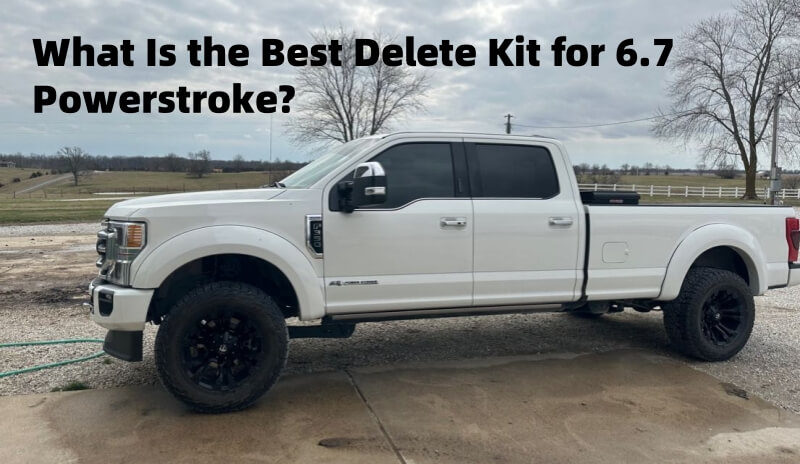
For 6.7L Ford Powerstroke owners (F-250/F-350), this heavy-duty platform is legendary for its relentless towing torque. However, beneath the hood lies a notorious engineering vulnerability: the factory EGR (Exhaust Gas Recirculation) system.
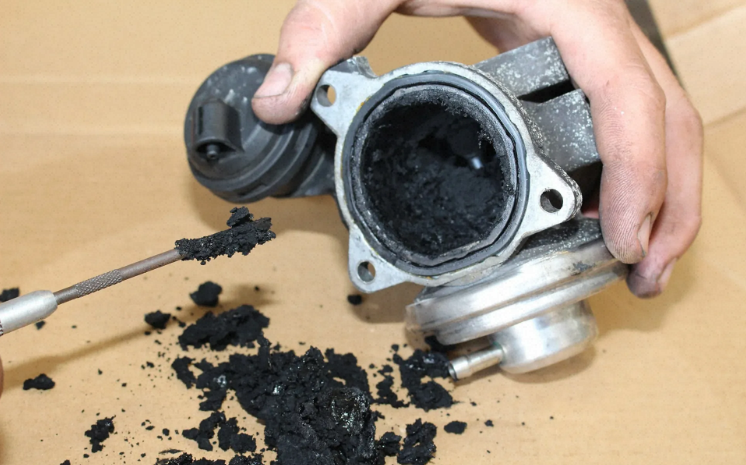
Under continuous thermal cycles, abrasive soot rapidly clogs the factory 6.7 Powerstroke EGR cooler. Worse yet, internal core fractures allow high-pressure coolant to dump directly into the combustion cylinders. Within seconds, this triggers a catastrophic hydrolock that shatters pistons and bends connecting rods. To permanently bypass this flaw, a premium 6.7L Powerstroke EGR delete kit is the premier upgrade for out-of-warranty or dedicated off-road rigs.
However, market prices span a confusing $50 to $300 spectrum. While they look like identical aluminum blocks on screen, picking the wrong kit compromises local thermal monitoring under heavy towing, causes chronic coolant seepage, or risks bricking your PCM/ECU with mismatched calibration files. This definitive 2026 guide cuts through the noise to help you select the perfect EGR delete setup for your Super Duty.
I. Single Plate (Normal) vs. Dual Plates (Upgraded)
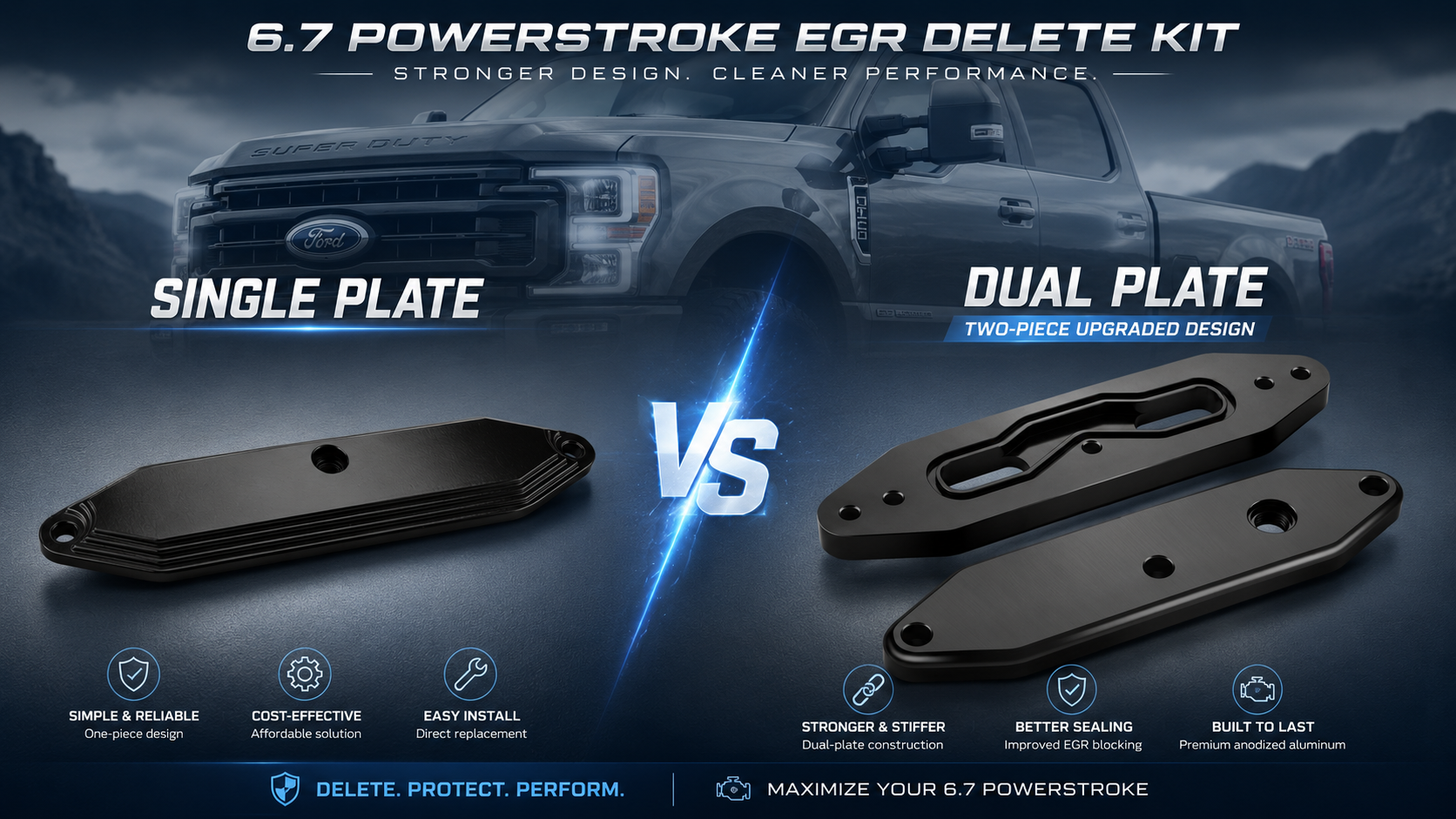
When shopping for a best delete kit for 6.7 Powerstroke on platforms like SuncentAuto, you will notice that the core block-off plates generally fall into two major engineering design categories: Single Plate Systems and Dual/Double Plate Systems.
Dispelling a Major Misconception: Regardless of which plate architecture you select, both require you to act as a surgeon and completely remove the heavy, restrictive, and leak-prone factory EGR valve and cooler assembly from the engine bay. Both variants achieve the core goal of eliminating coolant leaks, preventing hydrolock, and stopping soot from contaminating your intake. The fundamental difference lies in how they manage the remaining coolant circulation and temperature tracking once that factory hardware is gone.
1. Single Plate Scheme (Direct Physical Block-Off)
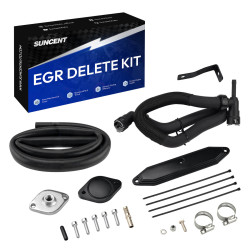
Full Components Included: Typically features one solid, completely flat, long CNC-machined aerospace-grade 6061-T6 aluminum block-off plate, a lengthened high-pressure coolant bypass hose, heavy-duty mounting brackets, high-temp sealing O-rings, and structural hardware.
How It Works: The single-plate design takes a straightforward approach to physical isolation. Once you pull out the bulky EGR cooler assembly, an opening is left exposed above the passenger-side intake manifold.The single plate bolts directly over this port, creating a hard physical seal to lock off the circuit. Because the plate is solid and flat, engine coolant cannot pass through it. Instead, the coolant that originally fed the EGR system is forced to bypass the entire area completely via a long external coolant bypass hose that loops around the engine bay to complete the loop.
In-Depth Advantages (Pros):
- Pure Mechanical Simplicity: Fewer parts to manage, no complex stacking alignment during installation, and an un-intimidating bolt-on logic.
- High Cost-Efficiency: Lower manufacturing complexity translates to a highly budget-friendly price point, making it perfect for owners looking to clean up the engine bay on a strict budget.
Potential Downsides (Cons):
- It operates as a "blind" block-off. The block-off plate has zero expansion potential for additional probes, meaning you cannot install aftermarket sensors at this specific thermal junction. You remain dependent on the factory coolant sensor at the back of the engine block, which can exhibit data lag under extreme stress.
Ideal Candidate: Truck owners on a budget whose vehicles are primarily used for daily commuting, light-duty work, or street driving without frequent heavy towing demands.
2. Dual Plate Scheme (Internal Fluid Channel + Expansion Port)
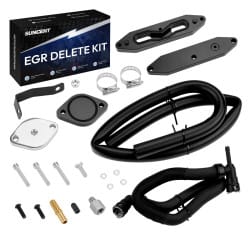
Full Components Included: Features a specialized dual-piece block-off plate setup designed to stack together. It includes structural mounting brackets, frame quick-connect plugs to seal the factory air and water circuits, and premium multi-layer seals.
How It Works: The dual-plate configuration is engineered for advanced fluid routing and hardware expansion, utilizing two distinct layers that interlock seamlessly:
- The Bottom Plate (Fluid Channel): This is not a flat cover. The engine-facing side features a precise, CNC-milled fluid channel and dedicated sealing grooves. It bolts directly to the engine block where the cooler sat, allowing coolant to flow directly through the aluminum block itself rather than forcing it through external rubber hoses. This keeps fluid velocity high and keeps coolant circulating directly against the core engine metal for optimized thermal transfer.
- The Top Plate (Sensor Block-Off): This plate stacks securely over the channel plate to complete the seal. Crucially, it features a pre-drilled, pre-tapped auxiliary monitoring port (standard 1/8" NPT threads).
The Standout Feature — Auxiliary Temperature Monitoring: Owners who install a dual-plate kit can choose to configure an auxiliary aftermarket temperature sensor probe (such as a secondary water temperature gauge) directly into this 1/8" NPT port. The tip of the sensor sits directly in the active coolant stream flowing through the milled channel, sending real-time data directly to an aftermarket monitor (like an Edge Insight CTS3) inside the cab.
In-Depth Advantages (Pros):
- Zero-Delay Localized Monitoring: Under heavy load, local thermal spikes happen first and fast at the EGR junction. An external sensor placed here bypasses factory ECU reporting delays, giving you instant data.
- Ultimate High-Temp Insurance: When pulling heavy loads up steep grades, this secondary gauge allows you to spot localized hot spots or air pockets minutes before the factory dashboard gauge reacts, letting you back off the throttle to prevent warped heads or blown head gaskets.
Potential Downsides (Cons):
- Carries a higher upfront cost (premium upgrade tier) and requires the separate purchase of aftermarket gauges or sensor probes to utilize the expansion port.
Ideal Candidate: Dedicated towing rigs, hot-shot haulers pulling heavy fifth-wheels or construction equipment, and performance enthusiasts who demand complete diagnostic control over their truck's thermal footprint.
💡 Pro Insider Avoidance Guide: The Small Details That Matter
No matter which plate architecture you select, pay close attention to these vital hardware sub-components when selecting a kit on SuncentAuto:
- Steer Clear of Cheap Paper Gaskets: The exhaust backpressure inside a 6.7L Powerstroke is massive. Low-grade kits include cheap paper or asbestos gaskets that will blow out under high boost, causing annoying exhaust leaks. Insist on kits that utilize high-grade Viton O-rings or Multi-Layer Steel (MLS) gaskets to guarantee a permanent seal.
- Inspect Fastener Strength Ratings: Factory Ford exhaust bolts degrade over time due to heat cycling and rust. If a kit includes cheap, unmarked silver steel bolts, they risk snapping off inside the cylinder head during installation. Ensure your kit's bolts feature clear Class 12.9 (Metric) or Grade 8 (Imperial) markings to withstand heavy vibration and torque.
II. Year-by-Year Precise Matching: The 2026 Selection Standard
One of the most pervasive and dangerous myths circulating in the diesel aftermarket industry is that "a single 6.7L kit can seamlessly fit all model years." Believing this misinformation can lead to severe installation gridlock. The historical reality is that Ford engineers have introduced multiple mid-cycle refreshes to the 6.7L Powerstroke platform, shifting under-hood cooling hose layouts, bracket mount alignments, electrical sensor networks, and turbocharger housing configurations over the years. You must match your delete hardware strictly to your truck's specific vehicle generation to ensure physical compatibility.
| Vehicle Generation / Model Years | Core Under-the-Hood Structural Revisions | Key Kit Selection Focus & Target Hardware |
|---|---|---|
| 2011 - 2014 Models | This represents the first-generation factory 6.7L cooling path, built around an early-style wastegated turbocharger setup. These early-generation factory EGR cooler cores are highly susceptible to premature soot clotting and metal fatigue fractures under repetitive heat cycles. | The primary focus is ensuring the kit includes heavy-duty, factory-spec coolant bypass plugs and solid backing brackets to securely seal the cooling paths once the bulky core is pulled out. Cross-reference available setups using the 2011-2019 Ford 6.7 Powerstroke EGR cooler delete kit for foundational compatibility. |
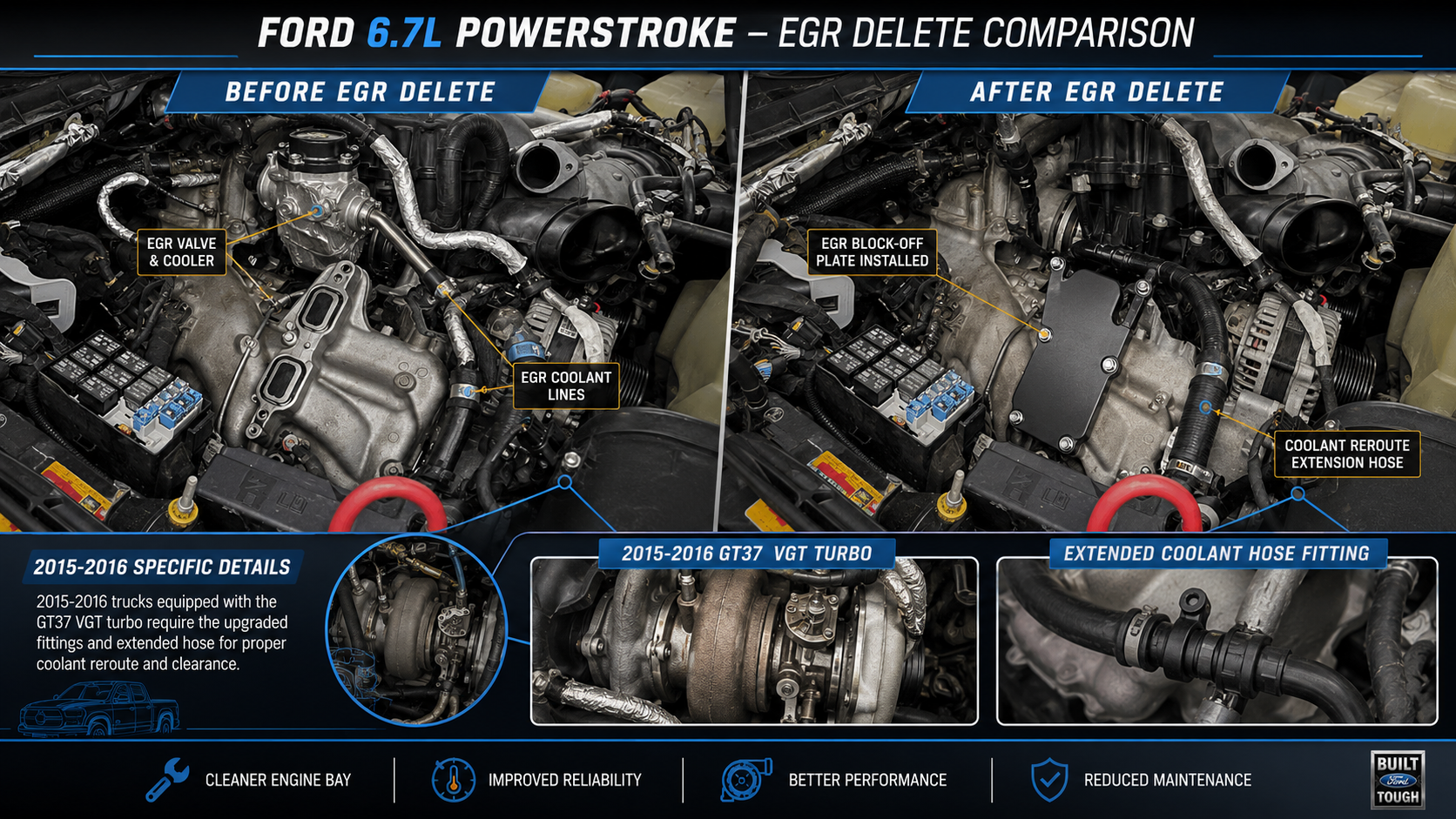
| 2015 - 2016 Models | Ford executed a major performance upgrade during these two years, replacing the early wastegated unit with a significantly larger GT37 Variable Geometry Turbocharger (VGT). This engineering shift completely changed the under-hood landscape, completely rearranging the routing of the coolant lines, bracket positioning points, and mounting tab locations on the engine block. | You absolutely must purchase a generation-specific kit designed strictly for these two model years, such as the specialized 2015-2016 Ford F250 6.7L EGR delete with coolant bypass or the high-strength KAX 2015-2016 Powerstroke diesel delete kit. These specific kits include a custom-engineered, ultra-long coolant extension line fitted with specialized factory quick-connect adapters to clear the GT37 VGT footprint. |
| 2017 - 2025+ Models | Ford introduced a complete structural cab-and-chassis redesign, shifting the physical dimensions of the engine bay. Coolant hose diameters were revised, port geometries were modified, and the onboard PCM/ECU sensor networks were reprogrammed to be incredibly sensitive to pressure and voltage variances. | You must verify the kit is certified for 2017–2025+ applications. Even a microscopic variance in plate hole spacing or a fractionally loose hose connection will cause ongoing leaks or trigger unerasable powertrain codes. Look through the comprehensive EGR delete kit to map out verified year ranges for late-model Super Duty pickups. |


Double-checking your truck's specific manufacturing date and matching it accurately against the verified product line details prevents you from receiving incompatible line connections and keeps your truck project moving forward smoothly without shipping delays.
III. Why Buying an EGR Delete Kit Must Be Paired with a Tuner (ECU Calibration)
There is an absolute, non-negotiable mechanical reality that every heavy-duty diesel owner must face before picking up a wrench or ordering hardware: without a dedicated electronic performance tuner, the physical delete hardware you install is nothing more than a non-functional pile of metal.
The moment you physically unbolt the EGR valve, pull out the cooler assembly, and seal off the ports, your truck’s Powertrain Control Module (PCM/ECU) will instantly detect the total loss of exhaust gas flow and mass airflow deviations, along with disconnected sensor feedback loops. The factory computer will immediately interpret this as a severe hardware failure, illuminating the Check Engine Light on your dashboard and throwing a permanent P0401 trouble code (EGR Insufficient Flow Detected).
Following this diagnostic trigger, the ECU will automatically initiate an un-bypasable safety override known as "Limp Mode." To protect the engine from perceived damage, the vehicle's computer heavily restricts your fuel rail pressure, detunes your transmission shift patterns, and completely dumps your turbocharger boost pressure. Your high-torque workhorse will instantly lose its pulling power, leaving you with barely enough horsepower to creep down the shoulder of the highway at a snail's pace.
To prevent this electronic lockup, you must flash your truck's computer with a custom tune file before running the engine with the hardware removed. This electronic calibration reprograms the ECU from its core logic layer, cleanly rewriting the vehicle's parameters to permanently disable the tracking loops for the deleted emission sensors and preventing any limp-mode triggers.
Dominant 2026 Diesel Tuning Platforms for the 6.7L Powerstroke:
- EZ LYNK (Cloud-Based Intelligent Tuning Architecture): This stands as the current gold standard for modern 6.7L Powerstroke truck customization. Operating through a high-speed WiFi or Bluetooth Auto Agent module that plugs into your OBDII port, it pairs directly with your smartphone or tablet. Rather than using rigid pre-loaded files, your chosen professional diesel calibrator can remotely review your live engine data logs and push custom, tailored delete calibrations straight through the cloud to your vehicle. Additionally, the phone app acts as an active, high-resolution digital gauge cluster, tracking critical variables like real-time Exhaust Gas Temperatures (EGTs), precise oil pressure, and boost.
- Mini Maxx V2 (Hardwired Independent Tuning Platform): For truck owners seeking an incredibly reliable, high-value, classic standalone interface, this is the definitive choice. The Mini Maxx V2 is a dedicated, physical monitoring screen that plugs directly into the vehicle's diagnostic port. It is ideal for owners who want a straightforward, localized installation without relying on smartphone apps or continuous cloud connectivity. It allows you to disable the factory emission parameters with a straightforward setup while giving you the freedom to toggle between pre-set on-the-fly horsepower levels.
If you are still weighing the pros and cons of these two radically different software ecosystems to manage your vehicle's computer, dive into our comprehensive, side-by-side technical teardown: Mini Maxx V2 vs. EZ LYNK 6.7 Powerstroke Delete Tuner Comparison.

IV. Materials and Craftsmanship: The Hidden Realities Between $50 and $130+ Kits
The exhaust manifold and core coolant water passages of a heavy-duty diesel engine endure an incredibly hostile operational environment, with intense heat cycling that routinely breaks past 1000°F. When you are comparing cheap unbranded kits to premium setups over $130, the true difference goes far beyond basic aesthetics. The hidden metallurgy, structural tolerances, and material sciences engineered into these kits dictate whether your truck runs flawlessly for hundreds of thousands of miles or develops unresolvable structural leaks within a few months.
1. Aluminum Grading: Billet CNC 6061-T6 Aerospace Aluminum vs. Low-Grade Cast Aluminum
When selecting your hardware, always verify that the block-off plates are machined from a solid piece of billet 6061-T6 aerospace-grade aluminum using precise CNC milling. Cheap, low-quality kits cut corners by using porous cast aluminum or inferior pot metals to lower manufacturing costs.
Under the punishing high-pressure backpressure and extreme heat cycles of a 6.7L Powerstroke, cast metal will experience microscopic, structural warping that is invisible to the naked eye. In a dual-plate scheme where coolant runs directly through the base block, even a fraction of a millimeter of warping will compromise the mating surface and cause immediate coolant seepage. In a single-plate setup, a warped exhaust block-off plate will cause severe turbocharger boost leaks, forcing you to lose significant horsepower and torque when hauling heavy loads uphill.
2. Surface Treatment: Premium Anodized Protection vs. Raw Machined Aluminum
Premium upgrade kits feature a distinct matte black or bright silver finish. This is far more than an aesthetic upgrade; it is a vital chemical defense mechanism known as Anodization. This electro-chemical process creates a permanent, ultra-hard, non-porous aluminum oxide layer directly on the surface of the metal.
A diesel engine bay is a highly corrosive environment filled with high-temperature acidic blow-by gasses, aggressive road salt spray, moisture, and engine oils. Raw, un-anodized aluminum blocks found in bargain kits will quickly oxidize, developing a powdery white surface crust and deep chemical pitting. This oxidation eventually creeps under your seals, lifting the gasket and ruining its sealing pressure. An anodized barrier serves as a permanent shield against chemical degradation, keeping your engine bay clean and secure.
3. Coolant Hose Metallurgy: Multi-Layer EPDM Reinforced Rubber vs. Cheap PVC Plastic
Hose construction is arguably the most critical factor for owners selecting a single-plate configuration. Because a single-plate kit completely cuts off the structural metal coolant path of the EGR cooler, all of the high-pressure, scalding engine coolant must be rerouted through a single bypass hose looping across the hot engine bay.
If a kit cuts costs by supplying a standard single-wall PVC hose or unreinforced fuel line, it will quickly turn brittle, crack, and fail due to the intense radiant heat. A sudden hose burst will drop your engine's coolant to zero within seconds, leaving you stranded with an overheated motor. High-performance kits always include heavy-wall, multi-layer EPDM (Ethylene Propylene Diene Monomer) rubber hoses or multi-layer silicone lines reinforced with an internal high-density braided mesh mesh, held tight by OE-grade spring clamps. For more on choosing the right configuration, explore how long a deleted 6.7 Powerstroke lasts with high-quality components.
V. 6.7 Powerstroke EGR Delete: The Comprehensive Pros and Cons Breakdown
Before pulling into your shop and picking up your sockets, it is vital to approach an EGR modification with a balanced, highly analytical mindset. Weighing the undeniable mechanical performance gains against the regulatory realities and system deviations ensures you can make an informed choice that matches your vehicle's operating conditions perfectly.
The Distinct Performance Advantages (Pros):
- Permanent Eradication of Soot Contamination: The factory system routinely funnels heavy carbon soot directly back through the cylinder head. An EGR block-off permanently cuts off this pathway, preventing abrasive carbon deposits and sticky unburnt fuel oil from turning into tar sludge inside your intake manifold runners. This keeps your fresh engine oil clean for significantly longer intervals, which preserves the cross-hatching on your cylinder walls, protects your piston rings, and saves the engine's internal main bearings from premature wear.
- Drastic Drop in Engine Heat Load and EGTs: By removing the loop that reintroduces superheated exhaust gases into the combustion cycle, your engine draws in nothing but cool, dense, pure ambient air. This optimized combustion profile sharply drops your active Exhaust Gas Temperatures (EGTs) and drastically reduces the severe thermal fatigue placed on your aluminum cylinder heads, keeping them safe from heat-induced micro-fractures.
- Physical Elimination of Catastrophic Cooler Fractures: You are completely removing the thin-walled factory EGR cooler—the single most high-risk point of fluid failure on the 6.7L engine. Once this component is gone, you can confidently run high-boost performance tunes or haul massive loads up steep mountain grades without worrying about an internal core split dumping coolant into your cylinders and causing an instant, engine-shattering hydrolock.
- Active Defense and Zero-Delay Expansion (Dual-Plate Exclusive): Opting for an upgraded dual-plate configuration breaks you free from the slow data tracking of factory sensors. By running an aftermarket probe straight through the integrated 1/8" NPT sensor port, you get immediate temperature readings right where the fluid experiences the highest thermal stress. If a hot spot or localized steam pocket forms under heavy loads, you can spot the hazard on an accessory dashboard display minutes before the factory ECU triggers a dashboard alarm, keeping you fully in control of your engine safety.
The Inherent Risks and Disadvantages (Cons):
- Severe Legal, Regulatory, and Environmental Compliance Risks: Physically deleting or modifying any factory-installed emission control component is a direct violation of environmental regulations in many jurisdictions. If your truck is registered in an area with mandatory annual smog checks, it will fail inspection immediately. Consequently, this specialized modification hardware is strictly restricted to closed-course racing, competition vehicles, or off-road, non-highway use only (Off-Road or Competition Use Only). For a full exploration of these legal bounds and operational trade-offs, reference our detailed breakdown on 6.7 Powerstroke EGR delete pros and cons.
- Instant Voiding of OEM Powertrain Warranties: Dealership and service center technicians can easily spot modified CNC block-off plates the moment they pop your hood. The installation of an aftermarket delete kit will immediately void any remaining factory or extended powertrain warranty on your vehicle's engine and drivetrain components.
- Significantly Slower Winter Warm-Up Times: The factory EGR cooler assembly serves a dual purpose as a fast heat exchanger during cold starts, using the heat of early exhaust gases to quickly warm your engine coolant. Once deleted, your engine will take up to twice as long to reach its optimal operational temperature on freezing winter mornings, which delays your cabin's heater output and requires a longer low-idle warm-up period.
- Coolant Circuit Air Locks During Post-Install: Because removing the bulky cooler assembly completely changes your truck's cooling paths (whether routing through long external lines or internal plate grooves), the cooling system becomes highly prone to trapping small pockets of air (Air Lock) right after reassembly. Owners must closely monitor their coolant reservoir levels for the first one to two weeks, checking fluid levels frequently and topping off as the system purges trapped air over time.

六、 Summary & Final Buyer's Checklist
Ready to restore maximum operating efficiency and allow your 6.7L Powerstroke engine to finally breathe clean, ambient air? Before finalize your order and head to checkout, cross-reference your cart with this definitive 3-step buyer's checklist to guarantee an optimal, modification project:
- Cross-Verify Your Exact Engine Generation: Confirm your vehicle's manufacturing year. Double-check if your truck requires the highly specialized coolant line routing of the 2015–2016 model years, or if your truck is built on the 2011–2014 or late-model 2017–2025 platform architecture. Never attempt to force-fit a kit across generational boundaries, as plumbing layouts differ radically.
- Synchronize Software and Hardware Deployment: Under no circumstances should you unbolt your factory EGR cooler until your custom delete tunes are safely downloaded onto your tuning device (such as an EZ LYNK platform or a hardwired Mini Maxx V2). The physical hardware removal and the software calibration flash must happen at the exact same time. Running the engine without the proper software correction will instantly lock your truck into an un-driveable Limp Mode.
- Step Up to the Advanced Tier — Strongly Select the Dual-Plate Configuration: While a standard single-plate package offers a lower initial price point, we strongly urge you to make the small financial step up to an premium dual-plate kit (such as the Suncent Upgraded Anodized Dual-Plate Series).
🎁 Exclusive Limited-Time Offer: Prepare for Summer Towing Season!
Planning to optimize your vehicle's long-term reliability and power this month? You are in perfect time to take advantage of the massive Memorial Day Savings Event happening right now at SuncentAuto!
For a limited time, you can secure a massive 18% OFF discount on premium heavy-duty diesel delete components and comprehensive block-off kits. Plus, brand-new registered users can stack an additional exclusive first-time buyer coupon code at checkout for maximum savings.
👉 Click Here to Claim Your Suncent Memorial Day Coupon Codes and visit the dedicated Suncent 6.7 Powerstroke Hub to clear out your factory vulnerabilities before extreme summer hauling conditions arrive!
Which electronic tuning platform are you planning to run on your 6.7L rig—are you going cloud-based with the EZ LYNK platform or keeping it simple with a physical Mini Maxx V2 screen? Are you leaning toward a budget-friendly single plate or stepping up to the advanced thermal management of a dual-plate kit? Let us know your build sheet, project experiences, and custom questions in the comments section below!