 Contents
Contents
- What Types of Delete Kits Are Available for the 6.7L Powerstroke?
- How to Choose the Best Delete Kit for a 6.7 Powerstroke
- Recommended 6.7 Powerstroke Delete Kits by Model Year
- Does a 6.7 Powerstroke Delete Require Tuning?
- Can You Delete Only the EGR or DPF?
- What Benefits Can You Get After Deleting a 6.7 Powerstroke?
- Legal Restrictions
- Conclusion
The 6.7 Powerstroke engine is equipped with a series of emissions-control systems to meet emissions standards. However, emissions-control systems such as the DPF and EGR can restrict engine performance, reduce fuel efficiency, and lead to high maintenance costs. Therefore, many truck owners consider installing emissions-system delete kits. A 6.7L Powerstroke delete kit is a combination of hardware and tuning used to remove or bypass factory emissions-control systems, with core components including a DPF delete pipe, EGR delete kit, and tuning device. This article will guide you in choosing the best delete kit for 6.7 Powerstroke engine in 2026.
⚠️ For Off-Road Use Only: Removing emissions-control systems may violate U.S. federal and state laws. This article is for educational and off-road/competition-use reference only. Please confirm local regulations before purchasing.
What Types of Delete Kits Are Available for the 6.7L Powerstroke?
For the 6.7L Powerstroke diesel engine, common types of delete kits and their main characteristics are as follows:
| Kit Type | Included Components | Core Function | Is Tuning Required? | Mainstream Market Price Range (USD) |
|---|---|---|---|---|
| EGR Delete Kit | EGR cooler bypass components, block-off plates, coolant reroute hoses, gaskets, installation hardware | Completely blocks exhaust gas recirculation, addressing intake carbon buildup and EGR cooler leakage | Yes | $100 - $300 |
| DPF Delete Pipe | Straight pipe replacing the DPF, with optional muffler/exhaust tailpipe | Replaces the factory DPF/SCR emissions exhaust, improves exhaust flow, and lowers EGT | Yes | $150 - $450 |
| Tuning Device (Tuner) | Tuning device itself, such as Mini Maxx V2 or EZ LYNK Auto Agent, plus preconfigured tune files | Disables DPF/EGR/DEF fault codes, shuts off regeneration logic, and improves power | It is the tuning itself | $600 - $1,500+ |
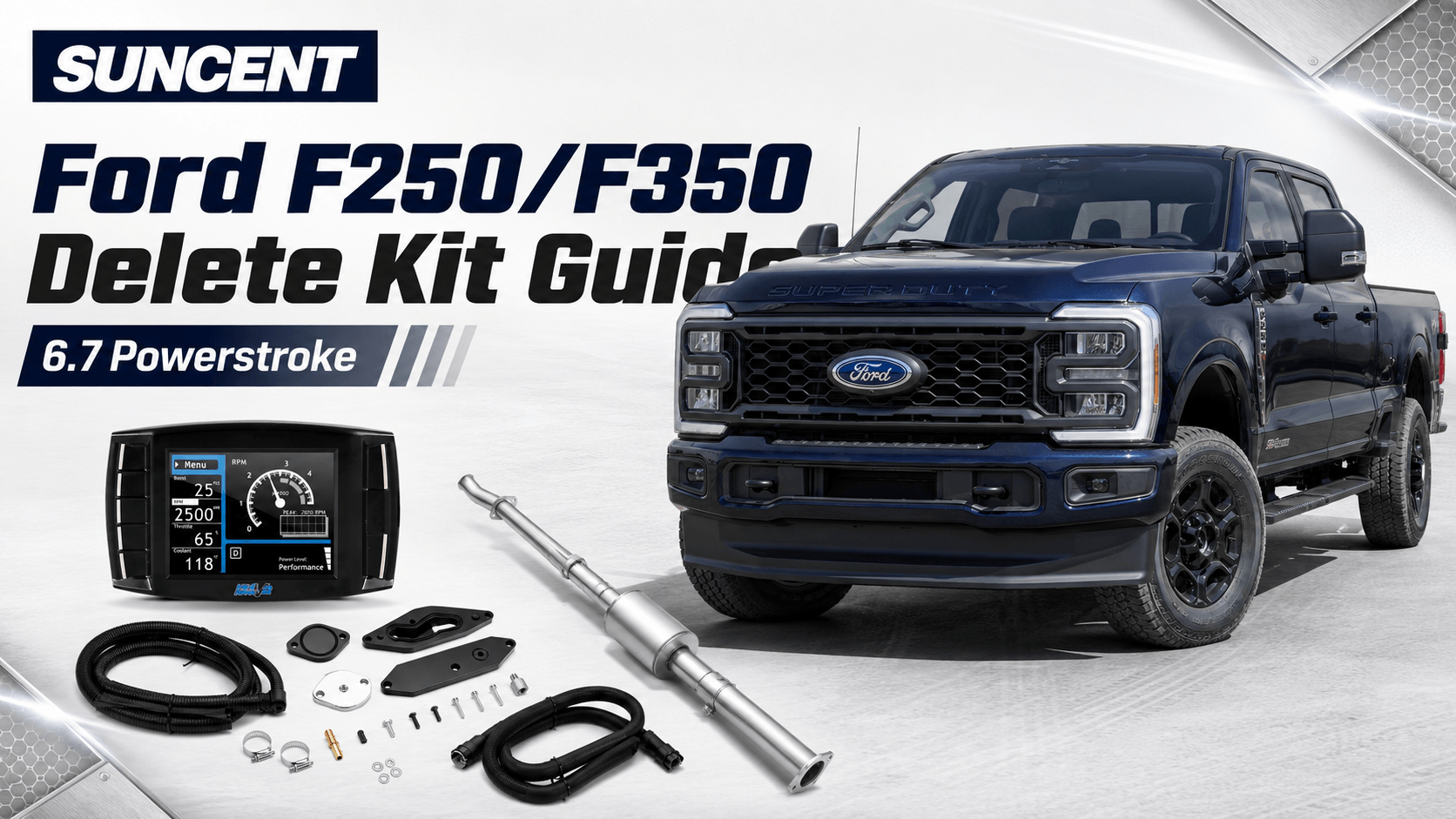
| Complete All-in-One Kit | EGR delete components + DPF delete pipe + tuning device/software | Provides all hardware and software in one package, completely removing exhaust and emissions restrictions | Included | $1,100 - $3,000+ |
How to Choose the Best Delete Kit for a 6.7 Powerstroke
Choosing a delete kit is not about buying the most expensive option. It should match your specific needs. Below are the key factors to consider.
1. Determine the Model Year and Exact Vehicle Configuration
This is the most important step in the entire selection process. The 6.7L Powerstroke has gone through multiple emissions-system and ECU strategy changes since 2011, and kits for different model years should not be mixed freely.
- 2011–2012: Equipped only with DPF and EGR, without a DEF/SCR system
- 2013–2014: SCR/DEF system introduced, adding a DEF tank, injector, and NOx sensors
- 2015–2016: EGR cooler redesigned, with changes to exhaust routing and sensor locations
- 2017–2019: ECU encryption upgraded and EGR cooler mounting changed
- 2020–2022: Changes to the turbo, aftertreatment housing, and hanger positions affect pipe fitment
- 2023–2025: Next-generation ECU security system, with extremely limited tuning support
In addition to the model year, you also need to confirm:
- Vehicle model: F-250 / F-350 / F-450
- Cab configuration: Regular Cab / SuperCab / Crew Cab
- Drivetrain: 4x2 / 4x4
- PCM strategy code: The tune file must match your ECU strategy
Before purchasing, be sure to provide your VIN to customer service to confirm fitment. A description such as "fits all 6.7L" is not enough to confirm compatibility.
2. Choose the Type of Delete Kit
Depending on your goals and budget, choose one of the following types:
- EGR delete only: Suitable for limited budgets or situations where only a specific EGR issue needs to be addressed.
- DPF delete only: Improves exhaust flow but does not address EGR-related carbon buildup.
- DPF + EGR delete kit: Suitable for users who already have a tuning device, with hardware covering both major emissions components.
- Complete all-in-one kit: Includes a DPF delete pipe, EGR delete kit, and a tuning device. For off-road-only vehicles, this is the easiest option and the least likely to create compatibility problems.
If you are looking for long-term reliability and overall optimization, it is recommended to choose a complete all-in-one kit directly to avoid component mismatches caused by purchasing parts separately.
3. Choose the Pipe Size: 4-Inch vs. 5-Inch Exhaust?
The diameter of the DPF delete pipe directly affects exhaust flow, EGT, and power-output characteristics. Both 4-inch and 5-inch systems have their own suitable applications:
| Comparison | 4-Inch Exhaust | 5-Inch Exhaust |
|---|---|---|
| Exhaust Flow | Suitable for stock to mildly modified trucks | Suitable for high-power, large-turbo, heavily modified setups |
| Best Use | Daily driving, light towing, mixed street/off-road use | Heavy towing, competition, high-EGT operation |
| Low-RPM Torque | Maintains good low-end torque with moderate backpressure | May slightly reduce low-RPM torque |
| Exhaust Sound | Milder, with less cabin noise | Deeper and louder, with potentially more cabin drone |
| Installation Difficulty | Requires less space and is easier to install | Requires more space; some vehicles may require hanger adjustment |
| Recommended For | Most off-road users and mild builds | High-power builds and competition users |
Selection recommendations:
- 4-inch pipe: The best overall balance for most daily-driven trucks, occasional towing, and trucks retaining stock power levels.
- 5-inch pipe: Better suited for trucks seeking an extreme exhaust note, high-power builds generally making 100+ additional horsepower, or extremely heavy towing loads.
4. Evaluate Material Quality
Delete kits are continuously exposed to heat, vibration, and corrosive environments, so material quality directly affects service life and reliability.
| Material Type | Advantages | Disadvantages | Recommendation |
|---|---|---|---|
| T-409 Stainless Steel | Corrosion-resistant, heat-resistant, reasonably priced, industry standard | Less corrosion-resistant than 304 | ⭐⭐⭐⭐⭐ First Choice |
| 304 Stainless Steel | Best corrosion resistance and heat resistance | Higher price | ⭐⭐⭐⭐ Premium Choice |
| Aluminized Steel | Low cost, short-term heat resistance | More prone to long-term corrosion and shorter life | ⭐⭐ Not Recommended |
| Regular Carbon Steel | Lowest cost | Very prone to rust and unsuitable for exhaust environments | ⭐ Avoid |
5. Tuning Completeness
Tuning is the "brain" of the entire delete system. Without the correct tuning, the hardware cannot operate properly, and the truck may enter torque-limiting mode and continuously trigger fault codes.
When choosing a tune, confirm that the tune file is specifically written for your vehicle model year and ECU strategy. Also confirm whether the manufacturer provides tuning updates and technical support.
6. Consider Installation Instructions and After-Sales Support
Choose brands that provide complete after-sales support, model-year-specific hardware, and clear fitment verification.
Before purchasing, confirm:
- Installation instructions: Whether detailed PDF or video guides are provided, covering key steps such as EGR cooler removal, coolant draining, sensor removal, and other critical procedures.
- Technical support: Whether phone or online support is available during installation.
- Fitment confirmation: Whether VIN lookup service is available to confirm the model year and vehicle configuration before purchase.
- Return policy: Whether hassle-free returns are available and how long the return period is.
- Warranty policy: How long the hardware warranty lasts and whether tuning devices are covered by a separate warranty.
- Brand reputation: Review installation feedback and after-sales reviews from other users.
SuncentAuto provides: a 45-day hassle-free return policy, free shipping within the U.S., online customer support, and model-year-specific fitment confirmation.
Recommended 6.7 Powerstroke Delete Kits by Model Year
Below are different SuncentAuto configurations recommended for four major model-year groups: 2011–2014, 2015–2016, 2017–2019, and 2020–2022. The main differences come down to exhaust size, muffler configuration, whether CCV hardware is included, and how the tuning solution is packaged.
2011–2014 6.7 Powerstroke
For 2011–2014 trucks, you can choose between a standard 4" race-pipe setup, a muffled version, or a more complete package that also includes CCV/PCV reroute hardware.
A straightforward all-in-one setup with a 4" race pipe, EGR kit, and Mini Maxx V2 tuner.
Best for: Users who want the core exhaust, EGR, and tuning components in one package and prefer a direct exhaust sound.
View KitUses a 4" exhaust with a muffler while still combining EGR hardware and a Mini Maxx V2 tuner.
Best for: Users who want a complete setup but prefer a more controlled exhaust note than an unmuffled race pipe.
View KitAdds CCV/PCV reroute hardware to the race pipe, EGR, and Mini Maxx V2 combination.
Best for: Users who want to cover more related components in one purchase rather than adding a CCV kit later.
View Complete Kit2015–2016 6.7 Powerstroke
For 2015–2016 trucks, the main choice is between a simpler 4" race-pipe configuration and a larger 5" downpipe-back system.
A dedicated 2015–2016 setup combining a 4" race pipe, EGR hardware, and Mini Maxx V2 tuner.
Best for: Users who want a relatively simple all-in-one configuration without moving to a larger 5" exhaust.
View 4" KitCombines a 5" downpipe-back exhaust with EGR hardware and a Mini Maxx V2 tuner.
Best for: Users who prefer a larger exhaust diameter and a deeper, more noticeable exhaust note.
View 5" Kit2017–2019 6.7 Powerstroke
For 2017–2019 trucks, SuncentAuto offers a similar three-level choice: a standard 4" configuration, a 5" downpipe-back option, or a more complete kit with CCV hardware.
A standard all-in-one setup using a 4" race pipe, EGR kit, and Mini Maxx V2 tuner.
Best for: Users looking for the most straightforward configuration for a 2017–2019 truck.
View 4" KitUses a 5" downpipe-back exhaust together with EGR hardware and Mini Maxx V2.
Best for: Users who want a larger-diameter exhaust and a deeper exhaust sound.
View 5" KitA more complete combination that includes CCV/PCV reroute hardware in addition to the exhaust, EGR, and tuner.
Best for: Users who want more of the related hardware included in one package.
View Complete Kit2020–2022 6.7 Powerstroke
For 2020–2022 trucks, the setup is better understood as three separate modules: mechanical hardware + EZ LYNK tuning device + vehicle-specific tune file.
Mechanical package with a 5" downpipe-back exhaust and EGR hardware.
Best for: Users who already have a compatible tuning solution. No tuner is included.
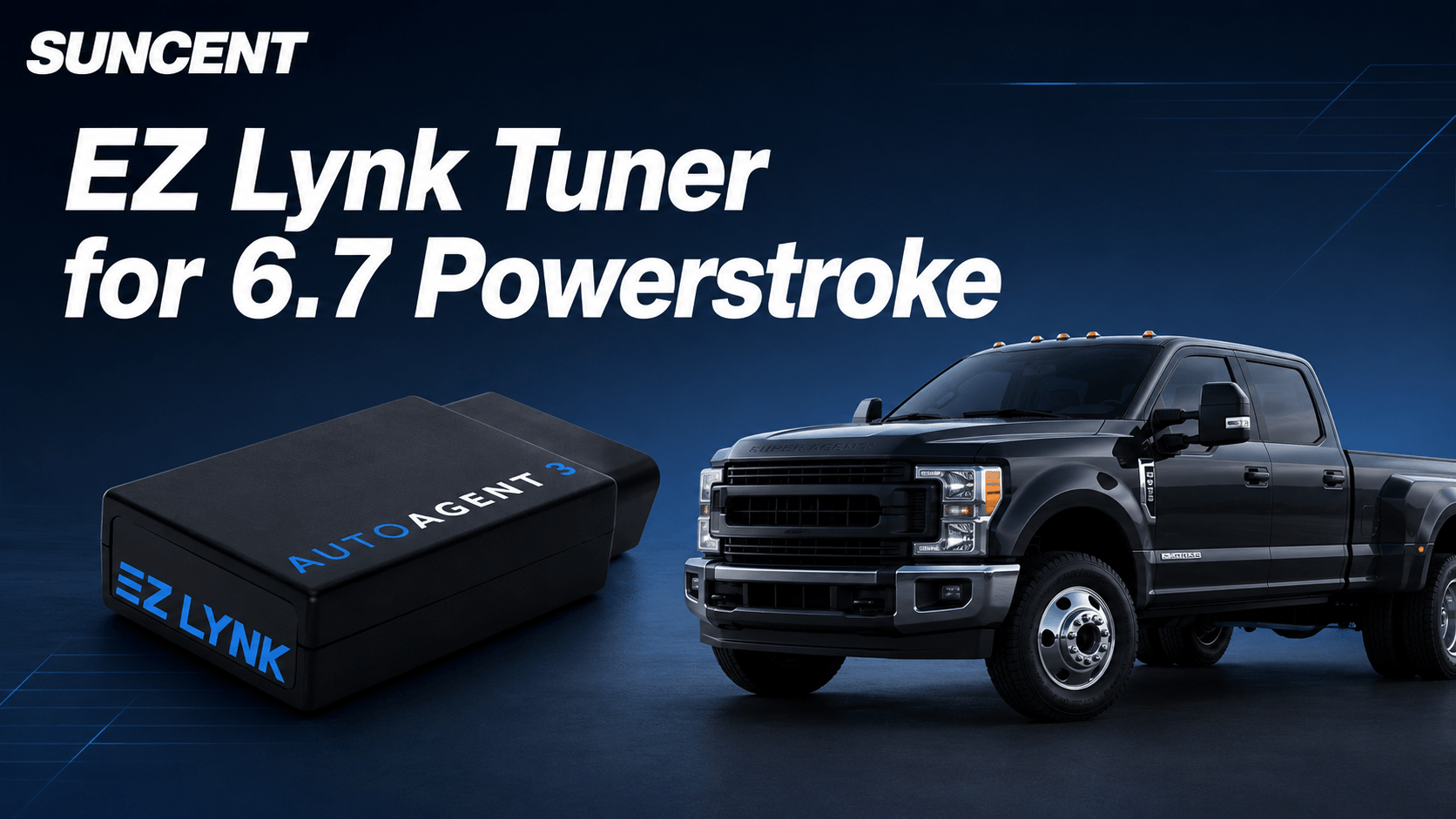
View HardwareThe tuning device used to connect the truck with compatible cloud-delivered tuning.
Best for: Users building a complete 2020–2022 tuning setup. The tune file is purchased separately.
View EZ LYNKVehicle-specific 6.7 Powerstroke tuning package for compatible 2020–2022 Ford Super Duty applications.
Includes: 4-week support and no transmission tuning in this version.
View Tune FileComplete 2020–2022 setup: 5" Exhaust + EGR Hardware + EZ LYNK Auto Agent 3 + Vehicle-Specific Tune File.
Regardless of which option you choose, confirm the model year, vehicle model, Pickup/Cab & Chassis configuration, exhaust configuration, tuner compatibility, and tune-file support again before ordering.
Does a 6.7 Powerstroke Delete Require Tuning?
Yes. Without tuning, the delete cannot operate properly.
The ECU is responsible for monitoring and controlling all emissions systems. When you remove or bypass emissions-related hardware such as the DPF and EGR, the ECU detects the abnormal condition and may trigger the following:
- Check engine light stays on: The Check Engine Light (CEL) cannot be cleared permanently.
- Torque-limiting mode is activated: The truck enters limp mode and vehicle speed is limited to an extremely low level.
- Emissions test failure: The vehicle cannot pass any form of emissions inspection.
The function of a tuning device is to reprogram the ECU so that it no longer looks for the removed components while also optimizing fuel-injection and turbocharger strategies.
Tuning selection points:
- Confirm that the tune file is written specifically for your model year and PCM strategy.
- Mini Maxx V2 is a mainstream tuning platform for 2011–2019 models, while EZ LYNK Auto Agent is more widely used on 2020+ models.
- Avoid tune files from unknown sources or so-called "universal" tunes.
Can You Delete Only the EGR or DPF?
Technically, yes, but it is not recommended.
Deleting Only the EGR
An EGR delete addresses carbon buildup caused by exhaust gas recirculation and the risk of EGR cooler cracking, but it does not address DPF clogging.
Under frequent idling or short-trip driving conditions, the DPF can still accumulate soot, resulting in higher exhaust backpressure, frequent regeneration, and reduced power.
Deleting Only the DPF
A DPF delete removes exhaust backpressure, improves turbo efficiency, and improves throttle response, but it does not solve EGR-related carbon buildup.
The EGR system still introduces exhaust containing soot and unburned fuel into the intake manifold. Over time, this can cause intake-valve carbon buildup, EGR cooler restriction, and reduced power.
Why It Is Recommended to Delete Them Together
The EGR and DPF are interconnected systems. Soot introduced by the EGR accelerates DPF clogging, while increased exhaust backpressure caused by the DPF increases the workload on the EGR system.
Deleting only one leaves the other system continuing to create problems. For off-road-only vehicles, a complete delete involving EGR + DPF + DEF is the most reliable solution for long-term reliability.
Read More: Can You Delete EGR without Deleting DPF?
What Benefits Can You Get After Deleting a 6.7 Powerstroke?
The benefits after deleting mainly appear in three areas: performance, economy, and reliability.
1. Performance Improvement
After removing the DPF and EGR, exhaust backpressure is significantly reduced, allowing the turbocharger to engage earlier and noticeably improving throttle response.
The following is a set of verified dyno-test data from a 2019 F-250 6.7L Powerstroke:
| Configuration | Peak Horsepower | Peak Torque |
|---|---|---|
| Stock | ~397 HP | ~880 lb-ft |
| Delete + Mild Tune | ~452 HP | ~975 lb-ft |
| Delete + Aggressive Tune | ~547 HP | ~1,100+ lb-ft |
| Gain with Mild Tune | +55 HP | +95 lb-ft |
With more aggressive tuning and supporting modifications, the 6.7L Powerstroke can gain 100–150 HP.
2. Improved Fuel Economy
DPF regeneration cycles inject additional fuel to raise exhaust temperature, resulting in unnecessary fuel consumption.
After eliminating regeneration cycles, users commonly report a 2–5 MPG improvement. Highway driving typically shows the most noticeable improvement, while towing conditions show smaller but still noticeable gains.
3. Improved Reliability and Lower Maintenance Costs
- Eliminates EGR cooler failure risk: A cracked EGR cooler can allow coolant to enter the intake system, with repair costs reaching $2,800–$5,500.
- Eliminates DPF cleaning or replacement costs: Professional DPF cleaning costs approximately $400–$600, while replacement costs approximately $2,500–$4,500.
- Reduces intake-valve carbon buildup: After eliminating EGR, the intake system is no longer exposed to carbon-containing exhaust gases, improving long-term engine health.
- Lowers EGTs: Exhaust temperatures may drop by 200–300°F after deletion, reducing thermal stress on the turbocharger.
📊 Important: Actual results vary depending on vehicle configuration, tuning level, driving conditions, and maintenance history. The figures above represent general ranges reported across multiple independent tests.
Legal Restrictions
Before purchasing any hardware related to removing emissions-control systems, buyers should understand that tampering with emissions systems remains a serious legal issue for vehicles driven on public roads.
The U.S. Environmental Protection Agency (EPA) states that tampering with emissions-control systems and selling or installing defeat devices may lead to enforcement penalties.
- Inspection and registration risks: Trucks with emissions-control systems removed may immediately fail inspection. Even in areas with weaker enforcement, registration or compliance issues may arise later depending on local regulations.
- Resale and trade-in issues: Delete-related modifications also reduce resale flexibility. Some dealers may refuse trade-ins, and some states have stricter rules regarding modified vehicles.
- Important usage restrictions: Any modifications related to removing emissions systems should only be used on legally permitted off-road terrain. These modifications should not be treated as normal upgrades for vehicles driven on public roads.
Conclusion
If you are researching delete hardware for a specific model year of the 6.7L Powerstroke, carefully compare model-year compatibility, included components, tuning support, and legal usage restrictions before making a decision.
For off-road-only vehicles, a complete all-in-one kit can simplify the purchasing process and reduce the fitment risks associated with sourcing different components separately.
Ready to unlock the full potential of your Powerstroke?
Shop SuncentAuto 6.7 Powerstroke Delete Kits →
Before installation, be sure to confirm local regulations. Removing emissions-control systems is intended only for legal off-road use.