 Contents
Contents
Last updated: June 2026. This guide has been refreshed with current 6.7L Cummins fitment notes, newer RAM security gateway considerations, Cab & Chassis compatibility details, tuner platform updates, and current SuncentAuto package options.
Emissions-related modifications may be restricted or prohibited for on-road vehicles depending on federal, state, provincial, or local laws. Always verify your local regulations before purchasing, installing, or using any emissions-related hardware or tuning.
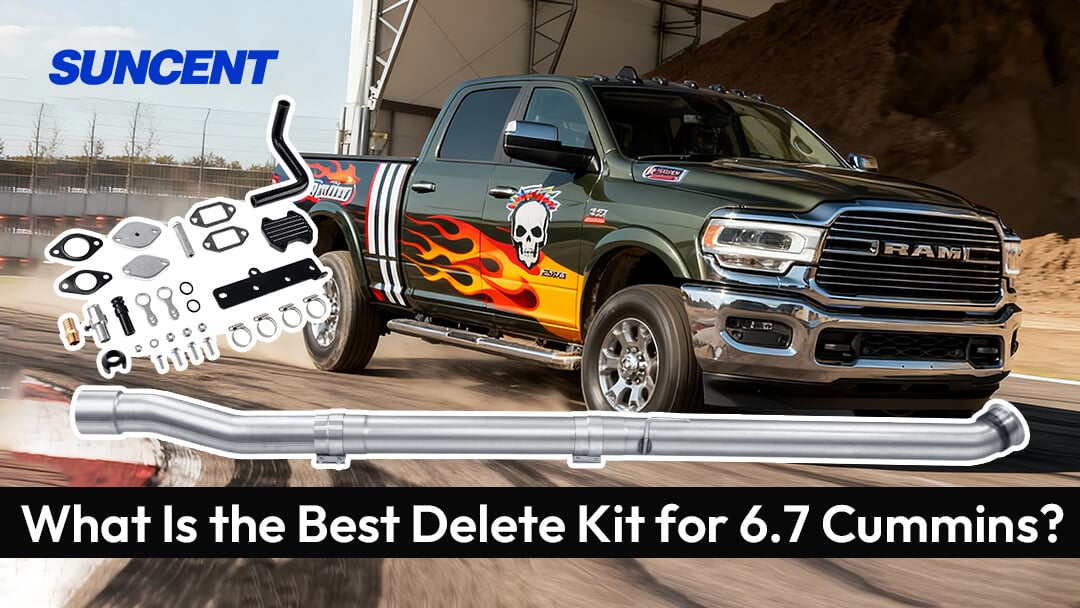
If your 6.7L Cummins is plagued by DPF regen failures, EGR cooler leaks, or DEF system warnings, a delete kit may be the solution. This guide covers what a delete kit is, the top products in 2026, how to choose the right one, and the pros and cons -so you can make an informed decision on what is the best delete kit for your 6.7 Cummins .
Please note: Deleting the emissions control system is illegal for on-road vehicles in all 50 states of the United States. The information in this article is provided for educational purposes and closed-course/off-road use only. Be sure to understand your local laws before modifying your vehicle.
What Is a 6.7 Cummins Delete Kit?
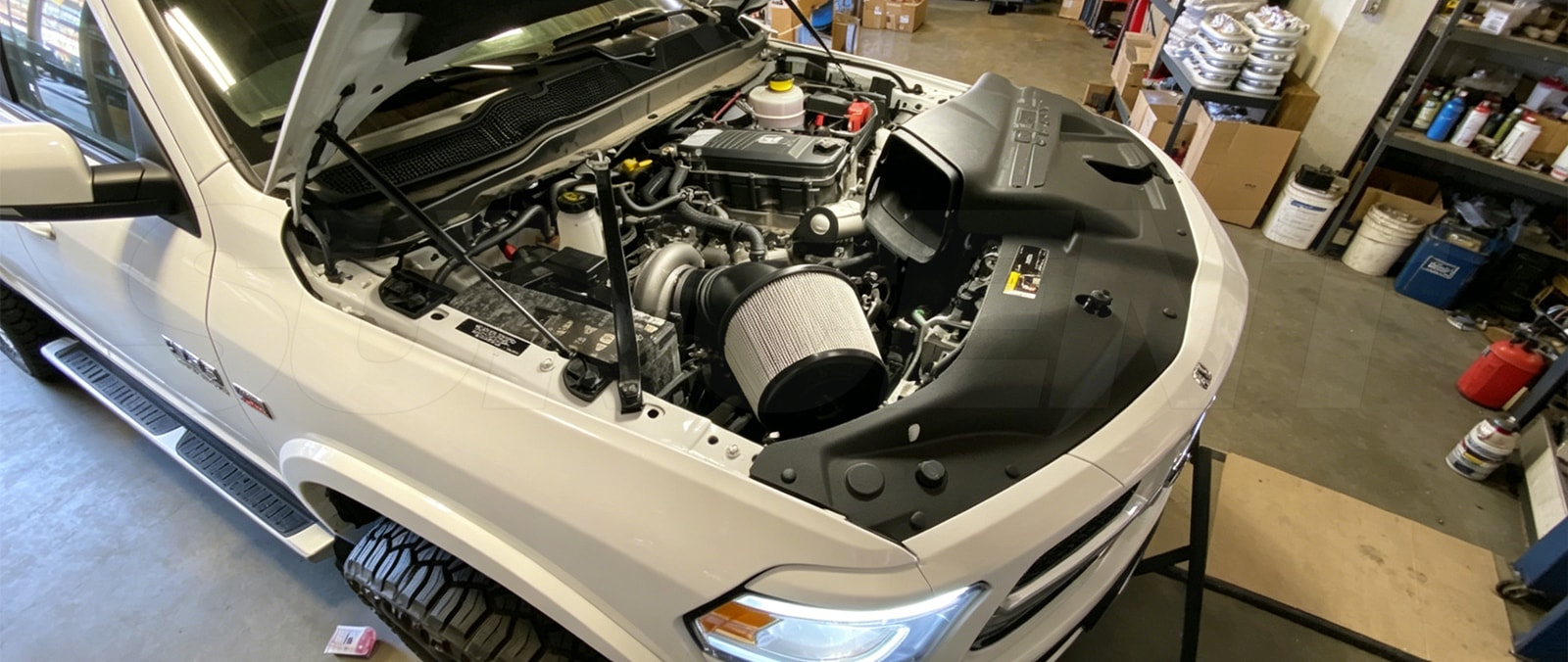
The 6.7L Cummins delete kit is a set of aftermarket components designed to remove or bypass the factory emissions control system, specifically for Dodge Ram 2500/3500 and Cab & Chassis vehicles from 2007 to this year.
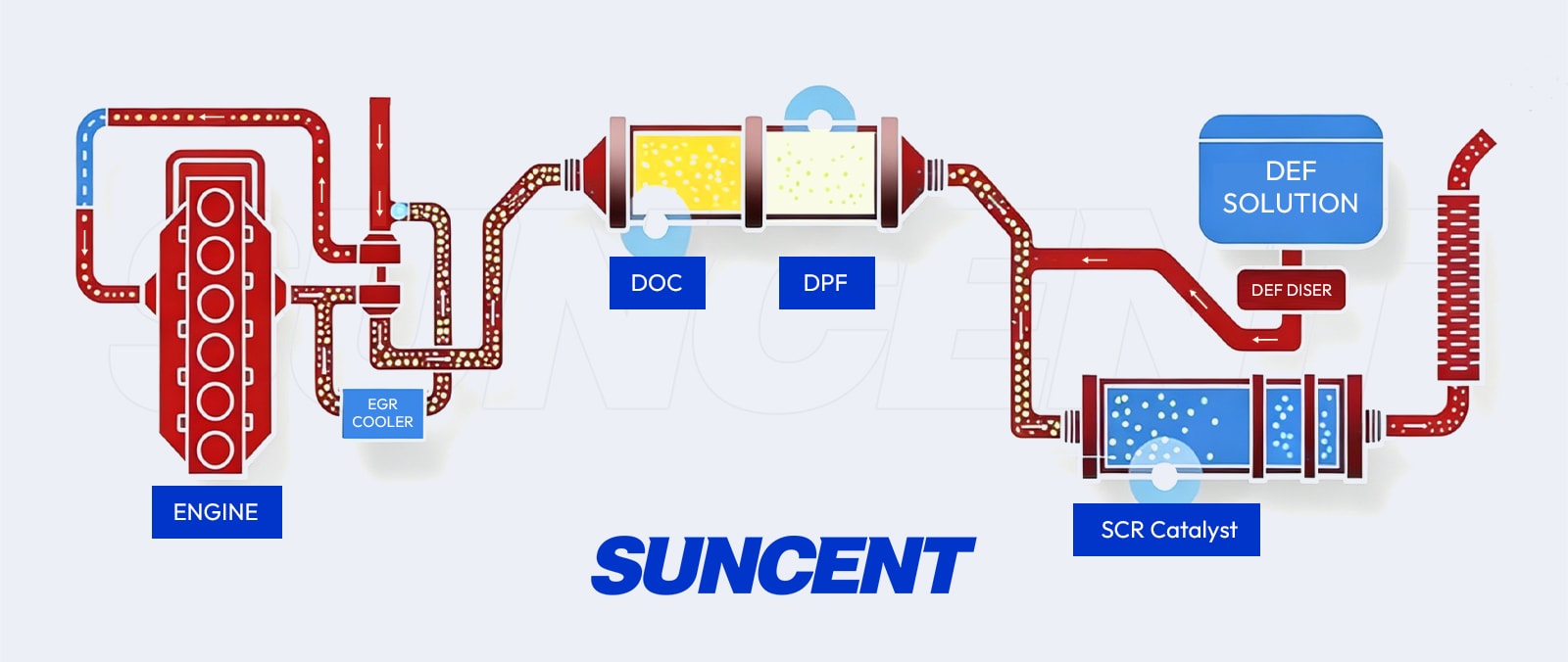
This system typically includes hardware components and matching tuning software, aiming to remove or bypass the three major emissions systems — EGR (Exhaust Gas Recirculation), DPF (Diesel Particulate Filter), and DEF/SCR (Diesel Exhaust Fluid/Selective Catalytic Reduction).

EGR (Exhaust Gas Recirculation)
The factory EGR system is responsible for routing a portion of exhaust gases back into the intake manifold to reduce NOx emissions. However, after prolonged use, carbon buildup tends to form in the intake system, severely clogging the intake passages, intake valves, and the EGR cooler. The cooler is also prone to cracking, allowing coolant to enter the cylinders.
Deleting it removes the EGR cooler and valve, seals the ports with a block-off plate, and disables related signals via tuning. Result: fresh air only, no carbon buildup, better throttle response, and cleaner oil.
DPF (Diesel Particulate Filter)
The main job of the DPF is to trap particulate matter produced by diesel combustion to meet emissions standards. The problem is that under long-term short-distance driving, low-speed operation, or frequent towing, regeneration often doesn't complete properly, leading to clogging. Some owners experience DPF clogging warnings as early as 60,000 miles, putting the truck into limp mode, with dealership replacement quotes as high as $3,000–$4,000. Even if you force a regeneration, fuel consumption runs 2–3 MPG higher than normal.
When deleting, the factory DPF along with the exhaust section is removed and replaced with a straight-through delete pipe, while the differential pressure sensor is also removed or disabled. After DPF deletion, exhaust backpressure drops significantly, the turbo spools faster, and no fuel is wasted on regenerations. Many owners report daily fuel economy improving from around 14 MPG to 17 MPG.
DEF/SCR (Diesel Exhaust Fluid/Selective Catalytic Reduction System)
The factory DEF/SCR system works by injecting DEF (urea solution) into the exhaust to reduce nitrogen oxides into harmless nitrogen and water. The problem lies in its long system chain, which includes the DEF pump, injector, heater, level sensor, and NOx sensors — multiple components that can fail. Once any part malfunctions, it can trigger fault codes, torque limiting, or even speed limiting.
When deleting DEF, the DEF tank, DEF pump, injection nozzle, and SCR catalytic converter are removed, the SCR section is replaced with a straight pipe, and all related sensors (level, temperature, NOx sensors) are disconnected. After deletion, you are completely free from DEF refilling and maintenance hassles.
Software Tuning - An Essential Piece
After the hardware is removed, the ECU will illuminate the check engine light and enter limp mode due to missing sensor signals. Therefore, you must reflash the ECU with a diesel tuner to disable EGR, DPF, and DEF-related logic, turn off regeneration cycles, and recalibrate injection timing and boost parameters. Without software tuning, the hardware delete is pointless — some owners have removed only the DPF without tuning, only to find the truck throwing codes and going into limp mode every dozen or so miles, making it undrivable. The two are inseparable.
How to Choose the Best 6.7 Cummins Delete Kit - Factors to Consider
Model Year Compatibility
Whether you drive a 2012, 2014, 2015, 2016, 2017, 2018, 2019, 2020, 2021, or 2022 model, finding the best delete kit for your specific 6.7 Cummins year is crucial. Below we break down compatibility by model year.
- 2007–2009: No DEF system – Choose an EGR+DPF delete kit (skip DEF components).
- 2010–2012: First models equipped with DEF – Full EGR/DPF/DEF delete kit.
- 2013–2018: Updated ECU – Need a tuner with specific programming for 2013 and later models.
- 2019 to now: Stringent emissions sensors – Choose a kit with "sensor bypass adapters" to avoid entering limp mode.
Pickup vs. Cab & Chassis vs. Dually: Fitment Details Many Owners Miss
Model year is only one part of choosing the right 6.7 Cummins delete kit. Before ordering hardware or tuning, you also need to confirm whether your truck is a standard pickup, a Cab & Chassis commercial truck, or a dual-rear-wheel dually. These platforms may look similar from the outside, but the exhaust routing, frame layout, tailpipe position, and tuning protocol can be very different.
Standard RAM 2500/3500 Pickup
Most RAM 2500 and 3500 pickup models use the common pickup-frame layout. For these trucks, most properly matched EGR delete kits, DPF delete pipes, and turbo-back exhaust systems are designed as direct-fit bolt-on components. In most cases, the main selection points are model year, engine, cab and bed configuration, exhaust diameter, muffler choice, and tuner compatibility.
3500/4500/5500 Cab & Chassis Trucks
RAM 3500, 4500, and 5500 Cab & Chassis models require extra attention. These commercial-duty trucks often use different wheelbases, different frame layouts, and different ECM calibration strategies than standard pickups. Many entry-level tuners that work on pickup models do not support 2019+ Cab & Chassis trucks.
For newer Cab & Chassis applications, the safer route is usually an EZ LYNK-based tuning platform paired with custom files built specifically for the Cab & Chassis calibration. Exhaust sections may also require trimming or adjustment during installation depending on the truck’s wheelbase and body configuration.
Dually / DRW Models
Dual-rear-wheel trucks typically share the same engine-bay hardware as single-rear-wheel models, but the rear exhaust section can be different. The tailpipe outlet angle is important because it helps direct exhaust heat and flow away from the inner rear tires. When choosing a 4-inch or 5-inch exhaust system, make sure the kit is compatible with DRW fitment when applicable.
Why 2013–2018 Owners Should Consider a CCV Reroute Kit
On 2013–2018 6.7L Cummins trucks, a CCV reroute kit is a smart supporting upgrade when emissions-related hardware is being modified for off-road or closed-course use. Technically, removing or disabling the EGR system without changing the factory CCV system may not immediately trigger a fault code by itself. However, it can create a long-term intake contamination issue.
The factory CCV system routes oily crankcase vapor back into the intake tract. Once the EGR flow is removed, that moisture and oil vapor are no longer mixed with the same volume of hot exhaust gas. Over time, the vapor can condense inside the intake system and leave a heavy oil film on the intake manifold, turbo inlet area, and MAP sensor.
That buildup can eventually affect sensor accuracy, reduce airflow efficiency, and contribute to drivability issues. For that reason, many 2013–2018 Cummins owners add a CCV reroute kit at the same time as an EGR or full delete package.
2019+ / 2022–2024 RAM: The 5 Key Parts Needed for a Complete Setup
Newer fifth-generation RAM trucks, especially 2022–2024 models, use a more restrictive factory security architecture. For a complete off-road or closed-course delete setup, hardware alone is not enough. A properly matched system typically needs five core pieces working together:
- EGR delete hardware
- DPF/DEF race pipe or turbo-back exhaust section
- Compatible tuning hardware
- Custom tune files matched to the exact truck
- SGM bypass cable for the factory security gateway
The 2019–2024 6.7 Cummins platform requires careful tuner selection because the factory security gateway can block communication between the tuning device and ECM. The SGM bypass cable allows the tuning device to communicate properly during the flashing process. Without the correct bypass, tuner, and files, the truck may not accept the calibration or may continue to show emissions-related faults.
Before ordering parts for a 2019+ RAM, always confirm the exact year, model, engine, pickup vs. Cab & Chassis configuration, and whether the truck uses a locked or security-gateway-equipped ECM.
Tuning Requirement
The tuner must be used together with the delete kit — neither works without the other.
| Scenario | Result |
| Delete kit only (without tuner) | ECU detects missing parts → triggers check engine light → truck goes into limp mode. |
| Tuner only (without delete kit) | Slight performance improvement, but emissions components are prone to clogging, leading to expensive repairs. |
| Delete kit + tuner | Runs clean and efficient, maximum power, and no warning lights. |
Material Quality
The material of the exhaust delete pipe directly affects durability and corrosion resistance. Prioritize T-409 stainless steel. T-409 stainless steel offers excellent corrosion resistance and high-temperature performance, ensuring the delete pipe remains durable and rust-free under harsh conditions for long-term use. Low-quality galvanized steel or plain carbon steel pipes will corrode quickly in high-temperature and humid environments and should be avoided.
Brand Reputation and User Feedback
In the diesel truck community, brand reputation often reflects real-world reliability. Before buying, take time to read real user reviews on forums to understand actual experiences with different brands. You can evaluate products from the following aspects: reliable performance, clear installation instructions, solid after-sales support, and a good return policy.
Top 4 Best 6.7 Cummins Delete Kits 2026
1. Best EGR Delete Kit for 6.7 Cummins

Kit Contents: EGR block-off plate, coolant bypass lines, gaskets, and mounting hardware.
Benefits:
- Completely eliminates EGR carbon buildup, keeping the intake system clean.
- Temperature in the EGR-deleted area drops by 20°C (approx. 68°F), under-hood temperature drops by 7°C (approx. 12.6°F).
- Long-term use can save hundreds to thousands of dollars, with fuel efficiency improved by about 5% .
- No more periodic cleaning or replacement of EGR components.
- 6061 billet aluminum CNC machining, stainless steel, and 3-layer silicone hoses, heat-resistant to 1,472°F , fully corrosion-proof.
Suitable for: Owners who want to improve engine reliability without deleting DPF/DEF; those living in areas with strict emissions testing (keeping DPF and DEF housings while only deleting EGR makes it harder to detect).
2. Best DPF Delete Kit for 6.7 Cummins
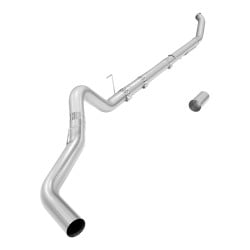
Kit Contents: 5-inch post-turbo DPF delete pipe (no muffler), clamps, mounting brackets.
Benefits:
- Eliminates DPF regeneration cycles - no more worrying about interrupted or failed regens.
- 5-inch post-turbo straight-through design greatly increases exhaust flow and reduces exhaust resistance.
- Completely eliminates DPF clogging and regeneration problems, drastically lowering long-term maintenance costs.
- T-409 stainless steel construction, more heat-resistant and corrosion-resistant than factory.
- The DPF hardware alone can contribute 30–70 HP gains, with even more significant gains when paired with tuning.
Suitable for: Owners primarily troubled by DPF regeneration issues; those who frequently drive short trips (which prevent DPF regeneration from completing); drivers seeking a more direct throttle response.
3. Best EGR+DPF Combo Delete Kit for 6.7 Cummins

Kit Contents: EGR block-off plate + coolant bypass lines + 5-inch post-turbo DPF delete pipe + throttle valve delete kit.
Benefits:
- Solves both EGR carbon buildup and DPF regeneration pain points.
- Significant performance gains: 60–100 HP and 120–200 lb-ft of torque.
- Fuel economy improvement of 1–3 MPG .
- 5-inch post-turbo exhaust pipe with no muffler, effectively reducing exhaust backpressure under load.
- T-409 stainless steel and precision-machined aluminum for long-lasting durability.
Suitable for: Owners seeking a comprehensive performance and reliability upgrade; heavy towing users; those who want to solve all emissions system problems at once.
4. Best All-in-One Full Delete Kit for 6.7 Cummins

Kit Contents: EGR delete kit + DPF delete pipe (4-inch straight pipe, no muffler) + CCV crankcase ventilation modification filter kit + Mini Maxx V2 delete tuner.
Benefits:
- 100–200+ HP gain, 200–400+ lb-ft torque gain.
- Fuel economy improvement of 3–5 MPG .
- Completely eliminates all emissions-system-related fault codes and limp mode.
- Significantly lowers exhaust gas temperature (EGT), reducing engine heat load.
- One kit includes EGR delete, DPF delete, CCV modification, and the Mini Maxx V2 tuner - hardware and software in one package.
Suitable for: Users pursuing maximum performance and a complete modification experience; vehicles already out of warranty; trucks used off-road or on closed courses.
If you drive a different model year of the 6.7L Cummins, or want to explore more hardware combinations and tuner options, feel free to visit SuncentAuto's dedicated 6.7 Cummins category page to find the full product line that fits your vehicle.
Build Your Own 6.7 Cummins Delete Kit at SuncentAuto
A 6.7 Cummins setup should not be treated as a one-size-fits-all package. A daily-driven 2500, a heavy-towing 3500 dually, and a commercial Cab & Chassis truck may all need different hardware, exhaust routing, and tuning support. That is why SuncentAuto uses a modular package system that lets you choose the right combination instead of being locked into a fixed kit.
On select 6.7 Cummins product pages, you can configure the core components step by step, including EGR hardware style, exhaust diameter, muffler option, tuner platform, and supporting accessories. This makes it easier to build a package around your truck’s model year, emissions-system layout, sound preference, and intended use.
Step 1: Choose Your EGR Delete Style and Finish
The EGR portion of the package is where many owners start. Depending on your truck and build goal, you may choose a basic EGR cooler delete setup, a dedicated throttle valve delete, or a more complete EGR plus throttle valve delete combination with application-specific brackets and hardware.
For owners who care about engine-bay appearance, SuncentAuto also offers finish options on select kits. Common choices include black and silver anodized-style finishes, allowing the hardware to match a clean factory-style build or a more custom performance look.
Step 2: Choose Exhaust Diameter and Sound Level
Exhaust selection affects sound, flow, backpressure, and highway comfort. The right choice depends on whether you want a clean daily-driver tone, a more aggressive straight-pipe sound, or a deeper turbo-back setup for heavy towing and lower exhaust gas temperatures.
- 4-inch race pipe: A popular all-around choice that maintains strong low-end response while giving the truck a sharper, more aggressive exhaust note.
- 4-inch race pipe with muffler: A better option for owners who want improved flow but prefer to reduce harsh high-frequency exhaust noise.
- 4-inch or 5-inch turbo-back exhaust: Replaces the factory exhaust section from the downpipe back, helping reduce restriction and manage exhaust gas temperature under load.
- 5-inch turbo-back with muffler: A strong choice for heavy towing, highway driving, and owners who want a deeper tone without excessive in-cab drone.
Step 3: Choose the Right Tuning Platform
Tuning is the control center of the build. The correct tuner must match the truck’s model year, ECM strategy, emissions hardware configuration, and whether the vehicle is a standard pickup or Cab & Chassis model. SuncentAuto supports multiple diesel tuning ecosystems so owners can choose between straightforward plug-and-play setups and more advanced cloud-based custom tuning.
Mini Maxx V1 / V2 Series
The Mini Maxx platform is a practical choice for owners who want a simple handheld tuner with built-in power levels and an onboard display. Common tune level styles include stock-style, tow, street, and performance-oriented options depending on the file set and truck application. For many earlier 6.7 Cummins pickup builds, Mini Maxx V1 or V2 offers a straightforward way to load the required calibration and monitor key data.
Mini Maxx V1 is known for its familiar interface and stable legacy support, while Mini Maxx V2 provides updated hardware and firmware for newer package configurations. It is often the value-focused choice for pickup owners who want a clean, simple tuner-and-hardware package.
EZ LYNK AutoAgent 3 Cloud-Based Platform
EZ LYNK AutoAgent 3 is the higher-end option for owners who need more flexibility. Instead of relying only on preloaded files, the platform connects through a mobile app and supports cloud-delivered custom tune files. This is especially useful for trucks with more complex requirements, including high-demand towing builds, higher-power setups, 2019+ security-gateway-equipped trucks, and Cab & Chassis applications that require specialized calibration support.
If your truck is a 2019+ RAM, a 2022–2024 model, or a commercial Cab & Chassis configuration, tuner selection should be confirmed before ordering. In many cases, EZ LYNK with the correct tune files and required bypass hardware is the more complete solution for avoiding communication issues, incomplete flashing, or persistent fault codes.
Why Choose SuncentAuto?
SuncentAuto has over 10 years of experience in the diesel truck modification industry, focusing on providing high-performance, high-value auto parts. The quality services we offer:
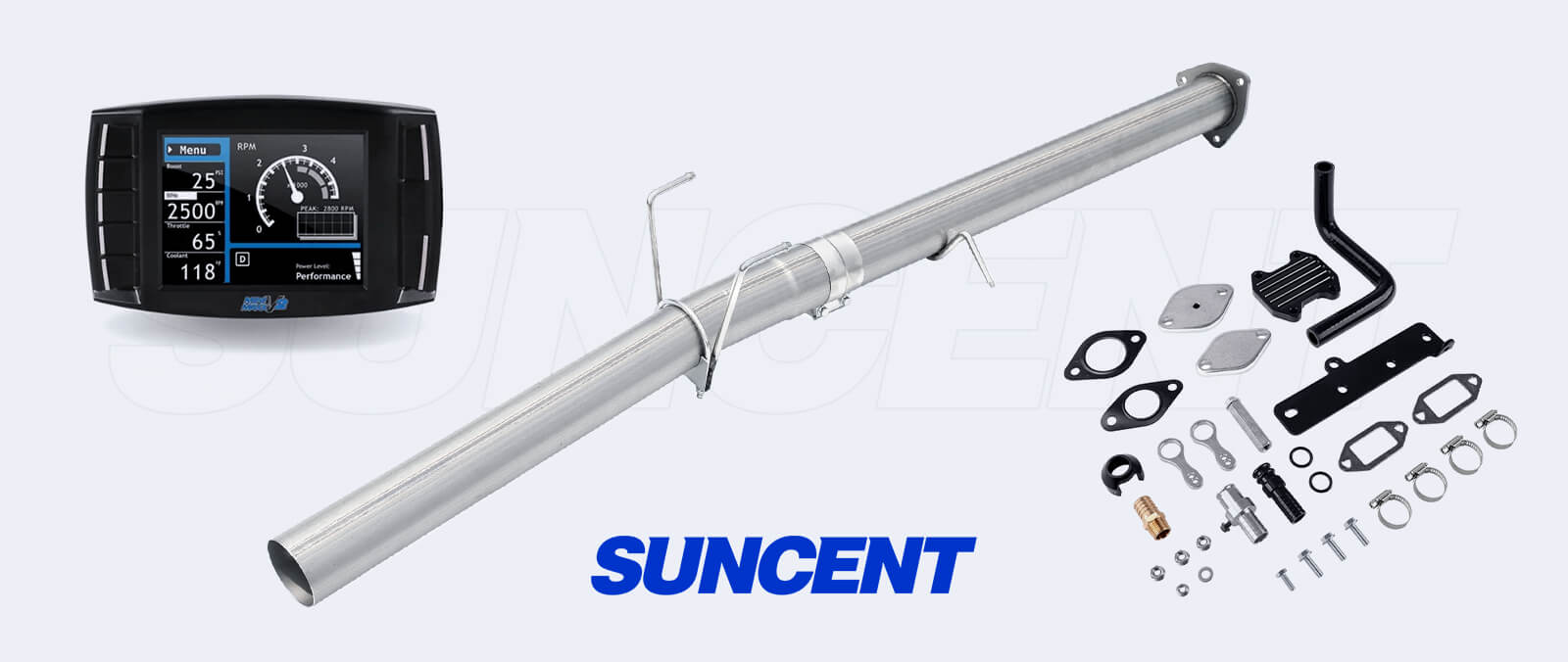
- Free shipping within the U.S.
- 45-day return and exchange policy
- Comprehensive product coverage: from EGR deletes to complete All-in-One kits, meeting diverse needs
- OEM-grade material standards: 409 stainless steel pipes, CNC-machined block-off plates for durability and precise fitment
- Professional technical support: expert team providing installation guidance and troubleshooting
👉 Shop SuncentAuto 6.7 Cummins delete kits now and use exclusive reader promo code BLOG12 to enjoy 12% off!
5 Ways to Save on Your SuncentAuto 6.7 Cummins Build
Upgrading your 6.7 Cummins for off-road performance, towing reliability, or lower long-term maintenance costs does not mean you have to overpay. SuncentAuto offers several discount paths that can help you save on delete kits, exhaust hardware, EGR components, tuners, and supporting accessories.
Here are the main ways to reduce your total checkout cost when building a complete Cummins package.

1. New Customer Email Sign-Up: 10% Off
If this is your first time shopping with SuncentAuto, check the homepage pop-up or email sign-up area near the bottom of the site. New subscribers can receive a first-order coupon for 10% off, which is a simple way to save on your first Cummins order.
2. Category Bundle Discount Code: 15% Off
If you are buying a more complete package that includes exhaust hardware, EGR components, and tuning equipment, use the dedicated delete-kit category discount code DDK15 at checkout to receive 15% off eligible full-package combinations.
3. Father’s Day Tiered Savings: Up to $140 Off
During the 2026 Father’s Day promotion, SuncentAuto is offering tiered savings based on order value. Use the matching code at checkout depending on your cart total:
- Spend $350 or more: use code DAD50 to save $50.
- Spend $500 or more: use code DAD80 to save $80.
- Spend $800 or more: use code DAD140 to save $140.
For example, if a 2013–2018 6.7L Cummins 4-inch delete package with a Mini Maxx V2 tuner, EGR hardware, and stainless exhaust pipe is listed at $1,356.99, applying code DAD140 would reduce the checkout price by $140, bringing the package down to $1,216.99 before any applicable taxes, shipping adjustments, or other checkout conditions.
4. Reader-Only Blog Code: 12% Off
As a thank-you for reading this technical guide, SuncentAuto also offers the exclusive reader promo code BLOG12. Use it at checkout to receive 12% off eligible standalone hardware, replacement parts, and select modification accessories.
5. Affiliate Father’s Day Code: 20% Off
From June 11 through June 30, 2026, SuncentAuto is also supporting a limited-time affiliate promotion with select diesel truck forums, creators, and enthusiast communities. During this promotion window, use code SACEN20 at checkout to receive 20% off eligible orders.
Pre-Sale Fitment Check and After-Sales Support
Correct fitment matters on diesel trucks, especially when ordering large exhaust sections, EGR hardware, tuners, and complete package kits. SuncentAuto helps reduce ordering mistakes with fitment tools and technical support before and after the sale.
Use the “Check Vehicle” Fitment Tool
On supported product pages, click the “Check if this fits your vehicle” button and enter your exact truck details, including year, make, model, engine, and configuration. For example, a 2018 RAM 3500 pickup and a 2018 RAM 3500 Cab & Chassis may require different exhaust or tuning considerations even though both use a 6.7L Cummins engine.
Taking a minute to verify whether your truck is a standard pickup, Cab & Chassis, single-rear-wheel, or dually can help ensure that the parts arriving at your garage match your actual application.
Diesel Truck Technical Support
SuncentAuto’s truck support team can help answer fitment, installation, and tuning-preparation questions by email. This is especially useful if you are working with a 2019+ truck, a Cab & Chassis platform, a dually exhaust layout, or a multi-part package that includes both hardware and tuning.
Shipping and Quality Support
Diesel exhaust parts are large, heavy, and can be exposed to rough handling during transit. If an order arrives with shipping damage, missing hardware, or a product defect, contact SuncentAuto support with photos and order details so the team can review the issue and help arrange the appropriate replacement parts or resolution.
Is Deleting a 6.7 Cummins Worth It? - Full Pros and Cons Analysis
Pros of Deleting a 6.7 Cummins
1. Significant Performance Increase
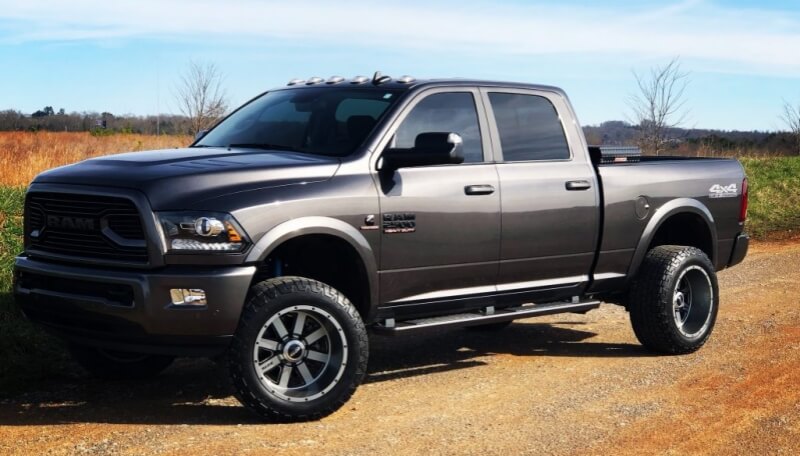
This is the most obvious advantage of a delete kit. A stock 6.7 Cummins outputs approximately 350 HP and 660 lb-ft of torque. After deletion and professional tuning, typical output reaches 400–450 HP and 800+ lb-ft of torque.
2. Fuel Economy Improvement
After DPF deletion, the engine no longer burns extra fuel for regenerations — studies show that DPF regeneration increases fuel consumption by about 13%. After deletion, many owners report fuel economy gains of 1–3 MPG, and with more aggressive tuning, even 3–5 MPG.
3. Drastically Reduced Maintenance Costs
EGR cooler replacement costs about $1,200–$2,500, and DPF replacement costs about $3,000–$5,000. After deletion, these expensive repairs are eliminated.
4. Extended Engine Life
EGR deletion prevents carbon particles from depositing in the intake passages and combustion chamber, and the risk of EGR cooler leakage disappears. Many owners report significantly improved oil analysis results after deletion, allowing them to safely extend oil change intervals.
Cons of Deleting a 6.7 Cummins
1. Legal Risk (Most Important)
Under Section 203 of the Clean Air Act, removing or tampering with emissions control devices on on-road vehicles is a federal violation. After the DOJ policy adjustment in January 2026, criminal prosecutions have decreased, but civil penalties still exist.
⚠️ Special note : The delete kits described in this article are for educational purposes and off-road use only. State and federal laws strictly restrict emissions system modifications. Please fully understand your local regulations before purchasing and installing.
2. Resale Value Impact
Although some modification enthusiasts specifically look for modified used trucks, most buyers deliberately avoid vehicles that have been deleted because the new owner would inherit the legal liability for emissions non-compliance.
3. Inspection and Registration Issues
In states that conduct emissions testing (e.g., California, Colorado, New York), a deleted vehicle will fail the annual inspection and cannot be legally registered.
How to Install the 6.7 Cummins Delete Kit
Installation Steps:
Step 1. Ensure the vehicle has no diagnostic fault codes (clear all current/historical fault codes before proceeding).
Step 2. Flash the delete tune using the tuner (engine off, ignition on).
Step 3. After confirming the tune is loaded, disconnect the battery.
(Important Note: The emissions system must be disabled after installing the tuner to ensure proper operation.)
Step 4. Remove DPF/DEF/EGR hardware.
Step 6. Reconnect battery, start engine, verify no warning lights.

Installation Precautions:
1. Prohibit high-temperature operations to prevent burns
After the vehicle is turned off, high-temperature components such as the exhaust system need to cool down sufficiently (approximately 30 minutes) before disassembly or assembly.
2. Perform rust removal beforehand
Common high-temperature components and chassis component screws are prone to rust. Necessary rust removal treatment is required before disassembly to prevent screws from jamming.
3. Wear protective equipment
For example, when performing exhaust pipe modifications that require cutting, wear safety goggles and take appropriate isolation measures to prevent accidents caused by flying sparks.
4. Environmental protection
After DIY maintenance or modification upgrades, used engine oil, coolant, etc., must be disposed of at designated recycling stations.
For detailed illustrated instructions, please visit SuncentAuto's Installation page.
Conclusion
What is the best delete kit for 6.7 Cummins? The best delete kit for a 6.7 Cummins engine should balance durability, compatibility, and cost-effectiveness. Compared to other aftermarket kit brands, SuncentAuto offers a more reliable all-in-one solution. It's made of durable stainless steel, suitable for year-round use, and offers industry-leading aftermarket support. You can explore available kits on the SuncentAuto website if you'd like to compare specifications.