
 Contents
Contents
- How Much Is Diesel Per Gallon Right Now?
- Diesel Prices by State: Where Is Diesel Cheapest in August 2026?
- How Much Is Diesel in California Right Now?
- Why Is Diesel Fuel So Expensive Right Now?
- Is Diesel Cheaper Than Gas Right Now?
- What Do High Diesel Prices Mean for Truck Owners?
- How Can Diesel Truck Owners Cut Fuel Costs?
- What About Diesel Performance Upgrades?
- Will Diesel Prices Go Down in 2026?
- FAQs
- Sources & Editorial Notes
If you’ve pulled your diesel truck into a fuel station recently and watched the pump counter spin faster than a casino slot machine, you’re definitely not alone in asking: Why on earth is diesel so expensive right now?
As August 2026 rolls on, persistent price hikes are delivering a real wallet punch to truck owners, RVers, contractors, and heavy-fleet operators across the country. According to the latest fuel tracking data from AAA as of August 18, 2026, the U.S. national average retail diesel price has climbed to a staggering $5.4677 per gallon.
That’s nearly a 15-cent jump in just one week, nearly 38 cents higher than last month, and a painful leap from the ~$3.69 per gallon we saw this time last year. For anyone relying on diesel to tow, haul freight, or earn a living, filling up is getting genuinely tough on the bottom line.
Which naturally brings up the single question on every driver's mind: When are diesel prices actually going to come back down?

How Much Is Diesel Per Gallon Right Now?
As of August 18, 2026, the national average price for diesel stands at $5.4677 per gallon. Of course, what you actually pay when you pop the fuel cap varies depending on your state, local refinery supply, transport distance, tax rates, and competition between neighboring truck stops.
To put this recent spike in perspective, here’s how today’s national average stacks up against key benchmarks over the past year, based on historical AAA fuel data:
| Period | U.S. Diesel Price |
|---|---|
| Current — August 18, 2026 | $5.4677 |
| Yesterday | $5.4454 |
| One Week Ago | $5.3213 |
| One Month Ago | $5.0883 |
| One Year Ago | $3.6909 |
Diesel Prices by State: Where Is Diesel Cheapest in August 2026?
Where you fill up makes a massive difference to your wallet. Driven by variations in regional refinery capacity, logistics distances, and local fuel taxes, prices swing dramatically across state lines. In August 2026, the spread between the cheapest and most expensive states tops $2.00 per gallon.
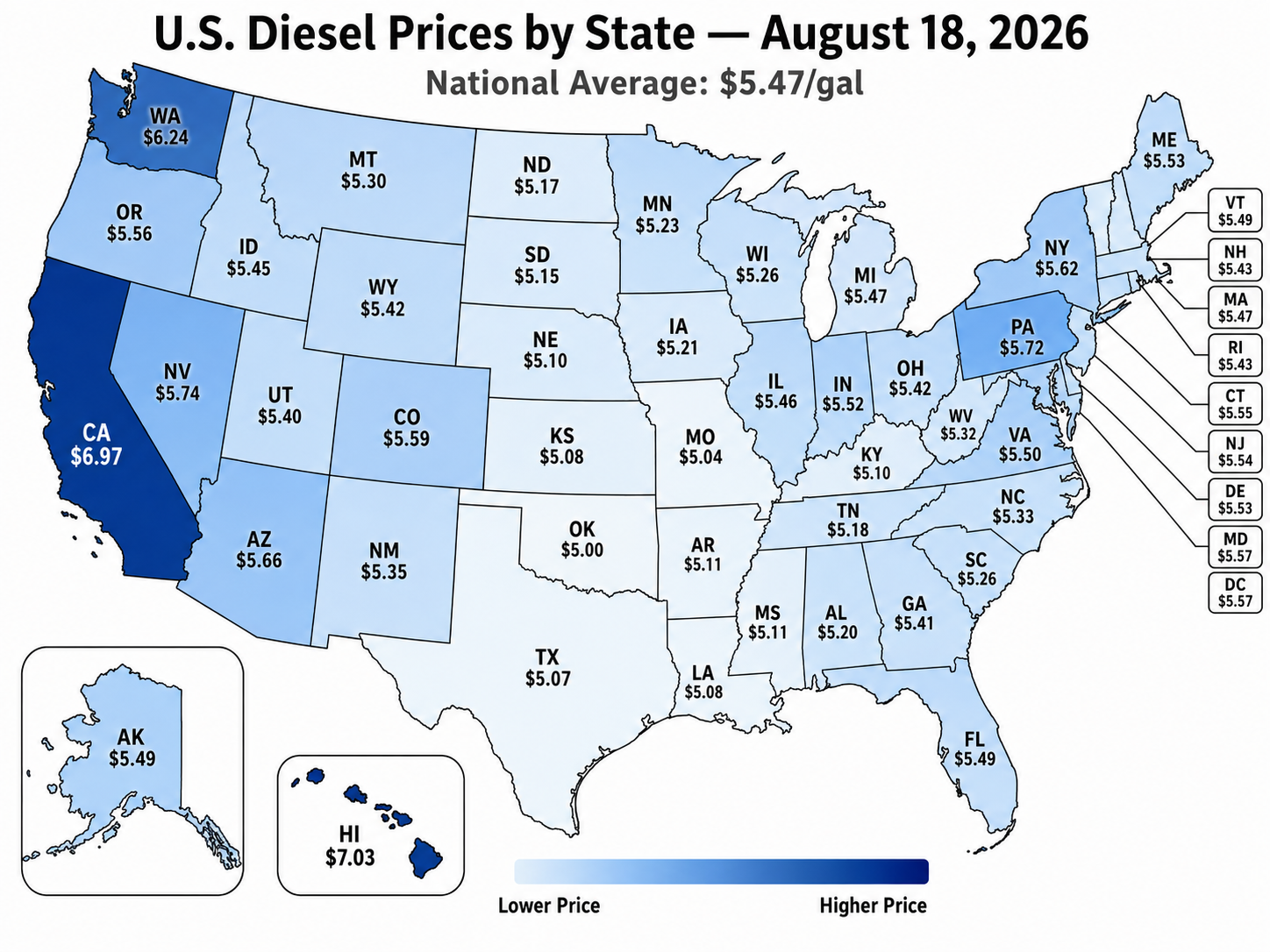
Here is how diesel prices break down across the country right now, drawn from AAA’s latest state-by-state fuel stats:
| State | Diesel Price | vs. U.S. Average |
|---|---|---|
| Oklahoma | $5.0025 | -$0.4652 |
| Missouri | $5.0405 | -$0.4272 |
| Texas | $5.0666 | -$0.4011 |
| Louisiana | $5.0757 | -$0.3920 |
| Kansas | $5.0835 | -$0.3842 |
| Pennsylvania | $5.7192 | +$0.2515 |
| Nevada | $5.7419 | +$0.2742 |
| Washington | $6.2395 | +$0.7718 |
| California | $6.9679 | +$1.5002 |
| Hawaii | $7.0278 | +$1.5601 |
10 States With the Cheapest Diesel Right Now
If you're hauling through the South, Midwest, or Great Plains, you'll catch a relative break at the pump compared to the rest of the nation.
- Oklahoma — $5.0025
- Missouri — $5.0405
- Texas — $5.0666
- Louisiana — $5.0757
- Kansas — $5.0835
- Nebraska — $5.0978
- Kentucky — $5.1028
- Mississippi — $5.1086
- Arkansas — $5.1087
- South Dakota — $5.1517
Note: State averages reflect overall regional trends; individual truck stops and highway plazas may price slightly above or below these figures.
10 States With the Most Expensive Diesel
On the flip side, drivers in these ten states are taking the hardest hit. High state excise taxes, strict environmental fuel standards, regional supply bottlenecks, and steep transport costs combine to send prices through the roof.
- Hawaii — $7.0278
- California — $6.9679
- Washington — $6.2395
- Nevada — $5.7419
- Pennsylvania — $5.7192
- Arizona — $5.6625
- New York — $5.6230
- Colorado — $5.5886
- Maryland — $5.5728
- Oregon — $5.5590
How Much Is Diesel in California Right Now?
If you’re running a diesel truck in California, your wallet is taking a far heavier beating than almost anywhere else in the country. As of August 18, 2026, California’s statewide diesel average stands at a jaw-dropping $6.9679 per gallon—putting it roughly $1.50 per gallon above the national average.
Why the massive price disparity? Much of it comes down to geography and supply infrastructure. According to the U.S. Energy Information Administration (EIA), West Coast fuel markets operate in relative isolation from major Gulf Coast refining hubs and cross-country pipeline networks. That geographic barrier leaves the region heavily reliant on local refineries and imported fuel shipments.
On top of that, California stacks heavy state fuel taxes alongside its Low Carbon Fuel Standard (LCFS) regulations. Both policies add structural costs that get passed directly down to drivers every time they fill up.
Why Is Diesel Fuel So Expensive Right Now?
1. Crude Oil Prices and Global Supply
Crude oil is the fundamental raw ingredient used to make diesel, and its cost directly dictates a huge portion of what you see on the pump sign.
In August 2026, ongoing geopolitical tensions around the Strait of Hormuz continue to inject risk and volatility into the energy markets. With Brent crude holding steady around $85 a barrel, the base cost to refine diesel remains uncomfortably high.
As long as raw crude stays this expensive, retail diesel simply doesn't have much room to drop.
2. Diesel and Distillate Supply
It’s important to remember that diesel isn't just regular gas under a different label. It belongs to the broader "distillate" fuel family.
That means your diesel pickup is competing for fuel reserves alongside long-haul semi trucks, farm tractors, heavy construction gear, freight locomotives, and commercial shipping lines.
When industrial output and freight volume remain steady while national reserves stay tight, wholesale diesel prices react almost instantly.
3. Refining and Distribution Costs
All highway diesel sold in the U.S. must meet strict Ultra-Low Sulfur Diesel (ULSD) standards. Mandated by EPA diesel regulations , highway ULSD caps sulfur content at a maximum of 15 ppm. Stripping that sulfur out requires intensive, expensive refining steps that older high-sulfur diesel never needed.
Add in routine refinery maintenance turnarounds, terminal constraints, and the rising cost to truck fuel out to individual filling stations, and those distribution overheads squeeze the retail price even further.
4. Federal and State Diesel Taxes
Tax policy puts diesel at a built-in financial disadvantage right out of the gate.
At the federal level, highway diesel carries a 24.4-cent-per-gallon tax, compared to just 18.4 cents for regular gasoline . That bakes an automatic 6-cent penalty into every gallon before state taxes, local fees, or environmental surcharges even enter the equation.
Is Diesel Cheaper Than Gas Right Now?
Per AAA’s August 18, 2026 data, the national average for regular gasoline sits at $4.0654 per gallon, versus $5.4677 per gallon for diesel.
That puts diesel at a massive $1.4023 premium per gallon over gas—a price gap of roughly 34.5%.
| Fuel Type | Current Average | Year-Ago Average | Difference vs. Gas |
|---|---|---|---|
| Diesel | $5.4677 | $3.6909 | +$1.4023 |
| Regular Gasoline | $4.0654 | $3.1376 | Base |
Why Is Diesel More Expensive Than Gas?
Decades ago, diesel driver lore held that diesel was always the bargain option. That reality is long gone. Several major structural reasons keep diesel priced above gasoline today:
- Commercial demand dictates supply: Freight fleets, farming operations, and industrial equipment keep diesel demand high regardless of everyday passenger car driving trends.
- ULSD refining adds processing costs: Meeting federal Ultra-Low Sulfur mandates (15 ppm limit) requires specialized refinery equipment and hydro-treating processing.
- Seasonal distillate overlap: Diesel shares refining capacity with commercial transport, agricultural equipment, and seasonal home heating oil blends.
- Higher federal tax rates: Federal taxes take 24.4 cents per gallon of diesel compared to 18.4 cents for gas.
What Do High Diesel Prices Mean for Truck Owners?
If you drive a heavy-duty diesel truck for daily commuting, towing an RV, hauling job site equipment, or running work routes, even a single dollar jump at the pump stacks up fast.
Take a typical diesel pickup logging 2,000 miles a month at an average of 15 MPG:
- Monthly fuel consumption: roughly 133.3 gallons
- At last year’s $3.69/gal average: about $492 per month
- At today’s $5.47/gal average: about $729 per month
While you can't change the numbers posted on the gas station marquee, you can control how efficiently your truck burns through what's in the tank. Driver habits, mechanical maintenance, overall setup, towing weight, and DPF regeneration cycles all play a direct role in your real-world fuel economy.
Ford Super Duty owners curious about how vehicle setups and tuning impact efficiency can check out our detailed guide on 6.7 Powerstroke MPG after DPF delete, which covers real-world mileage expectations and ECU tuning considerations.
How Can Diesel Truck Owners Cut Fuel Costs?
You can't steer international crude prices, but you can stop your truck from burning through extra fuel unnecessarily. Start with the easiest, high-impact fixes first.
1. Reduce Unnecessary Idling
A diesel engine sips fuel continuously anytime it sits running. U.S. Department of Energy data highlights just how much fuel heavy-duty diesels waste during extended idling sessions.
Extended warm-ups and leaving the engine running while waiting at job sites, staging areas, or rest stops drain your tank for zero return. Cutting out avoidable idle time is one of the easiest ways to save fuel instantly without altering your routes.
2. Check Tire Pressure Regularly
Underinflated tires create extra rolling resistance, forcing your engine to work harder just to maintain highway speed. This drag is magnified on diesel pickups hauling heavy payloads or pulling trailers.
The U.S. Department of Energy emphasizes proper tire inflation as a cornerstone of basic fleet efficiency and mileage maintenance.
Check your tire pressure cold and keep them inflated to manufacturer specifications—especially before hooking up a trailer or hauling heavy loads.
3. Don't Ignore Dirty Air and Fuel Filters
Modern diesel powertrains rely heavily on unrestricted airflow and ultra-clean fuel. Modern high-pressure common-rail (HPCR) fuel systems are notoriously sensitive to debris, water, and fuel contamination.
A clogged fuel filter starves the engine, hurting power delivery and fuel economy. Learning how a fuel filter works helps you spot early signs of restriction before they turn into costly system failures.
4. Watch for Frequent DPF Regeneration
Your diesel particulate filter traps soot and periodically burns it off through regeneration. During an active DPF regeneration , the system injects extra fuel to raise exhaust temperatures high enough to burn away trapped particulate matter.
Because active regen burns extra diesel, a truck that enters regen too frequently will see its MPG drop noticeably. Our DPF maintenance and cleaning guide breaks down how soot accumulation, cleaning options, and abnormal regen intervals should be evaluated.
If your truck starts regenerating constantly, don't just throw parts at it right away. Inspect for short stop-and-go driving patterns, soot buildup, faulty differential pressure sensors, or underlying engine codes first.
5. Track Your Truck's MPG Instead of Guessing
Don't rely solely on the "lie-o-meter" dashboard reading. A quick hand calculation over several tankfuls gives you the true story on your truck's real-world efficiency.
Log your mileage alongside towing weights, route types, maintenance, and seasonal weather. Tracking real numbers makes it easy to see whether higher fuel expenses stem from market price spikes or an issue developing under the hood.
What About Diesel Performance Upgrades?
Beyond standard maintenance, many truck owners explore aftermarket tuning, exhaust setups, and hardware upgrades when looking to optimize towing performance, long-term durability, and operating efficiency.
It’s best to keep performance modifications distinct from routine fuel-saving upkeep. The right setup depends heavily on your vehicle platform, intended work environment, and local emissions laws.
If you're researching custom exhaust setups or hardware, explore SuncentAuto's diesel performance parts selection to compare compatible pipes, components, and hardware across platforms.
For owners looking for complete, engine-specific hardware bundles, SuncentAuto also carries diesel delete kits tailored for popular Powerstroke, Cummins, Duramax, and EcoDiesel platforms.
Depending on your specific hardware configuration, recalibrating the engine management software may also be required. Owners evaluating those options can browse compatible diesel tuners designed for their engine family.
Will Diesel Prices Go Down in 2026?
While diesel prices could ease later in the year, the exact timing and magnitude remain uncertain.
Keep an eye on these three main variables through the rest of 2026:
- Global crude oil supply: If global production expands or maritime shipping routes through the Middle East stabilize, lower crude costs could help relieve price pressure at the pump.
- Refinery operations: Seasonal refinery maintenance, unexpected downtime, and production capacity dictate how much finished diesel makes it to terminal racks.
- Distillate inventories: The EIA's Weekly Petroleum Status Report is the single best official benchmark for tracking U.S. distillate inventories and overall supply health.
We'll keep tracking EIA updates and AAA price metrics as diesel market trends evolve throughout 2026.