 Contents
Contents
- What Is a 5.9 Cummins?
- 5.9 Cummins Years and Generations Explained
- How Do I Know Which 5.9 Cummins I Have?
- 12-Valve vs. 24-Valve Cummins: What Actually Changed?
- Which 5.9 Cummins Is Best for You?
- What Are the Best 5.9 Cummins Years?
- What MPG Can You Expect From a 5.9 Cummins?
- 5.9 Cummins Reliability: Problems by Generation
- How Long Will a 5.9 Cummins Last?
- 5.9 vs. 6.7 Cummins: What Changed?
- Is a 5.9 Cummins Still Worth Buying in 2026?
- Conclusion
In the used diesel truck market, one of the first things many buyers look for is a Dodge Ram with a 5.9 Cummins. There is a simple reason for that: this engine's reputation for durability is hard to ignore.
But a lot of people miss one important point:
The 5.9 Cummins engines built from 1989 through 2007 are essentially several very different engines with very different personalities.
A mechanically injected 1997 12-valve and a high-pressure common-rail 2005 24-valve may share the same displacement and cast-iron block, but their fuel systems, driving experience, failure points, and modification potential are worlds apart.
If you use the same standards for buying a VP44 24-valve that you would use for a P-pump 12-valve, you may end up paying for electronic fuel-system problems you never wanted in the first place.
This guide will not waste your time telling you how “legendary” the 5.9 Cummins is. Instead, it will help you answer three questions: Which 5.9 Cummins are you actually looking at? Which generation fits the way you use your truck? And how do you avoid buying the wrong old diesel in 2026?
What Is a 5.9 Cummins?
The 5.9L Cummins is a 359-cubic-inch inline-six turbo-diesel engine that first appeared in Dodge heavy-duty pickups in 1989 and remained in the lineup through the 2007 transition to the 6.7L.
Its cast-iron block, cast-iron cylinder head, gear-driven timing system, and industrial-duty roots helped establish its reputation in the diesel world.
Across nearly two decades of production, the two most useful ways to separate one 5.9L from another are valve count—12V vs. 24V—and fuel system.
Cummins lists the 12-valve 6BT at roughly 160–215 hp and 400–440 lb-ft, while later 24-valve versions reached roughly 215–325 hp and 420–610 lb-ft. Common-rail injection arrived for the 2003 model year. See Cummins' official history of the 5.9L-to-6.7L evolution .
| Generation | Years | Valves | Fuel System | Core Character |
|---|---|---|---|---|
| Early 12V | 1989–1993 | 12V | Bosch VE rotary pump | Simplest design, modest stock power |
| P-Pump 12V | 1994–1998 | 12V | Bosch P7100 mechanical pump | Mechanical performance and heavy-duty work |
| VP44 24V | 1998.5–2002 | 24V | Bosch VP44 electronic rotary pump | Better drivability, but more fuel-system risk |
| Common-Rail 24V | 2003–2007 | 24V | Bosch CP3 common rail | Quietest, strongest stock power, most refined |
MotorTrend also provides a detailed history of the 5.9L's VE → P7100 → VP44 → CP3 evolution: 5.9-Liter Cummins Diesel Engine History and Specs .
5.9 Cummins Years and Generations Explained
The 5.9 Cummins did not spend 18 years using one basic configuration. The fuel system changed several times, and those changes shaped how each generation drives, how it makes power, and what kind of owner it suits best.
1989–1993: VE-Pump 12-Valve — The Pure Mechanical Veteran
Core Setup: Bosch VE rotary pump + 12-valve cylinder head
Factory Output: About 160 hp / 400 lb-ft
As the first 5.9 Cummins used in Dodge pickups, this version's biggest strength is simplicity. It depends very little on electronic fuel control. MotorTrend notes that when many competing diesels were still naturally aspirated, the Cummins already used direct injection and turbocharging, giving it unusually strong low-rpm torque for its era.
The limitation is fueling capacity. The VE pump can support pump tuning, larger injectors, and turbo upgrades, but it does not have the same high-horsepower potential as the later P7100.
Watch Out For: Low stock horsepower, poor cabin insulation, and an older truck platform that is less comfortable for long interstate trips.
Best For: Farmers and old-truck owners who care more about mechanical simplicity and low-cost utility than horsepower.
1994–1998: P-Pump 12-Valve — The Heavy-Work and Big-Power Legend
Core Setup: Bosch P7100 inline injection pump + 12-valve cylinder head
Factory Output: Later automatic trucks about 180 hp / 420 lb-ft; later manual trucks about 215 hp / 440 lb-ft
The P7100—or P-pump—is the main reason this generation remains so popular. With the right injectors, turbo, and airflow upgrades, large power gains can be made through mechanical fuel adjustments without relying on computer tuning.
Before buying one, ask whether the Killer Dowel Pin, or KDP, has been addressed. The locating pin inside the front gear housing can work loose and, in the worst case, enter the geartrain and cause major engine damage.
Watch Out For: KDP history, aggressive previous fueling modifications, transmission condition, and the normal steering, suspension, and chassis wear that comes with a 30-year-old truck.
Best For: Contractors, farmers, snow-removal operators, DIY diesel owners, and serious performance enthusiasts.
1998.5–2002: VP44 24-Valve — The Electronic Transition
Core Setup: Bosch VP44 electronically controlled rotary pump + 24-valve cylinder head
Factory Output: Roughly 215–235 hp in earlier versions; about 245 hp / 505 lb-ft in later High Output applications
The 24-valve head improved airflow and electronic fuel control made the engine smoother on the road. Compared with a 12-valve, these trucks feel noticeably more civilized at highway speeds.
The major ownership concern is fuel supply. The VP44 relies heavily on the lift pump to provide enough fuel for operation, lubrication, and cooling. A weak lift pump can shorten VP44 life considerably.
Some late second-generation trucks also use the well-known 53 block, which is associated with cracking and external coolant leakage. Having a 53 casting does not automatically mean the block is damaged—it means it deserves closer inspection.
MotorTrend — Cummins Fatal Flaws
Watch Out For: Lift-pump pressure, VP44 history, and 53-block coolant leakage.
Best For: Buyers who want a more affordable 24-valve truck and are willing to verify the fuel system before buying.
2003–2007: Common-Rail 24-Valve — The High Point of the 5.9L Era
Core Setup: Bosch CP3 high-pressure pump + common-rail injection + 24-valve cylinder head
Factory Output: 2003–2004 versions reached as high as about 305 hp / 555 lb-ft; 2004.5–2007 versions reached about 325 hp / 610 lb-ft
Common rail changed the character of the 5.9 Cummins. Higher and more precise injection pressure brought smoother combustion, lower diesel noise, easier cold starts, better throttle response, and the strongest stock output of the 5.9L era.
The tradeoff is fuel-system complexity. High-pressure injectors are far more sensitive to fuel quality and contamination than the older mechanical systems.
Turbocharger, injector, calibration, output, and other engine-related details changed across the 2004.5 transition.
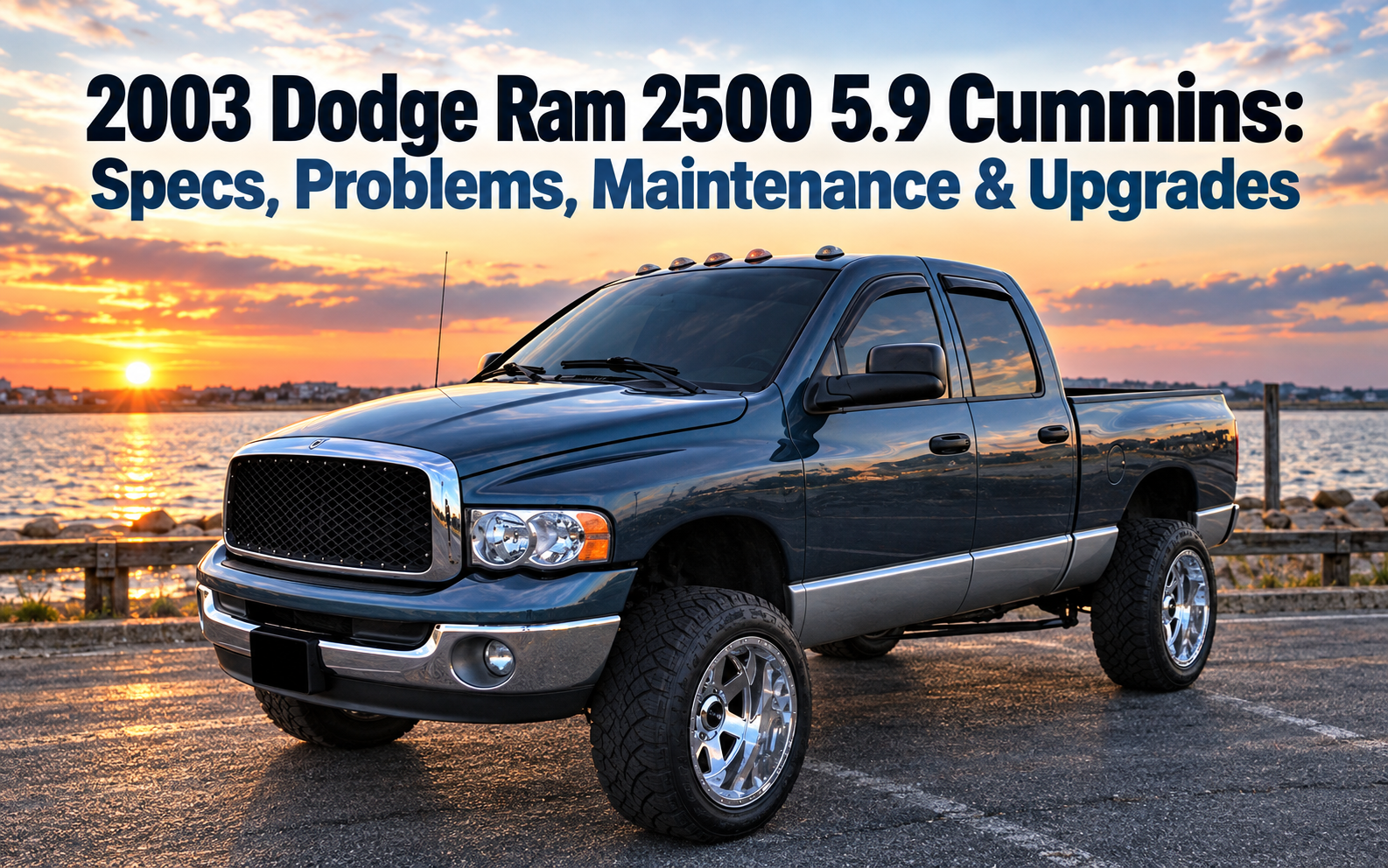
For a deeper look at the first common-rail year: 2003 Dodge Ram 2500 5.9 Cummins Guide
Watch Out For: Injector condition, fuel-system history, and aggressive previous tuning.
Best For: Owners who want strong stock power, better refinement, lower engine noise, and frequent long-distance towing capability.
How Do I Know Which 5.9 Cummins I Have?
If the truck still has its original engine, model year gives you a useful starting point. But many 5.9 Cummins trucks are now old enough to have received replacement engines, rebuilt long blocks, or complete swaps.
Valve count → injection system → ESN/CPL
Look at the Injection Pump
| What You See | Most Likely Engine |
|---|---|
| Bosch VE rotary pump | 1989–1993 12V |
| Bosch P7100 inline pump | 1994–1998 12V |
| Bosch VP44 electronic rotary pump | 1998.5–2002 24V |
| CP3 pump + common fuel rail | 2003–2007 24V |
Pay extra attention to 1998. Early 1998 trucks can still use the P7100 12-valve, while the 1998.5 transition brought the VP44 24-valve.
Also pay attention to 2004.5. Once you know you have a common-rail engine, do not assume every 2003–2007 turbo, injector, exhaust component, or tuning product fits every version.
If you are researching exhaust-system terminology and fitment: What Is a Downpipe? Complete Guide to Performance and Tuning .
For select 2003–2004 applications: 5" Turbo-Back Exhaust for 2003–2004 Dodge Ram 5.9L Cummins .
Final Verification: ESN and CPL
Cummins says the Engine Serial Number generally contains eight digits. If the dataplate is missing or unreadable, the ESN can also be identified on the engine itself.
Cummins QuickServe — Finding Your Engine Serial Number
If the body year and the hardware under the hood disagree, trust the actual injection system and ESN.
12-Valve vs. 24-Valve Cummins: What Actually Changed?
The obvious difference is valve count:
- 12V: 2 valves per cylinder
- 24V: 4 valves per cylinder
But owners usually notice the difference in three more practical places: how the truck drives, how it is repaired, and how it is modified.
| Comparison | 12V Cummins | VP44 24V | Common-Rail 24V |
|---|---|---|---|
| Years | 1989–1998 | 1998.5–2002 | 2003–2007 |
| Injection | VE / P7100 | VP44 | CP3 Common Rail |
| Fuel Control | Mostly mechanical | Electronic pump control | Electronic high-pressure injection |
| Factory Output | 160–215 hp | Up to about 245 hp | Up to about 325 hp |
| Main Character | Simple and mechanical | Affordable electronic 24V | Smooth, quiet, strongest stock power |
What Will You Notice While Driving?
A 12-valve feels more mechanical, louder, and more old-school.
A VP44 24V feels smoother and more electronically controlled.
A common-rail 24V takes another large step forward with smoother idle, less diesel noise, easier cold starts, and more precise power delivery.
What Will You Notice When You Work on It?
The 12V relies much more heavily on mechanical fuel control. A P-pump owner can make fueling changes through components such as fuel plates, governor springs, delivery valves, injectors, and pump adjustment.
VP44 and common-rail engines rely much more heavily on electronic fuel control and diagnosis.
Which Is Easier to Modify?
Want easier electronically controlled power? Look toward the 24V platforms.
Want a serious mechanical horsepower build? The P-pump 12V remains the classic choice.
12V = mechanical simplicity.
VP44 24V = lower-cost step into electronic 24V.
Common Rail = refinement, towing, and higher stock power.
Which 5.9 Cummins Is Best for You?
No single 5.9 Cummins can do everything best. The most useful way to choose is to match the engine to the way the truck will actually be used.
| Your Real-World Use | 5.9 Cummins to Consider | Why |
|---|---|---|
| Farm / ranch / rural work | 1994–1998 P-Pump 12V | Mechanical simplicity and strong low-rpm work-truck character |
| Daily driving + weekend towing | 2003–2007 Common Rail | Quieter, smoother, easier to live with |
| Fifth-wheel / boat / equipment towing | 2004.5–2007 Common Rail | Highest factory 5.9L torque |
| Long-distance work / commercial hauling | 2003–2007 Common Rail | Better highway manners and lower driver fatigue |
| DIY owner who hates electronics | 1989–1998 12V | Minimal electronic fuel-system complexity |
| Mechanical performance / sled pull build | 1994–1998 P-Pump 12V | Large mechanical fueling potential |
| Budget 24V truck | 1998.5–2002 VP44 | Lower entry price if the fuel system checks out |
| Engine swap / custom project | 12V, especially P-Pump | Less electronic integration |
Farm and Ranch Work
Imagine a truck that hauls fencing supplies on Monday, pulls a livestock trailer on Wednesday, carries feed on Friday, and spends the rest of the week parked near a barn.
For that owner, the attraction of a P-pump 12-valve is not a dyno number. It is that the engine is mechanically straightforward.
If you already work on tractors, farm equipment, or older diesel machinery, the logic feels familiar.
You give up refinement, but you gain a powertrain that is easier to understand without layers of electronic fuel control.
Just remember that a simple engine can still live inside an old truck. Steering, cooling-system parts, brakes, transmission, and rust may still need attention.
Daily Driving + Weekend Camping or Boating
Now imagine a truck that drives 30 miles to work Monday through Friday, carries building materials on Saturday, and occasionally pulls a camper or boat for a few hundred miles.
That owner is more likely to appreciate the 2003–2007 common rail.
Less engine noise, smoother idle, easier starting, and stronger stock power matter a lot more when the truck is used every day.
Fifth-Wheel, Boat, or Equipment Towing
If towing is a major part of the truck's life, the later common-rail 5.9L deserves serious consideration.
The later engine's roughly 325 hp / 610 lb-ft factory output becomes useful when you are:
- Merging onto the interstate with a fifth-wheel
- Maintaining speed on a long grade
- Pulling a large boat through rolling terrain
- Moving equipment between jobsites
- Driving hundreds of miles while loaded
Engine torque still does not determine safe towing capacity by itself. GVWR, GCWR, payload, axle ratio, tire rating, hitch rating, transmission, and brakes still matter.
See: Ram 2500 Towing Capacity & Payload Guide .
Long-Distance Work and Commercial Hauling
Some people are not buying a 5.9 Cummins as a hobby.
The truck may spend its life moving tools, construction equipment, farm supplies, trailers, or commercial loads.
If you spend four to eight hours behind the wheel, quieter operation and smoother throttle response begin to matter much more.
This is also where downtime matters. A strong engine does not help much if the transmission, front end, wheel bearings, cooling system, or brakes keep the truck off the road.
If You Hate Electronics and Work on Your Own Truck
Some owners simply do not want more computers.
They want an engine they can understand with hand tools, gauges, mechanical diagnosis, and a service manual.
That is exactly why the 12-valve still has such a loyal following.
If You Want a Mechanical Performance Build
If the plan includes a larger turbo, more fuel, dyno work, drag racing, or sled pulling, the P-pump 12-valve remains one of the most interesting platforms.
But be careful with used trucks advertised as:
“Big turbo, big injectors, runs strong.”
That can also mean years of high EGT, high cylinder pressure, and more torque than the original transmission was designed to handle.
What About a Cheap VP44 Truck?
Price can change the answer.
A clean 2001 Ram may cost significantly less than a comparable P-pump or common-rail truck. That does not automatically make it a bad choice.
Before buying, ask:
- Is lift-pump pressure healthy?
- Has the lift pump been replaced?
- Has the VP44 been replaced?
- Why did the previous pump fail?
- Is there evidence of a 53-block coolant leak?
- Does the engine start normally hot and cold?
A lower-priced VP44 truck with good records can make sense. A lower-priced VP44 truck with no history can become expensive very quickly.
What Are the Best 5.9 Cummins Years?
“Best year” only makes sense when you also consider the condition of the entire truck.
1996–1998: Late P-Pump 12-Valve
Why Buy: Later P-pump calibration, stronger factory output, mechanical simplicity, and excellent modification potential.
What to Check: KDP history, blow-by, cold starts, transmission condition, and evidence of aggressive fueling.
2003–2004: Early Common Rail
Why Buy: CP3 common rail replaced the VP44 while delivering smoother idle, lower noise, better cold starts, and stronger stock power.
What to Check: SO vs. HO configuration, transmission combination, injector condition, and fuel-system history.
2004.5–2007: Late Common Rail
Why Buy: Highest factory 5.9L output and the most modern daily-driving and towing experience.
What to Check: Injector history, hard starting, white smoke, fuel dilution, previous tuning, and transmission condition.
What MPG Can You Expect From a 5.9 Cummins?
There is no single MPG number that applies to every 5.9 Cummins truck.
Most Dodge Ram 2500/3500 trucks from this period were not rated like light-duty passenger vehicles, so the numbers below should be treated as practical real-world ranges, not official EPA guarantees.
| 5.9 Cummins Version | Years | Typical Real-World MPG | Possible Unloaded Highway MPG | Main MPG Factors |
|---|---|---|---|---|
| VE-Pump 12V | 1989–1993 | About 15–19 MPG | About 19–22 MPG in favorable conditions | Transmission, axle ratio, 2WD/4WD, highway speed |
| P-Pump 12V | 1994–1998 | About 15–18 MPG | High teens to around 20 MPG | Transmission, gearing, fueling changes, tire size |
| VP44 24V | 1998.5–2002 | About 14–18 MPG | Roughly 17–20 MPG | Transmission, 4WD, axle ratio, lift, tires, towing load |
| Common-Rail 24V | 2003–2007 | About 14–17 MPG | About 18–21+ MPG under favorable unloaded highway conditions | Truck weight, tires, speed, tuning, injectors, towing |
These are planning ranges rather than fixed specifications. Period reporting on the original 1989 Cummins-powered Dodge recorded approximately 19–22 MPG unloaded.
Real-world owner fuel logs from later trucks vary widely, with many P-pump, VP44, and common-rail trucks falling somewhere in the mid-to-high teens depending on configuration and use.
The biggest MPG variables are:
- Transmission
- Axle ratio
- 2WD vs. 4WD
- Tire size
- Lift height
- Tuning and fueling
- Highway speed
- Towing weight
5.9 Cummins Reliability: Problems by Generation
The 5.9 Cummins has a strong durability reputation, but each generation has its own weak point.
Instead of repeating the full engine history, this section focuses only on what to inspect and diagnose.
| Generation | Main Risk | Typical Symptoms / Consequences | What to Check | Common DTCs |
|---|---|---|---|---|
| 1989–1998 12V | Killer Dowel Pin | Timing-gear damage in severe cases | KDP/tab repair history | Mechanical system; no useful warning DTC |
| 1998.5–2002 VP44 | Lift-pump / VP44 failure | Hard start, stalling, no-start, power loss | Lift pressure and VP44 history | P0216, P1688 / P1689 |
| Some 1999–2002 24V | 53 block cracking | External coolant leakage | Casting number and coolant evidence | No specific DTC |
| 2003–2007 Common Rail | Injector wear / leakage | Hard starting, smoke, fuel dilution | Oil level, injector return, fuel-system diagnosis | P0148 / P0087, P0201–P0206 |
KDP Check
On older 12-valves, confirm whether the KDP has already been secured. Do not rely on a warning light—this is primarily a physical inspection and repair-history issue.
VP44 and Lift-Pump Check
If a VP44 has already been replaced, ask why it failed and whether the lift-pump problem was corrected at the same time.
53 Block Check
A 53 casting is not automatic proof of failure. Inspect for dried coolant, active seepage, unexplained coolant loss, and previous repairs.
Common-Rail Injector Check
Investigate long crank time, rough idle, white smoke, rising oil level, or a strong diesel smell in the engine oil.
How Long Will a 5.9 Cummins Last?
A properly maintained 5.9 Cummins reaching 250,000–300,000 miles does not automatically mean the engine needs a rebuild.
Cummins has documented a 2003 5.9L-powered Ram still in service at 281,000 miles: 281,000 Miles and Counting .
What Matters on a High-Mileage Engine?
Cold Start
Ask to see the engine completely cold. Long cranking, heavy white smoke, or poor initial idle can reveal problems that a pre-warmed truck may hide.
Blow-By
Some crankcase vapor is normal on a diesel. Heavy continuous vapor combined with high oil consumption deserves closer inspection.
Oil Condition
On a common-rail engine, rising oil level or a strong diesel smell can point toward fuel dilution.
Cooling-System History
Ask about coolant loss and previous overheating. A durable engine can still be damaged quickly by serious overheating.
Tuning History Can Matter More Than Mileage
A 180,000-mile truck with aggressive fueling and years of excessive EGT can be a worse engine than a stock 280,000-mile work truck with regular maintenance.
Mileage tells you how far it traveled. It does not tell you how hard it was treated.
When Does a 5.9 Cummins Need a Rebuild?
A rebuild becomes more justified when you have actual evidence such as:
- Low compression
- Severe blow-by
- Heavy oil consumption
- Bearing knock
- Cylinder damage
- Block or head damage
- Persistent coolant or lubrication problems
For oil-service intervals: Diesel Truck Oil Change Interval: 3,000 vs. 5,000 vs. 10,000 Miles .
5.9 vs. 6.7 Cummins: What Changed?
The 6.7L replaced the 5.9L during the 2007 transition as Cummins needed more torque while also meeting newer emissions requirements.
| Comparison | Late 5.9 Cummins | Early 6.7 Cummins | Practical Difference |
|---|---|---|---|
| Displacement | 5.9L / 359 cu in | 6.7L / 408 cu in | More displacement and low-rpm torque potential |
| Factory Output | Up to about 325 hp / 610 lb-ft | About 350 hp / 650 lb-ft at launch | More stock reserve power |
| Turbo | Mainly fixed geometry | VGT | Faster response and exhaust-brake capability |
| Emissions | Much simpler | EGR + DPF; later versions added SCR/DEF | More emissions hardware to maintain |
| Main Appeal | Simplicity | Torque and modern towing features | Different priorities rather than a simple “better” engine |
For detailed year-by-year 6.7L output: 6.7 Cummins HP & Torque by Year .
Is a 5.9 Cummins Still Worth Buying in 2026?
Yes—but only if you are buying the truck's actual condition, not the mythology surrounding the 5.9 Cummins name.
By 2026, even the newest 5.9L-powered Rams are nearly 20 years old, while the earliest 12-valve trucks are well over 30.
This means the buying decision is no longer just about the engine.
Why Are People Still Buying Them?
- Known weak points: The major generation-specific problems are well understood.
- Simple emissions hardware: The 5.9L predates the later DPF/DEF-heavy diesel era.
- Huge aftermarket: Replacement parts, performance parts, and DIY knowledge remain widely available.
The Four Biggest Whole-Truck Risks
| Risk Area | What to Inspect | Why It Matters |
|---|---|---|
| Transmission | Slipping, delayed engagement, harsh shifts, torque-converter issues | A strong or modified 5.9L can be hard on an aging automatic transmission. |
| Steering & Front End | Ball joints, tie rods, track bar, wheel bearings | Excessive steering play or death wobble should not be dismissed as “normal.” |
| Frame & Rust | Frame rails, cab mounts, brake/fuel lines, bed supports | Structural rust can matter more than another 50,000 miles on the engine. |
| Unknown Mods | Large injectors, aggressive tuning, unknown turbo setup, no EGT monitoring | You do not know how hard the truck was run or for how long. |
2026 Pre-Purchase Inspection Order
- Confirm the actual engine generation using the injection system and ESN.
- Demand a true cold start.
- Check the generation-specific weak point.
- Ask for receipts for major fuel-system, transmission, and cooling-system work.
- Find out how the truck was used: commuting, towing, farm work, construction, or commercial hauling.
- Inspect the entire truck, not just the engine.
Conclusion
The most important thing to understand about the 5.9 Cummins is that the name represents several very different engines.
- VE 12V: The simplest old-school mechanical version.
- P-Pump 12V: The classic mechanical work and performance platform.
- VP44 24V: A more affordable 24V option, but fuel supply must be checked carefully.
- Common-Rail 24V: The strongest, smoothest, and most modern-feeling 5.9L.
If you only ask, “What is the best 5.9 Cummins year?” you may not get a useful answer.
A better question is:
What will this truck actually do every week?
Farm work, interstate towing, commuting, commercial hauling, DIY ownership, and performance builds all place different demands on the truck.
Start with the job. Then choose the generation. Finally, let condition and maintenance history decide whether that specific truck is worth buying.