 Contents
Contents
- 1. What Are 6.4 Powerstroke Up-Pipes and How Do They Work?
- 2. Where Do 6.4 Powerstroke Up-Pipes Leak Most Often?
- 3. What Are the Main Symptoms of a 6.4 Powerstroke Up-Pipe Leak?
- 4. How Do You Diagnose a 6.4 Powerstroke Up-Pipe Leak?
- 5. How to Choose a 6.4 Powerstroke Up-Pipe Replacement
- 6.4 Powerstroke EGR vs. No-EGR Up-Pipes
- 6. Can You Replace 6.4 Powerstroke Up-Pipes Cab-On?
- 7. Which 6.4 Powerstroke Up-Pipe Setup Fits Your Truck?
- FAQs
If you drive a 2008–2010 Ford Super Duty and notice a loud hissing noise, a high-pitched whistle, or unusual rattling coming from behind the engine under hard acceleration, heavy towing, or quick boost rise—along with sluggish turbo response and power loss—don't rush to conclude that your turbo is blown. On the 6.4L Power Stroke diesel engine, the real culprit is often a part many owners overlook: the 6.4 Powerstroke up-pipes.
This issue is widely discussed in the Ford diesel community. Owners often begin with the same complaint: a hiss or squeal appears only when boost builds, and the source is difficult to see because the pipes sit at the rear of the engine. That makes diagnosis more important than simply replacing the first part that appears related to low boost.
Hear noise / experience low boost → diagnose an up-pipe leak → locate the leak → decide whether replacement is needed → choose the right replacement for your truck.
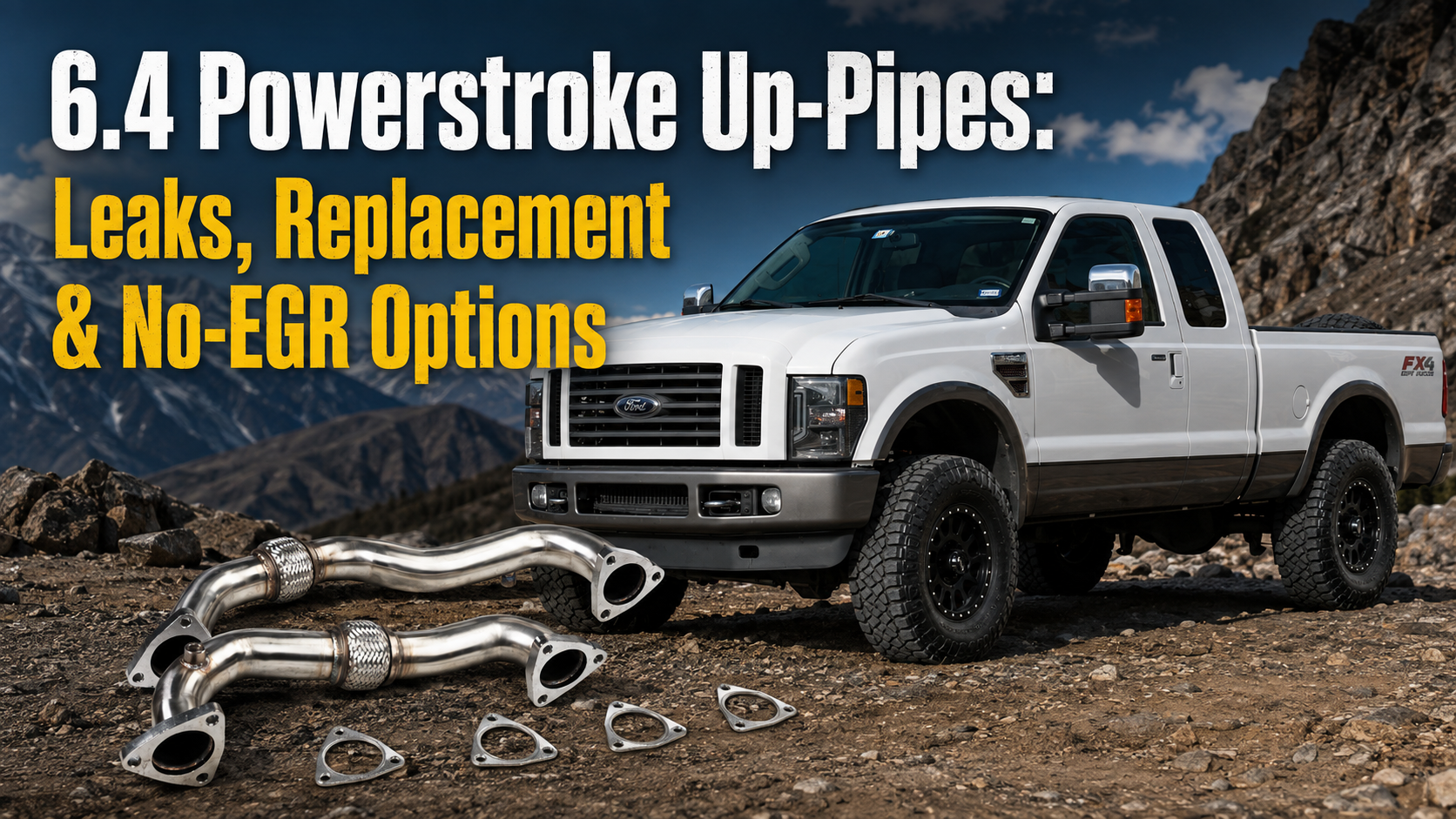
1. What Are 6.4 Powerstroke Up-Pipes and How Do They Work?
The 6.4L Power Stroke uses a series-sequential turbocharger system. Ford's diesel documentation also identifies the engine's two-stage turbocharger, DPF, and enhanced EGR system as major parts of the 6.4L emissions and air-management design.
Technical reference: Ford 6.4L Power Stroke Diesel Supplement .
The exhaust flow can be simplified as:
- Up-Pipes (Pre-Turbo): Route hot exhaust gas from the exhaust manifolds toward the turbocharger.
- Downpipe (Post-Turbo): Carries exhaust away from the turbo toward the downstream exhaust system.
- DPF / Aftertreatment: Sits farther downstream in the factory emissions system.
This distinction matters because an up-pipe leak is a pre-turbo exhaust leak. It is not the same as a downpipe leak or a DPF-related problem.
How Does an Up-Pipe Leak Cause Turbo Lag and Low Boost?
A turbocharger uses exhaust-gas energy to drive its turbine wheel. If a 6.4 Powerstroke up-pipe develops a crack or loses its seal, exhaust can escape before it reaches the turbine. Less available exhaust energy can result in slower turbo spool, reduced boost response, and sluggish performance under load.
For the underlying turbocharger principle, see Garrett Motion's explanation of how a turbocharger works .
Low boost alone does not prove the turbo or up-pipe has failed. If your truck has several other symptoms, start with our common 6.4 Powerstroke problems guide to compare other likely causes.
2. Where Do 6.4 Powerstroke Up-Pipes Leak Most Often?
Up-pipes work in a severe environment behind the engine, exposed to exhaust heat, vibration, engine movement, and repeated thermal cycling. Two areas deserve particular attention during inspection.
Flex Bellows
The flex bellows are one of the first places to inspect when a truck develops a pre-turbo exhaust leak. Their job is to accommodate thermal expansion and engine movement while keeping the exhaust path sealed.
When a bellow splits or cracks, the leak may be small at first and become much easier to hear once exhaust pressure rises under acceleration or towing load.
Flanges, Gaskets, and Sensor Connections
Leaks can also develop at connection points rather than through the pipe body:
- Exhaust manifold-to-up-pipe flanges
- Up-pipe connections at the turbocharger
- Worn or damaged exhaust gaskets
- Loose, damaged, or misaligned hardware
- Leaks around sensor bung areas
3. What Are the Main Symptoms of a 6.4 Powerstroke Up-Pipe Leak?
Hissing or Whistling Under Acceleration
One of the most recognizable symptoms is a hiss, whistle, or squeal that becomes louder as engine load and boost rise.
A typical pattern is:
- Little or no unusual sound at idle
- Noise becomes noticeable during acceleration
- Sound gets stronger under load or while towing
- Noise decreases quickly after lifting off the throttle
A charge-air leak or intercooler problem can sound similar, so the next step is to look for physical evidence.
Black Soot Behind the Engine or Near the Firewall
Black soot or carbon tracing is one of the most useful physical clues. Escaping exhaust can leave visible carbon around a cracked bellow, leaking flange, or gasket connection.
Pay particular attention to:
- Flex bellows
- Rear of the engine
- Firewall-side connections
- Manifold-to-up-pipe flanges
- Turbo-side connections
Slow Turbo Spool, Sluggish Power, or Low Boost
A significant pre-turbo leak can reduce the exhaust energy available to drive the turbine. The truck may feel slower to build boost or weaker under heavy load.
However, intercooler leaks, charge pipes, sensors, turbo controls, and other faults can produce similar performance symptoms.
Exhaust Smell Around the Engine Bay or Cab
Because the up-pipes sit near the rear of the engine and firewall, escaping exhaust can sometimes be noticed in the engine bay or around the cab air intake. A strong exhaust smell should not be ignored.
4. How Do You Diagnose a 6.4 Powerstroke Up-Pipe Leak?
Before ordering replacement parts, compare the symptoms with other common leak points.
| Suspected Issue | Common Clues | How It Differs |
|---|---|---|
| Up-Pipe Leak | Rear-engine soot, hiss or whistle under load, slower turbo spool | Soot often appears around bellows or rear turbo-side exhaust connections |
| Exhaust Manifold Leak | Soot near manifold ports, ticking sound | Evidence is concentrated closer to the cylinder-head/manifold area |
| Charge-Air / Intercooler Leak | Boost loss and rushing-air sound | Intake-side leak normally does not leave black exhaust soot |
| Belt / Pulley Issue | Squeal or mechanical noise | No exhaust soot or exhaust odor |
Step 1: Look for Soot
Allow the engine to cool completely. Use a flashlight and inspection mirror to check the bellows, flanges, gaskets, and turbo-side connection for carbon tracing.
Step 2: Note When the Noise Appears
Pay attention to whether the noise:
- Changes between cold and hot operation
- Appears only under acceleration
- Gets louder as boost builds
- Disappears or decreases when the throttle is released
Step 3: Check Boost and EBP Data
If you have a suitable scan tool, compare boost/MAP, exhaust back pressure, turbo response, and relevant diagnostic trouble codes with the physical evidence found during inspection.
Step 4: Rule Out Nearby Leak Sources
If the soot is concentrated around the manifold rather than the rear up-pipe connections, inspect the manifold and gasket first. For more information, see our exhaust manifold buying guide .
5. How to Choose a 6.4 Powerstroke Up-Pipe Replacement
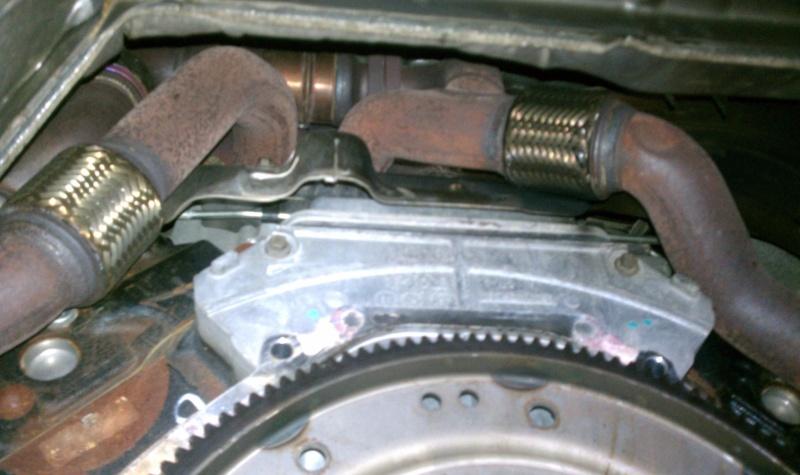
Rear-engine access on the 6.4L makes labor a major part of this repair. If a bellows or pipe body has failed, choosing a replacement with correct fitment and construction matters more than simply buying the cheapest pipe.
Material
Exhaust piping operates in a high-temperature and corrosion-prone environment. Stainless steel is therefore commonly used for aftermarket replacement pipes.
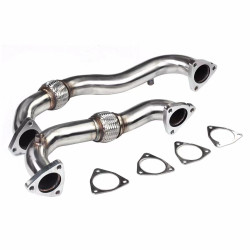
The Suncent 6.4 Powerstroke up pipes no EGR are made from 304 stainless steel.
Bellows Construction
Because the flex section must accommodate heat expansion and movement, pay close attention to bellows construction and weld quality when comparing replacement pipes.
Flange Alignment and Fitment
Confirm all of the following before ordering:
- 2008–2010 model year compatibility
- 6.4L Power Stroke engine
- F-250 / F-350 / F-450 / F-550 application
- Correct turbo-side connection
- Correct exhaust-manifold routing
- Correct EGR configuration
Sensor Bungs
Verify that the replacement pipe provides the sensor connections required by your truck's current configuration. The Suncent 6.4L kit includes dedicated EBP and O₂ sensor bung locations.
6.4 Powerstroke EGR vs. No-EGR Up-Pipes
The factory passenger-side exhaust routing is integrated with the 6.4L EGR system. That means EGR-compatible and no-EGR up-pipes are not simply two versions of the same universal pipe.
A no-EGR up-pipe is intended for a different exhaust/EGR configuration. Before ordering, verify:
- Whether the factory EGR system is still present
- The current passenger-side piping layout
- Sensor connection requirements
- Turbo-side fitment
- Whether the selected part is legal for the vehicle's intended use
See EPA guidance on emissions tampering and aftermarket defeat devices .
If you are comparing how different DPF, EGR, and full-system configurations are structured, see our 6.4 Powerstroke delete kit options guide.
6. Can You Replace 6.4 Powerstroke Up-Pipes Cab-On?
Yes, the job can be completed cab-on, but access behind the 6.4L is extremely limited.
Three approaches are commonly used:
| Method | Main Advantage | Main Drawback |
|---|---|---|
| Cab-Off | Maximum access to rear-engine exhaust connections | Requires suitable lifting equipment and additional setup |
| Cab-On + Transmission Removed | Creates substantially more room behind the engine | Adds transmission removal labor |
| Cab-On + Transmission Installed | Avoids major vehicle disassembly | Very limited fastener access and difficult gasket alignment |
What Else Should You Inspect While the Up-Pipes Are Accessible?
Because accessing this area requires significant labor, inspect nearby components before reassembly:
- Exhaust manifolds and manifold gaskets
- Manifold studs and damaged hardware
- EBP sensor connection and tube
- Turbo-side sealing surfaces
- Nearby wiring and heat shielding
If the goal is to address the truck more broadly rather than only repair one exhaust leak, see our guide on how to make a 6.4 Powerstroke more reliable .
7. Which 6.4 Powerstroke Up-Pipe Setup Fits Your Truck?
Once the leak has been confirmed, choose the repair scope based on what the inspection actually shows.
| Your Situation | Recommended Approach | What to Inspect or Replace |
|---|---|---|
| Confirmed Up-Pipe Leak Only Manifolds and turbo connections otherwise look healthy. | Replace the failed up-pipe with the correct configuration. | Up-pipes, fresh exhaust gaskets, flange condition, and sealing hardware. |
| High-Mileage Truck / Multiple Soot Traces Up-pipe leak plus signs of leakage around nearby manifold connections. | Refresh the affected pre-turbo exhaust area while access is available. | Up-pipes, manifold/gaskets, studs, EBP connection, and turbo-side sealing surfaces. |
| Existing Compatible No-EGR Configuration Vehicle already uses a matching non-EGR exhaust layout and the intended use complies with applicable law. | Select no-EGR up-pipes that match the existing exhaust layout. | Up-pipe configuration, sensor bungs, turbo connection, downstream exhaust, and calibration compatibility. |

Need No-EGR Up-Pipes for a Matching 2008–2010 6.4L Setup?
Suncent's 2008–2010 6.4L Powerstroke No-EGR Up-Pipes are designed for F-250, F-350, F-450, and F-550 6.4L applications and include two 304 stainless-steel up-pipes and exhaust gaskets.
If your project also involves the downstream exhaust system, read the 6.4 Powerstroke DPF delete kit guide before choosing additional components.